
PowerQUICC
Freescale PowerPC microcontrollers for networking and embedded systems
PowerQUICC is a family of microcontrollers from Freescale Semiconductor based on PowerPC and Power ISA cores. Designed for embedded applications like networking and automotive systems, these chips integrate communication engines to handle data tasks efficiently.
- Integrates a dedicated QUICC Engine for networking tasks
- Clock speeds range from 50 MHz to 1.5 GHz
- Used in routers, automotive systems, and industrial controls
- Successor platform is the software-compatible QorIQ
What it is
PowerQUICC refers to a series of microcontrollers developed by Freescale Semiconductor, originally starting with Motorola. These chips use PowerPC or Power ISA instruction sets and are built for embedded systems. They combine a general-purpose processor core with a specialized Communications Processor Module, known as the QUICC Engine. This separate core handles input/output, networking, and security tasks, allowing the main processor to focus on other work. The family includes system-on-chip designs tailored for industrial, automotive, and consumer electronics.
How it came about
Motorola introduced the first PowerPC-based embedded processors in this line, the MPC8xx family, in the mid-1990s. The MPC821 and MPC860 launched in 1995, featuring the integrated QUICC engine that gave the brand its name. Freescale Semiconductor continued development after spinning off from Motorola. The product line evolved through four distinct generations, increasing in speed and capability. In later years, Freescale announced that PowerQUICC development would cease in favour of the QorIQ platform, though manufacturing would continue for existing customers.
Inside the chip
The architecture centres on a PowerPC core paired with a communication offload engine. Early models used a single-issue, four-stage pipeline with speeds up to 133 MHz. Later generations adopted enhanced cores like the e300 and e500, featuring dual-issue pipelines and higher clock rates up to 1.5 GHz. Memory controllers support DDR and DDR2 SDRAM. Specialized units handle encryption, USB, Ethernet, and ATM protocols. The QUICC Engine or Communications Processor Module manages these peripheral tasks independently, reducing load on the main CPU.
How it was made
Freescale Semiconductor manufactured these chips, with some early designs originating from Motorola. Fabrication processes varied across the family, with later models like the MPC8544E produced using a 90 nm process and the MPC8569E using a 45 nm process. The chips are packaged as system-on-chip devices, integrating multiple controllers and memory interfaces onto a single die to save space and power in embedded devices.
Where it went
These processors serve a wide range of embedded applications. They are common in networking equipment such as routers, switches, DSLAMs, and wireless access points. The automotive industry uses them for vehicle systems, while industrial applications include printing and storage devices. Some models powered consumer products like the Killer NIC network card. High-end variants found roles in enterprise firewalls and antivirus hardware, leveraging their security acceleration features.
Versions and family
The family divides into four main lines. PowerQUICC I (MPC8xx) started with speeds up to 133 MHz. PowerQUICC II (MPC82xx) reached 450 MHz using the 603e core. PowerQUICC II Pro (MPC83xx) used the e300 core up to 677 MHz. PowerQUICC III (MPC85xx) employed the e500 core with speeds up to 1.5 GHz. Variants often include an 'E' suffix for built-in encryption. Some models lack the QUICC engine entirely, while others integrate RapidIO or PCI Express.
Why it matters
PowerQUICC established a strong presence in the embedded networking market. By offloading communication tasks to a dedicated engine, it allowed efficient handling of high-speed data in routers and telecom switches. The transition to the QorIQ platform marked the end of new PowerQUICC development, but the architecture influenced subsequent multi-core PowerPC designs. It remains a reference for integrating general-purpose computing with specialized I/O processing in system-on-chip designs.
Questions people ask about PowerQUICC
What is the QUICC Engine?
The QUICC Engine is a separate RISC core within the chip that handles communications tasks. It manages input/output, networking protocols, and security acceleration, offloading these duties from the main PowerPC processor.
Which companies developed PowerQUICC?
Motorola originally developed the first PowerPC-based embedded processors in this family. Freescale Semiconductor continued the development and manufacturing of the PowerQUICC line after its formation.
What replaced the PowerQUICC family?
Freescale ceased new development of PowerQUICC in favour of the QorIQ platform. QorIQ features PowerPC e500 based processors ranging from single-core to 32-core designs, maintaining software compatibility.
Good reading and sources
The facts on this page come from the Wikipedia article "PowerQUICC", written by its contributors and used under the CC BY-SA 4.0 licence, and from its Wikidata record (CC0). EveryChip rewrote the text in its own words, with AI assistance, and compares every page with the article to make sure no passage is copied. It may be reused under the same CC BY-SA 4.0 licence with a link back.
It may contain mistakes, and figures change over time. Nothing here is investment or buying advice. If something is wrong, tell us. Last refreshed 2026-11-14.
Like PowerQUICC
All microcontrollers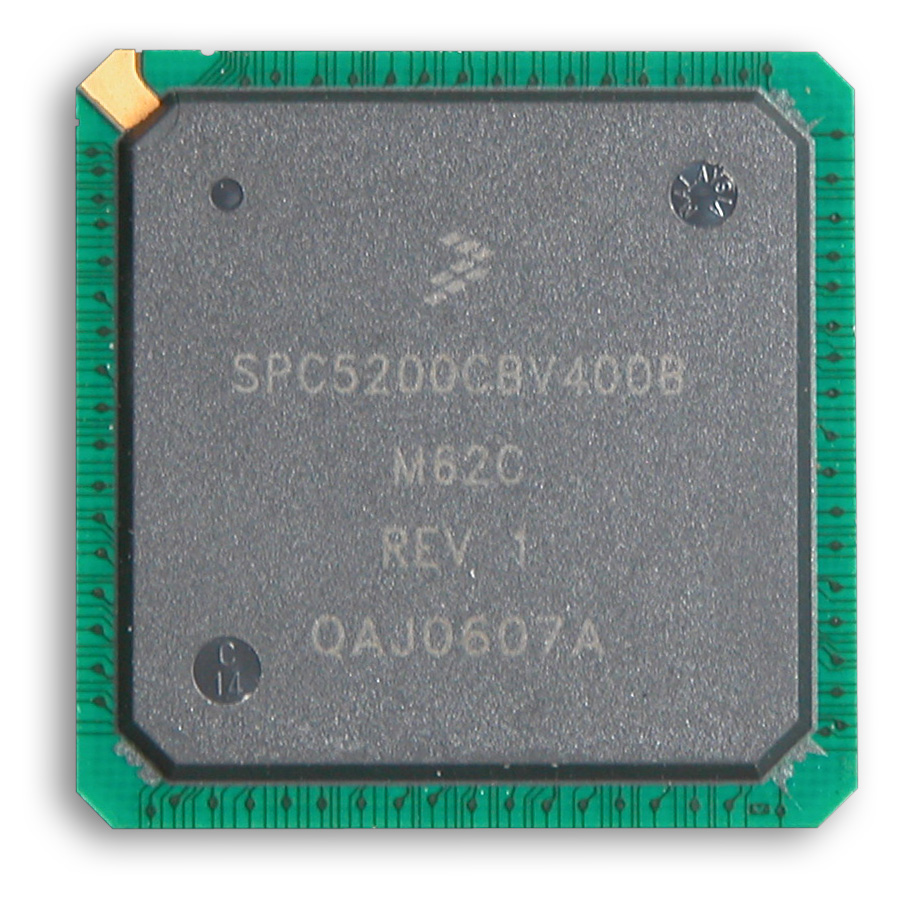 🇺🇸 United StatesPowerPC 5000
Automotive and industrial PowerPC microcontroller familyMicrocontroller · Power · 2002
 🇺🇸 United StatesPowerPC 400
Embedded 32-bit RISC processor cores for diverse applicationsCPU · Power · 1994
 🇺🇸 United StatesPowerPC e600
32-bit PowerPC microprocessor core for high-performance SoCsCPU · Power · 2004
🇺🇸 United StatesPowerPC e300
32-bit embedded microprocessor core by FreescaleCPU · Power · 2004
More from Freescale Semiconductor
All of them 🇺🇸 United StatesDragonBall
Low-power microcontroller for early handheld computersMicrocontroller · 68k · 1995
 🇺🇸 United States68HC12
16-bit microcontroller family from Motorola and FreescaleMicrocontroller · 68k · 1995
 🇺🇸 United StatesColdFire
Embedded microprocessor family derived from the Motorola 68000 architecture.Microcontroller · 68k · 1994
 🇺🇸 United StatesMotorola 68060
Final general-purpose 32-bit CPU in the Motorola 68000 lineCPU · 68k · 1994