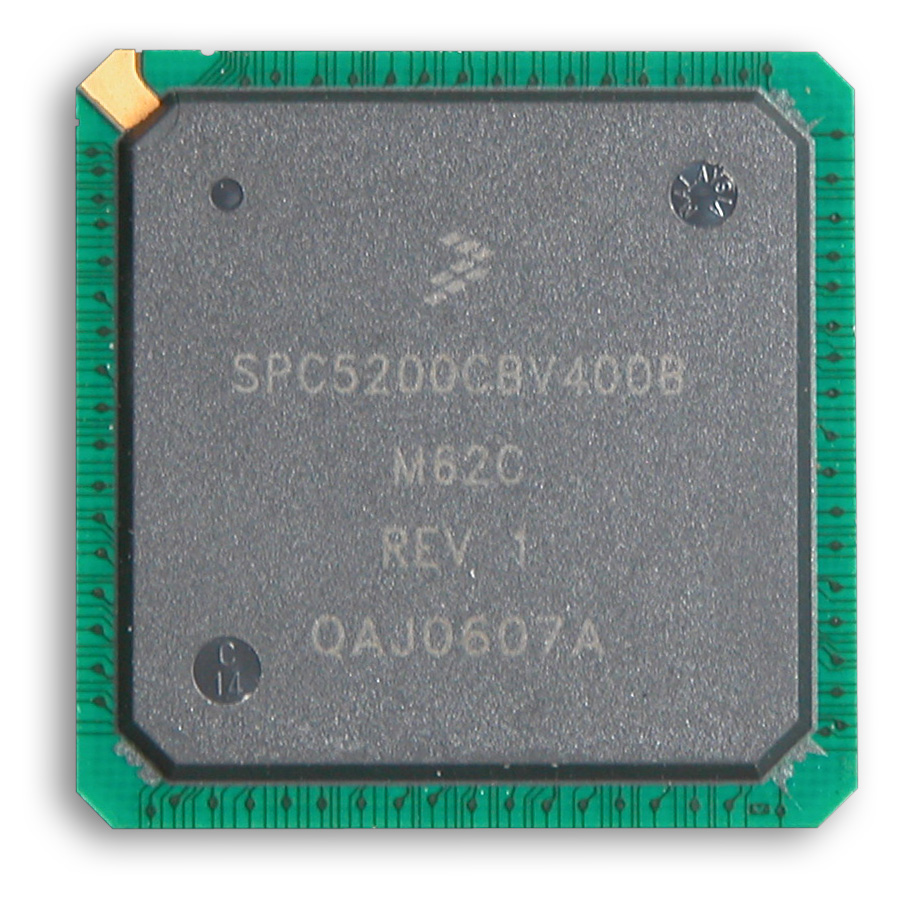
PowerPC 5000
Automotive and industrial PowerPC microcontroller family
The PowerPC 5000 is a series of microprocessors and system on a chip units for cars and industry. Designed by Freescale and STMicroelectronics, it uses Power ISA cores to manage vehicle systems and embedded tasks.
- Designed for automotive and industrial use
- Uses Power ISA e200 and e300 cores
- Built on a 90 nm fabrication process
- Jointly developed by Freescale and STMicroelectronics
- Supports up to 4 MB Flash memory
What it is
The PowerPC 5000 family comprises microprocessors and systems on a chip designed for automotive and industrial applications. Developed by Freescale, formerly Motorola, and STMicroelectronics, these chips manage tasks such as engine control, braking, and infotainment. The series includes distinct lines that do not share a common heritage, tailored for specific control needs in vehicles and machinery.
How it came about
Motorola introduced the MGT5100 in 2002 as part of its mobileGT platform for car telematics. Freescale continued development with the MPC5200 in 2003 and the MPC5121e in 2007. The MPC56xx line was jointly developed with STMicroelectronics using a 90 nm process. These releases expanded the family from basic control to complex multimedia and safety systems.
Inside the chip
The family uses Power ISA cores, specifically the e200 and e300 variants. The e300 core, derived from the PowerPC 603e, supports higher speeds and multimedia features. The e200 core focuses on real-time control for automotive systems. Chips include integrated memory, input/output controllers, and in some cases, graphics processing units for display acceleration.
How it was made
Manufacturing utilizes a 90 nm fabrication process for the MPC56xx series. The chips integrate various components on a single die, including Flash memory, static RAM, and peripheral controllers. This integration reduces the need for external components, making the units suitable for compact automotive and industrial designs.
Where it went
These processors power automotive systems like fuel injection, anti-lock braking, and adaptive cruise control radar. They also handle infotainment, display kiosks, and point of sales terminals. Industrial applications include robotics and automation equipment. The MPC5200B was notably used in the EFIKA computer.
Versions and family
The MPC51xx line targets telematics with graphics support. The MPC52xx offers general purpose control with enhanced input/output. The MPC55xx focuses on high-end automotive control with varying core speeds. The MPC56xx, also known as SPC56x by STMicroelectronics, covers body electronics, chassis control, and powertrain management with different memory configurations.
Why it matters
The PowerPC 5000 family established a standard for Power ISA based microcontrollers in the automotive sector. Its compliance with Power ISA specifications ensured compatibility across different manufacturers. The joint development between Freescale and STMicroelectronics broadened its adoption in European and global vehicle manufacturing.
Questions people ask about PowerPC 5000
What is the PowerPC 5000 used for?
It is used in automotive systems for engine control, braking, and infotainment. It also serves industrial applications like robotics and automation equipment.
Who designed the PowerPC 5000?
The family was designed by Freescale, which was previously Motorola, and STMicroelectronics. They collaborated on the MPC56xx line specifically.
What architecture does it use?
It uses the Power ISA architecture, specifically implementing the e200 and e300 core designs. These cores are compliant with Power ISA specifications.
What is the manufacturing process?
The MPC56xx family is built on a 90 nm fabrication process. This allows for high integration of memory and controllers on a single chip.
Good reading and sources
The facts on this page come from the Wikipedia article "PowerPC 5000", written by its contributors and used under the CC BY-SA 4.0 licence, and from its Wikidata record (CC0). EveryChip rewrote the text in its own words, with AI assistance, and compares every page with the article to make sure no passage is copied. It may be reused under the same CC BY-SA 4.0 licence with a link back.
It may contain mistakes, and figures change over time. Nothing here is investment or buying advice. If something is wrong, tell us. Last refreshed 2026-11-14.
Like PowerPC 5000
All microcontrollers 🇺🇸 United StatesPowerQUICC
Freescale PowerPC microcontrollers for networking and embedded systemsMicrocontroller · Power · 1995
🇺🇸 United StatesPowerPC e200
32-bit Power ISA microprocessor cores for automotive and industrial controlMicrocontroller · Power · 2007
 🇺🇸 United StatesPSoC
Configurable microcontroller with mixed-signal blocksMicrocontroller · Arm · 2002
 🇨🇭 SwitzerlandNomadik
Multimedia application processors for mobile devicesSoC · Arm · 2003
More from Freescale
All of them 🇺🇸 United StatesPowerPC e600
32-bit PowerPC microprocessor core for high-performance SoCsCPU · Power · 2004
WorldMotorola G5
Unreleased 64-bit PowerPC processor by MotorolaCPU · Power · 2000
 🇺🇸 United StatesAthlon
AMD's x86 desktop processor brand, from the first 1 GHz chip to entry-level Zen APUsCPU · x86 · 1999
 🇺🇸 United StatesRIVA TNT2
Nvidia graphics chip from 1999 with dual pipelinesGPU · GPU architecture · 1999