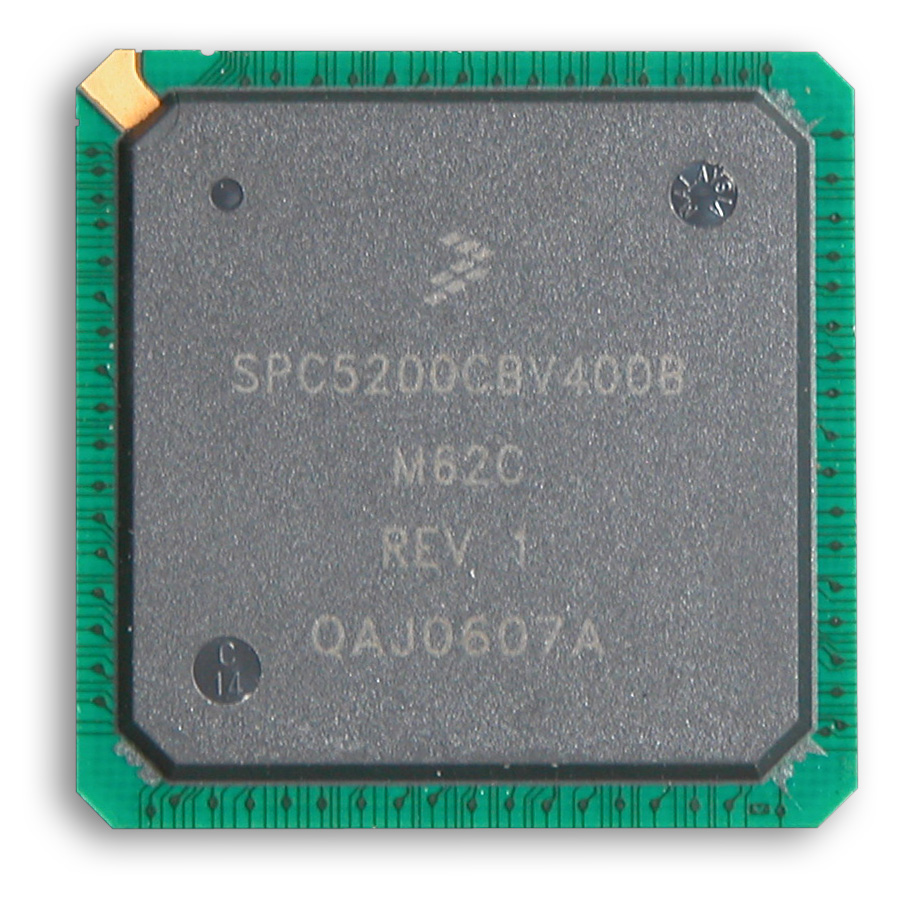
PowerPC e300
32-bit embedded microprocessor core by Freescale
Freescale Semiconductor introduced the PowerPC e300 in 2004 as a family of 32-bit microprocessor cores. Designed for system-on-a-chip integration, it supports speeds up to 800 MHz and serves embedded applications in networking and industrial control.
- Introduced by Freescale in 2004
- Speeds reach up to 800 MHz
- Backwards compatible with G2 and 603e
- Used in MPC83xx and MPC51xx families
- Features optional double-precision FPU
What it is
The PowerPC e300 is a family of 32-bit microprocessor cores created by Freescale Semiconductor. Launched in 2004, these cores target embedded systems where space and power efficiency matter. They operate at frequencies reaching 800 MHz and fit into system-on-a-chip designs. This product line marked an early release for Freescale after its separation from Motorola. The cores handle tasks in telecommunications, automotive controls, and industrial equipment.
How it came about
Freescale Semiconductor formed in 2004 as a spin-off from Motorola. The e300 core was among the first products the new company released that same year. Engineers designed it to continue the legacy of earlier PowerPC designs while improving performance for modern embedded needs. It builds directly on the architecture of the G2 and PowerPC 603e cores, ensuring software compatibility with older systems.
Inside the chip
This core uses a superscalar RISC architecture, meaning it can execute multiple instructions per cycle. It features a four-stage pipeline that includes units for loading and storing data, managing system registers, predicting branches, and handling integer math. An optional double-precision floating-point unit adds support for complex calculations. Local storage comes in two sizes: 16 kB or 32 kB for both data and instruction caches. This design balances speed with the simplicity required for embedded controllers.
How it was made
Specific manufacturing details such as the process node or transistor count are not provided in the available records. The core is intended for integration into larger system-on-a-chip packages rather than standing alone as a discrete component. Freescale Semiconductor handled the design and development of the architecture.
Where it went
The e300 core powers several specific processor families. It serves as the central processing unit in the MPC83xx PowerQUICC II Pro series, which handles telecommunications and networking tasks. Automotive and industrial control systems use the MPC51xx and MPC52xx families based on this core. Additionally, the MSC7120 optical network processor integrates this core alongside a digital signal processing unit for GPON applications.
Versions and family
The core appears in multiple product lines tailored for different industries. The MPC83xx series focuses on network infrastructure. The MPC51xx and MPC52xx chips target cars and factory machinery. The MSC7120 combines the core with specialized signal processing hardware. All these variants share the same underlying e300 architecture and maintain backward compatibility with previous PowerPC generations.
Why it matters
As one of the initial offerings from Freescale, the e300 helped establish the company’s presence in the embedded market after its split from Motorola. Its backward compatibility allowed developers to migrate existing PowerPC software without major rewrites. The core enabled efficient processing in network routers and industrial controllers during the mid-2000s.
Questions people ask about PowerPC e300
What is the PowerPC e300 used for?
It is designed for embedded applications in system-on-a-chip devices. Common uses include telecommunications networking, automotive control systems, and industrial machinery management.
Who developed the PowerPC e300 core?
Freescale Semiconductor developed the core. It was one of the first products released after the company spun off from Motorola in 2004.
Is the e300 compatible with older PowerPC chips?
Yes, it is completely backwards compatible with the G2 and PowerPC 603e cores. This allows existing software to run on new hardware without modification.
What is the maximum speed of the e300?
The microprocessor cores operate at speeds ranging up to 800 MHz. This performance level suits many embedded and real-time control tasks.
Good reading and sources
The facts on this page come from the Wikipedia article "PowerPC e300", written by its contributors and used under the CC BY-SA 4.0 licence, and from its Wikidata record (CC0). EveryChip rewrote the text in its own words, with AI assistance, and compares every page with the article to make sure no passage is copied. It may be reused under the same CC BY-SA 4.0 licence with a link back.
It may contain mistakes, and figures change over time. Nothing here is investment or buying advice. If something is wrong, tell us. Last refreshed 2026-11-14.
Like PowerPC e300
All CPUs and microprocessors 🇺🇸 United StatesPowerPC e600
32-bit PowerPC microprocessor core for high-performance SoCsCPU · Power · 2004
🇺🇸 United StatesPWRficient
Power-efficient PowerPC microprocessor series by P.A. SemiCPU · Power · 2007
WorldPowerPC e500
32-bit embedded microprocessor core by FreescaleCPU · Power · 2008
 🇳🇱 NetherlandsQorIQ
NXP communications microprocessor brand for networking infrastructureCPU · Arm · 2008
More from Freescale Semiconductor
All of them 🇺🇸 United StatesPowerPC 7xx
Third-generation 32-bit PowerPC microprocessor family for PCs and embedded systems.CPU · Power · 1997
🇺🇸 United StatesPowerPC e6500
Multithreaded 64-bit Power ISA microprocessor core by FreescaleCPU · Power · 2012