PowerPC e5500
64-bit embedded microprocessor core by Freescale
The PowerPC e5500 is a 64-bit microprocessor core designed by Freescale Semiconductor for embedded systems. Introduced in 2010, it supports the Power ISA v.2.06 and features an out-of-order pipeline, serving as the basis for the QorIQ P5 system on a chip family.
- First 64-bit Power ISA core designed solely by Freescale
- Clock speeds reach up to 2.5 GHz
- Features a four-issue, seven-stage out-of-order pipeline
- Basis for BAE Systems RAD5500 space-grade chips
- Includes 512 KB private L2 cache per core
What it is
The PowerPC e5500 is a 64-bit microprocessor core developed by Freescale Semiconductor. It implements most of the Power ISA version 2.06 specification, including hypervisor support, but excludes AltiVec vector processing. Designed for embedded applications, the core features a four-issue, seven-stage out-of-order pipeline. It was first introduced in June 2010 at the Freescale Technology Forum. The design allows for high configurability via the CoreNet fabric to meet specific system needs.
How it came about
Freescale had previously used the names e700 and NG-64 for similarly specified cores since 2004, though these were distinct products. The e5500 represents the first 64-bit Power ISA core designed entirely by Freescale. Simulated models became available in July 2010, followed by hard samples in late 2010. Full scale manufacturing commenced in the second half of 2011. This timeline marked a significant step in Freescale's independent development of high-performance embedded processors.
Inside the chip
The core builds upon the earlier e500mc design, adding instructions for byte and bit-level acceleration from the Power ISA 2.06 standard. These include parity, population count, bit permute, and compare byte operations. Its floating point unit is derived from the PowerPC e600, offering dual precision IEEE 754 compliance at full core speed. This unit converts between 64-bit floats and integers twice as fast as the e500mc. An enhanced branch prediction unit with an eight-entry link stack improves performance. The core includes three integer units and supports multi-core operation.
How it was made
Specific manufacturing process details and transistor counts are not provided in the available records. The core supports up to 2.5 GHz clock speeds. Memory architecture includes 32 KB each for data and instruction L1 caches per core. Each core also has a private 512 KB L2 cache. A shared L3 cache of up to 2 MB is available. The design interfaces with auxiliary application processing units and uses the CoreNet fabric for connectivity.
Where it went
The e5500 core powers the QorIQ P5 family of systems on a chip, which follow the P50x0 naming convention. These chips target high-performance embedded applications. BAE Systems has utilized the RAD5500 core, which is based on the e5500 design, to build radiation hardened systems on a chip. These specialized devices are intended for use in space environments where resistance to radiation is critical for reliable operation.
Versions and family
The primary variant family is the QorIQ P5 series. The RAD5500 is a radiation-hardened derivative produced by BAE Systems for space applications. While Freescale previously referenced e700 and NG-64 monikers for similar specifications, those are not the same product. The e5500 succeeds the 32-bit e500mc core. It serves as a predecessor to later 64-bit designs such as the PowerPC e6500 within the broader PowerPC embedded lineage.
Why it matters
As the first 64-bit Power ISA core designed solely by Freescale, the e5500 established a new baseline for the company's embedded processor portfolio. It enabled the creation of the QorIQ P5 platform, extending high-performance capabilities into multicore embedded systems. The adoption of its design by BAE Systems for space-grade hardware demonstrates its versatility and robustness in demanding environments beyond commercial embedded markets.
Questions people ask about PowerPC e5500
What instruction set does the e5500 use?
The e5500 implements most of the Power ISA version 2.06 specification. It includes hypervisor support and new byte- and bit-level acceleration instructions, but it does not support the AltiVec vector processing extension.
How much cache memory does the e5500 have?
Each core has 32 KB of L1 data cache and 32 KB of L1 instruction cache. It also includes a private 512 KB L2 cache per core and supports up to 2 MB of shared L3 cache across the system.
Is the e5500 used in space applications?
Yes, indirectly. BAE Systems built radiation hardened systems on a chip using the RAD5500 core, which is based on the e5500 design. These devices are specifically engineered for use in space environments.
What is the relationship between e5500 and e500mc?
The e5500 is based on the earlier e500mc core. It adds 64-bit capability, new instructions from Power ISA 2.06, and a faster floating point unit derived from the PowerPC e600, effectively doubling float-to-integer conversion speed.
Good reading and sources
The facts on this page come from the Wikipedia article "PowerPC e5500", written by its contributors and used under the CC BY-SA 4.0 licence, and from its Wikidata record (CC0). EveryChip rewrote the text in its own words, with AI assistance, and compares every page with the article to make sure no passage is copied. It may be reused under the same CC BY-SA 4.0 licence with a link back.
It may contain mistakes, and figures change over time. Nothing here is investment or buying advice. If something is wrong, tell us. Last refreshed 2026-11-14.
Like PowerPC e5500
All CPUs and microprocessors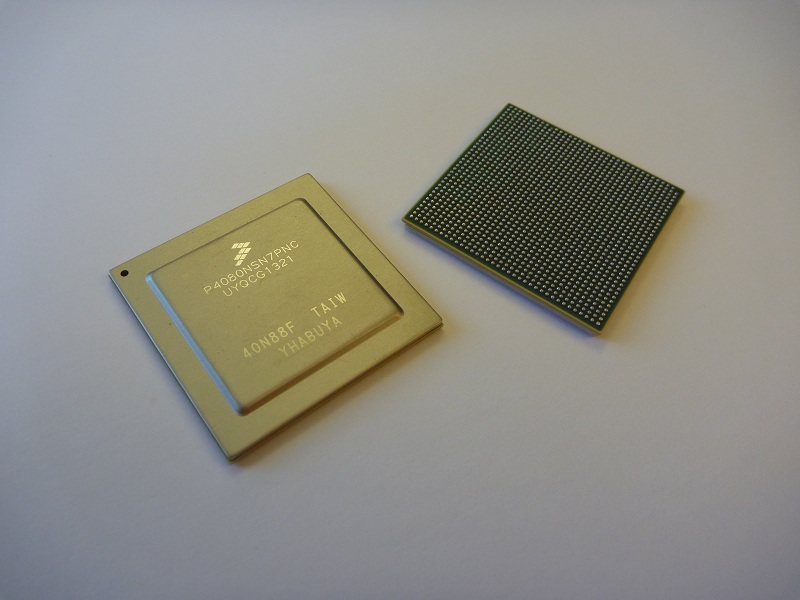 🇳🇱 NetherlandsQorIQ
NXP communications microprocessor brand for networking infrastructureCPU · Arm · 2008
More from Freescale Semiconductor
All of them 🇺🇸 United StatesPowerPC e300
32-bit embedded microprocessor core by FreescaleCPU · Power · 2004
 🇺🇸 United StatesRAD750
Radiation-hardened PowerPC processor for spacecraft and satellitesCPU · Power · 2001
 🇺🇸 United StatesPowerPC 7xx
Third-generation 32-bit PowerPC microprocessor family for PCs and embedded systems.CPU · Power · 1997