PowerPC e6500
Multithreaded 64-bit Power ISA microprocessor core by Freescale
The PowerPC e6500 is a 64-bit microprocessor core designed by Freescale Semiconductor. It introduced multithreading to the company's lineup and powers the QorIQ T2 and T4 system on chip families for embedded networking.
- First multithreaded core designed by Freescale
- Manufactured on a 28nm process node
- Supports up to 2.5 GHz clock speed
- Reintroduced enhanced AltiVec vector processing
- Powers QorIQ T2 and T4 SoC families
What it is
The PowerPC e6500 is a multithreaded 64-bit microprocessor core based on the Power ISA. Freescale Semiconductor, now part of NXP, designed this core to power their QorIQ AMP Series system on chip products. It marked a significant step for the company as their first core to support hardware multithreading. The design targets high-performance embedded applications, particularly in networking and telecommunications infrastructure.
How it came about
Freescale developed the e6500 to succeed earlier designs like the e5500. Hard samples of chips using this core became available in early 2012. Full production of the associated QorIQ T2 and T4 family systems on chip started later that year. In 2013, the company introduced the e6501, a revised version with better virtualization interrupt support.
Inside the chip
This core uses a 2x2-way superscalar architecture, allowing two virtual cores per physical hard core. Each core contains five integer units, two load-store units, and one 128-bit AltiVec unit for vector processing. It includes 32KB of L1 instruction cache and 32KB of L1 data cache. Clock speeds reach up to 2.5 GHz. The design supports up to eight multi-core CPU clusters and connects via the CoreNet fabric for configurable embedded setups.
How it was made
Manufacturing used a 28 nanometre process node. This technology allowed for the integration of multiple cores and complex logic duplication within the die. The production timeline saw hard samples in early 2012, with full volume manufacturing commencing in the latter months of that same year for the T2 and T4 families.
Where it went
The core powers the QorIQ T4240, which features twelve e6500 cores. The T2080 and T2081 chips use four cores each. These processors appear in high-end telecom equipment, such as 4G LTE macrocells, often paired with StarCore DSPs in the Qonverge B4420 and B4860 models. It also serves open hardware projects like Linux-based laptops and motherboards.
Versions and family
The e6501 is a direct revision introduced in 2013, offering enhanced virtualization interrupt capabilities. The core scales from single implementations to large multiprocessing clusters. It replaces the non-multithreaded e5500 architecture. Product variants include the T4, T2, and Qonverge series, differing in core counts and clock speeds ranging from 1.6 GHz to 2.5 GHz.
Why it matters
The e6500 reintroduced an enhanced version of AltiVec to Freescale products. Its multithreading capability allows one virtual core to often outperform an entire previous-generation e5500 core. This efficiency gain came from duplicating logic rather than just virtualizing it. The core enabled higher density multiprocessing in embedded networking gear.
Questions people ask about PowerPC e6500
What is the PowerPC e6500?
It is a 64-bit multithreaded microprocessor core designed by Freescale Semiconductor. It uses the Power ISA and is built for embedded systems, particularly in networking and telecommunications hardware.
How many threads does the e6500 support?
The core supports multithreading with two virtual cores per physical hard core. This 2x2-way superscalar design allows for higher throughput compared to previous single-threaded designs like the e5500.
Which products use the e6500 core?
It powers the QorIQ T2 and T4 family system on chip processors. Specific chips include the T4240, T2080, T2081, and the Qonverge B4420 and B4860 for telecom applications.
What is the difference between e6500 and e6501?
The e6501 is a revision of the e6500 introduced in 2013. It retains the same basic architecture but adds enhanced support for virtualization interrupts, improving performance in virtualized environments.
Good reading and sources
The facts on this page come from the Wikipedia article "PowerPC e6500", written by its contributors and used under the CC BY-SA 4.0 licence, and from its Wikidata record (CC0). EveryChip rewrote the text in its own words, with AI assistance, and compares every page with the article to make sure no passage is copied. It may be reused under the same CC BY-SA 4.0 licence with a link back.
It may contain mistakes, and figures change over time. Nothing here is investment or buying advice. If something is wrong, tell us. Last refreshed 2026-11-14.
Like PowerPC e6500
All CPUs and microprocessors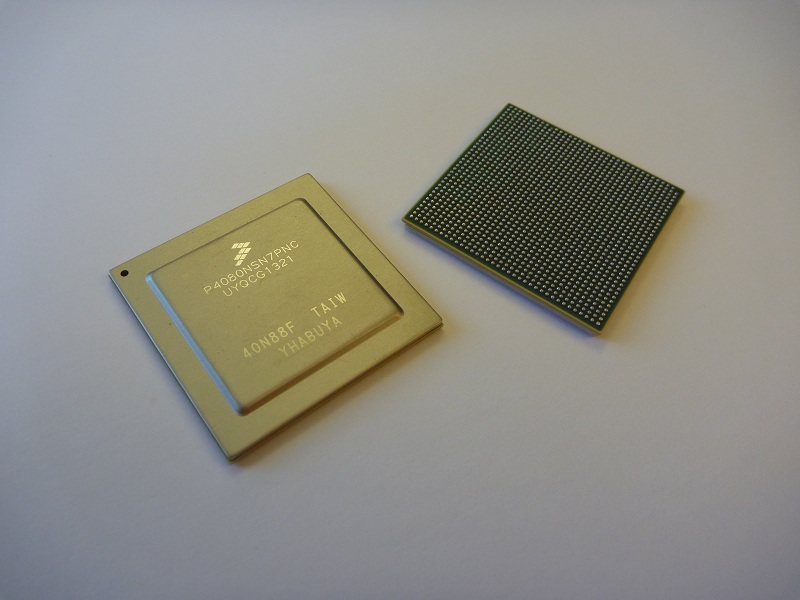 🇳🇱 NetherlandsQorIQ
NXP communications microprocessor brand for networking infrastructureCPU · Arm · 2008
🇺🇸 United StatesPWRficient
Power-efficient PowerPC microprocessor series by P.A. SemiCPU · Power · 2007
 🇺🇸 United StatesPowerPC e600
32-bit PowerPC microprocessor core for high-performance SoCsCPU · Power · 2004
 🇺🇸 United StatesPowerPC 400
Embedded 32-bit RISC processor cores for diverse applicationsCPU · Power · 1994
More from Freescale Semiconductor
All of them 🇺🇸 United StatesPowerPC e300
32-bit embedded microprocessor core by FreescaleCPU · Power · 2004