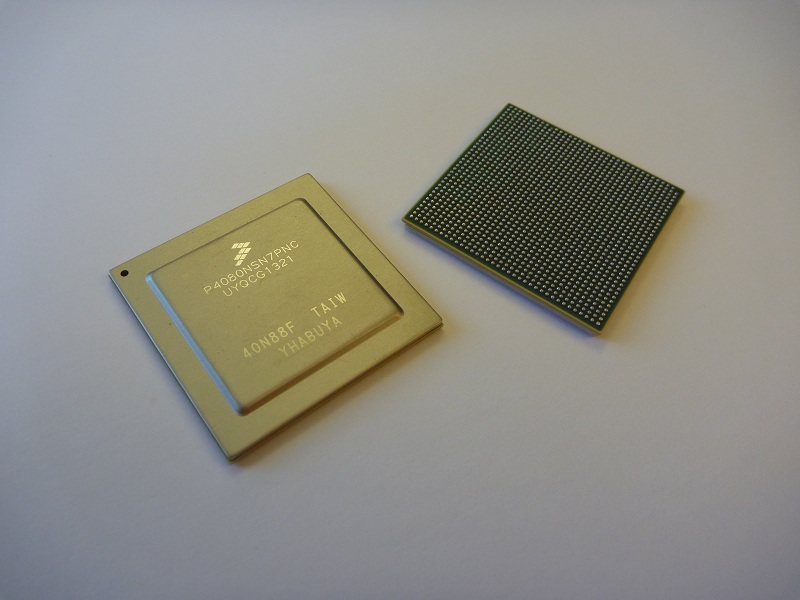
QorIQ
NXP communications microprocessor brand for networking infrastructure
QorIQ is a family of communication processors from NXP Semiconductors, evolving from the PowerQUICC line. It includes Power ISA and ARM-based chips designed for networking, telecom, and industrial control, launched in 2008.
- Launched in June 2008 by Freescale Semiconductor
- Supports both Power ISA and ARM architectures
- Manufactured on 45 nm, 28 nm, and 16 nm processes
- Features up to 12 cores with hardware hypervisor
- Targets networking, telecom, and industrial markets
What it is
QorIQ is a brand of microprocessors and systems on chip developed by NXP Semiconductors, formerly Freescale. These chips handle data processing for network infrastructure, telecommunications, and industrial control systems. The product line supports both Power ISA and ARM architectures, offering flexibility for different performance needs. Launched in 2008, it replaced the older PowerQUICC platform while maintaining software compatibility. The family includes multi-core processors with integrated networking accelerators and security engines.
How it came about
Freescale Semiconductor announced the QorIQ brand and its initial P1, P2, and P4 families in June 2008. This launch marked an evolutionary step from the PowerQUICC platform, aiming to address growing demands in connected devices and network traffic. Details for the P3 and P5 series followed in 2010. In 2011, the company introduced the Qonverge platform, combining CPU and DSP cores for wireless infrastructure. NXP acquired Freescale in late 2015, continuing the product line under the QorIQ name.
Inside the chip
The architecture uses e500, e5500, and e6500 cores for Power ISA models, and Cortex-A cores for ARM-based variants. Chips feature a CoreNet coherency fabric that connects multiple cores, allowing symmetric or asymmetric multiprocessing. Integrated hardware accelerators handle packet parsing, encryption, and regular expression matching. Memory controllers support DDR2, DDR3, and DDR4 with error correction. High-speed serial interfaces can be configured for Ethernet, PCIe, or RapidIO connections, providing flexible input and output options for system designers.
How it was made
Initial P series processors were manufactured using a 45 nm fabrication process. Later T series and Qonverge chips moved to a 28 nm process to reduce power consumption. The Layerscape LX generation utilizes a 16 nm FinFET process. Power envelopes range from less than 3 W for low-end embedded parts to 30 W for high-performance networking units. Packaging often involves 689-pin ball grid arrays, with pin compatibility maintained across certain families to simplify board design.
Where it went
These processors target networking equipment such as routers, switches, and wireless access points. They are used in telecommunications infrastructure for LTE base stations and core network elements. Industrial applications include military systems and aerospace controls due to wide temperature tolerances. The low-power Layerscape variants serve internet of things gateways and wireless infrastructure. High-end models support enterprise backbone networking and storage control planes.
Versions and family
The P series includes P1 to P5 models, scaling from single-core entry-level chips to eight-core high-performance units. The T series offers advanced multiprocessing with up to twelve threads per chip. Layerscape LS-1 and LS-2 families use ARM Cortex cores for low to mid-range networking. Qonverge combines general-purpose cores with digital signal processors for wireless tasks. Each family segments products by core count, clock speed, and interface availability.
Why it matters
QorIQ established a scalable platform for communication infrastructure, bridging the gap between legacy PowerPC systems and modern multi-core designs. Its hardware hypervisor support enabled virtualization in embedded networking gear. The transition to ARM architectures in the Layerscape line reflected industry shifts towards energy-efficient computing. Software compatibility with previous generations helped customers migrate existing codebases without complete rewrites.
Questions people ask about QorIQ
What architectures does QorIQ support?
QorIQ processors support both Power ISA and ARM architectures. Early P series chips used Power cores like e500 and e5500, while later Layerscape models adopted ARM Cortex-A cores.
Who manufactures QorIQ processors?
The brand was originally developed by Freescale Semiconductor, which was acquired by NXP Semiconductors in 2015. NXP now designs and oversees the production of these chips.
What is the Layerscape family?
Layerscape is an ARM-based subset of the QorIQ family. It targets low to mid-range networking and wireless infrastructure, using Cortex-A7, A9, A15, A53, and A72 cores.
Good reading and sources
The facts on this page come from the Wikipedia article "QorIQ", written by its contributors and used under the CC BY-SA 4.0 licence, and from its Wikidata record (CC0). EveryChip rewrote the text in its own words, with AI assistance, and compares every page with the article to make sure no passage is copied. It may be reused under the same CC BY-SA 4.0 licence with a link back.
It may contain mistakes, and figures change over time. Nothing here is investment or buying advice. If something is wrong, tell us. Last refreshed 2026-11-14.
Like QorIQ
All CPUs and microprocessors 🇺🇸 United StatesPowerPC e600
32-bit PowerPC microprocessor core for high-performance SoCsCPU · Power · 2004
🇺🇸 United StatesPowerPC e6500
Multithreaded 64-bit Power ISA microprocessor core by FreescaleCPU · Power · 2012
 🇺🇸 United StatesXScale
ARM-based microarchitecture for mobile and embedded systemsCPU · Arm · 2002
More from NXP Semiconductors
All of them 🇺🇸 United StatesPowerPC e300
32-bit embedded microprocessor core by FreescaleCPU · Power · 2004