Intel Edison
Small computer module for wearables and IoT devices
Intel Edison is a computer-on-module designed by Intel for wearable technology and Internet of Things projects. Released in late 2014, it combines an Atom processor with wireless connectivity on a compact board, though it was discontinued in 2017.
- Dual-core Atom CPU at 500 MHz with 1 GB RAM
- Built-in Wi-Fi and Bluetooth 4.0 connectivity
- Runs Yocto Linux and supports Arduino code
- Discontinued by Intel in June 2017
What it is
The Intel Edison is a small computer-on-module created for developers building wearable gadgets and Internet of Things hardware. Intel introduced the system to provide a powerful yet compact platform that could fit into tight spaces. It integrates a processor, memory, storage, and wireless radios onto a single board. The module runs a full Linux operating system, allowing it to handle complex tasks unlike simpler microcontrollers. It serves as a bridge between basic sensors and cloud services, making it suitable for prototypes and consumer products alike.
How it came about
Intel first announced the project at CES in January 2014. The initial concept described a device the size of an SD card with a Quark processor. By March 2014, the design changed to use a more capable Atom chip. The final version was revealed at the Intel Developer Forum in September 2014. This iteration was slightly larger than the original SD card promise but offered significantly better performance. Intel CEO Brian Krzanich demonstrated its potential with a baby monitoring demo. The product line ended on June 19, 2017.
Inside the chip
The module uses a system on a chip built on a 22 nanometre process. The main processor features two Atom Silvermont cores running at 500 MHz. A smaller Quark core operates at 100 MHz to handle real-time tasks. One gigabyte of LPDDR3 memory is packaged directly with the processor. Storage comes from four gigabytes of embedded flash memory. Wireless connectivity includes Wi-Fi and Bluetooth 4.0. The board exposes signals through a dense 70-pin connector, supporting USB, GPIO, and other interfaces for expansion.
How it was made
Intel manufactured the Edison using its own 22 nm fabrication technology. The physical module measures 35.5 by 25 by 3.9 millimetres. Components are placed on both sides of the board to save space. The package integrates the system on a chip with memory and flash storage. This high level of integration allows the module to remain small while providing substantial computing power. The manufacturing process supports the dual-core architecture and integrated wireless controllers.
Where it went
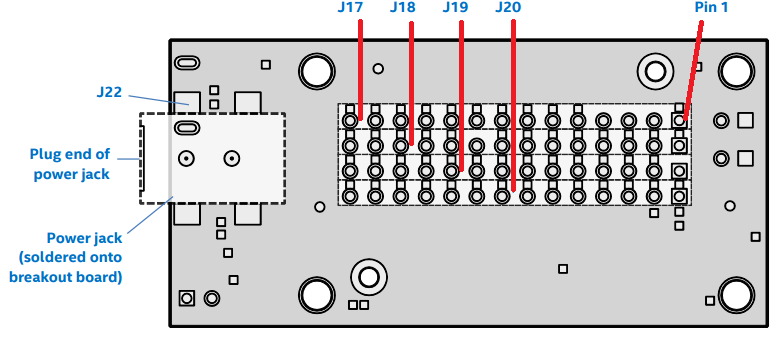
Developers used the Edison for wearable computers and Internet of Things applications. It powered devices like smart watches, health monitors, and connected sensors. The board supported Arduino sketches, C, C++, Python, and NodeJS. Intel provided an Arduino-compatible breakout board for easy prototyping. Another breakout option exposed native voltage levels for custom circuits. Third-party kits, such as the Modulowo Explore E, added support for motors and GPS modules. It ran Yocto Linux, enabling robust software development.
Versions and family
The final production version differed from the initial announcement. The first plan involved a Quark CPU, but the shipped product used an Atom Tangier SoC. Intel released an Arduino-compatible board with digital and analog pins. A separate breakout board offered through-hole solder points and USB On-The-Go support. These expansion boards allowed users to connect the small module to standard electronic components. No direct successor was named before the product was discontinued.
Why it matters
The Edison brought x86 compatibility and Linux to the wearable market. It allowed developers to use familiar programming tools like Eclipse and the Arduino IDE. By integrating Wi-Fi and Bluetooth, it simplified the creation of connected devices. The module demonstrated that small form factors could support full operating systems. Its discontinuation in 2017 left a gap in the market for similar high-performance tiny modules. Community support continued unofficially after official sales ended.
Questions people ask about Intel Edison
What processor does the Intel Edison use?
It uses a dual-core Intel Atom Silvermont processor running at 500 MHz. There is also a secondary Quark core at 100 MHz for real-time tasks.
Can I program the Edison with Arduino?
Yes, the module supports development in the Arduino IDE. Intel also provided an Arduino-compatible breakout board to simplify connections for hobbyists.
How much memory and storage does it have?
The board includes 1 GB of LPDDR3 RAM integrated into the package. It also has 4 GB of eMMC flash memory for storing the operating system and data.
Is the Intel Edison still available?
No, Intel discontinued the Edison board on June 19, 2017. It is no longer produced or sold officially by the company.
Good reading and sources
The facts on this page come from the Wikipedia article "Intel Edison", written by its contributors and used under the CC BY-SA 4.0 licence, and from its Wikidata record (CC0). EveryChip rewrote the text in its own words, with AI assistance, and compares every page with the article to make sure no passage is copied. It may be reused under the same CC BY-SA 4.0 licence with a link back.
It may contain mistakes, and figures change over time. Nothing here is investment or buying advice. If something is wrong, tell us. Last refreshed 2026-11-14.
Like Intel Edison
All systems on a chip 🇺🇸 United StatesIntel Quark
Low-power 32-bit x86 system on a chip for wearables and IoT.SoC · x86 · 2013
 🇨🇳 ChinaESP8266
Low-cost Wi-Fi microcontroller chip by Espressif SystemsMicrocontroller · RISC · 2014
🇺🇸 United StatesAtom
Low-power x86 system on a chip for mobile and embedded devices.SoC · x86 · 2012
 🇨🇳 ChinaESP32
Low-cost Wi-Fi and Bluetooth microcontroller family from Espressif SystemsMicrocontroller · RISC · 2016
More from Intel
All of them 🇺🇸 United StatesBroadwell
Intel's 14 nm shrink of the Haswell CPU microarchitectureCPU · x86 · 2014
WorldIntel X99
High-end desktop chipset supporting DDR4 memory and LGA 2011-v3 processors.Analog · 2014
 🇺🇸 United StatesSilvermont
Intel's 22 nm low-power Atom core design, used across four SoC familiesCPU · x86 · 2013
 🇺🇸 United StatesXeon D
Intel's low-power x86 system-on-chip line for microserversCPU · x86 · 2015