
ESP8266
Low-cost Wi-Fi microcontroller chip by Espressif Systems
The ESP8266 is a 32-bit microcontroller with integrated Wi-Fi and TCP/IP networking, produced by Espressif Systems in Shanghai. Released around 2014, it enabled affordable internet connectivity for hobbyists and IoT devices through its low price and compact design.
- Integrates Wi-Fi and TCP/IP stack on a single chip
- Runs on a 32-bit Tensilica L106 processor core
- Popularized in 2014 via the low-cost ESP-01 module
- Supports up to 16 MiB of external flash memory
- Succeeded by the ESP32 and ESP8285 variants
What it is
The ESP8266 is a system on a chip that combines a 32-bit microcontroller with Wi-Fi networking capabilities. Manufactured by Espressif Systems in Shanghai, China, it includes a complete TCP/IP stack, allowing devices to connect to wireless networks without extra hardware. The chip operates at 3.3 volts and features a Tensilica L106 processor core. Its integration of radio components and processing power in a single package made it a cornerstone for inexpensive internet-connected devices.
How it came about
Espressif Systems introduced the chip, but it gained widespread attention in August 2014. The English-speaking maker community discovered it through the ESP-01 module, produced by third-party manufacturer Ai-Thinker. Initial documentation was only available in Chinese, and English resources were scarce. The extremely low cost and minimal external component requirements attracted hackers and developers. They reverse-engineered the commands and translated manuals, sparking a surge in DIY projects and open-source software support.
Inside the chip
The heart of the chip is a Tensilica Diamond Standard 106Micro core, running at 80 MHz by default or overclocked to 160 MHz. It contains 160 kilobytes of RAM, split between instruction storage and data memory. The device supports up to 16 megabytes of external flash memory via QSPI. Integrated radio features include a power amplifier, balun, and switch for IEEE 802.11 b/g/n Wi-Fi. It offers 17 general-purpose input/output pins, serial interfaces, and a 10-bit analog-to-digital converter for sensor readings.
How it was made
Specific manufacturing details such as the fabrication plant or transistor count are not publicly specified in the provided records. The chip is designed by Espressif Systems. It is commonly distributed in various module forms, such as the ESP-01, which integrates the silicon with necessary passive components and an antenna. These modules simplify integration for engineers by handling radio frequency interference shielding and impedance matching internally.
Where it went
This microcontroller is widely used in Internet of Things applications, home automation, and hobbyist electronics. Developers use it to add Wi-Fi connectivity to sensors, lights, and appliances. Popular firmware platforms like Arduino, MicroPython, and NodeMCU allow users to program the chip easily. It serves as a bridge for simple TCP/IP connections using Hayes-style commands, enabling remote control and data logging for consumer and industrial embedded systems.
Versions and family
The ESP8285 is a variant with one megabyte of built-in flash memory, enabling single-chip designs. Espressif released numerous module versions, including the ESP-12E, which offers more pins. Third-party boards like NodeMCU added USB connectors for easier programming. The ESP32 family eventually succeeded the ESP8266, offering dual-core performance and Bluetooth. In 2020, the ESP32-C3 was announced as a pin-compatible successor using a RISC-V core.
Why it matters
The ESP8266 democratized Wi-Fi connectivity for embedded projects by drastically reducing cost and complexity. It fostered a large ecosystem of open-source tools and libraries, influencing the growth of the IoT sector. Its popularity forced other manufacturers to compete on price and integration. The chip established Espressif Systems as a major player in the microcontroller market and set a standard for affordable wireless development boards.
Problems and reception
Initial reception was hindered by a lack of English documentation and support. However, the community-driven translation efforts and release of official software development kits in October 2014 improved accessibility. The low price point and high functionality were praised by makers. Some early modules required careful handling of voltage levels and power supply stability, leading to the development of more robust developer boards with integrated regulators.


Questions people ask about ESP8266
What is the ESP8266 used for?
It is primarily used to add Wi-Fi connectivity to microcontroller projects. Common applications include home automation, IoT sensors, and remote control systems. Its low cost and integrated networking stack make it ideal for devices that need to send data over the internet without complex hardware.
How much memory does the ESP8266 have?
The chip has 160 kilobytes of RAM, divided into instruction and data sections. It does not have built-in flash memory for user code in the base model, but it supports up to 16 megabytes of external QSPI flash. The ESP8285 variant includes one megabyte of built-in flash.
Can I program the ESP8266 with Arduino?
Yes, there is an official Arduino core for the ESP8266. This allows developers to write C++ code using the familiar Arduino IDE. The core handles the Wi-Fi connection and hardware abstraction, making it accessible to beginners and experienced engineers alike.
What voltage does the ESP8266 require?
The chip operates at 3.3 volts DC. It can tolerate up to 3.6 volts. Connecting it directly to a 5-volt source will damage the device. Many development boards include a voltage regulator to safely step down 5-volt USB power to the required 3.3 volts.
Good reading and sources
The facts on this page come from the Wikipedia article "ESP8266", written by its contributors and used under the CC BY-SA 4.0 licence, and from its Wikidata record (CC0). EveryChip rewrote the text in its own words, with AI assistance, and compares every page with the article to make sure no passage is copied. It may be reused under the same CC BY-SA 4.0 licence with a link back.
It may contain mistakes, and figures change over time. Nothing here is investment or buying advice. If something is wrong, tell us. Last refreshed 2026-11-14.
Like ESP8266
All microcontrollers 🇨🇳 ChinaESP32
Low-cost Wi-Fi and Bluetooth microcontroller family from Espressif SystemsMicrocontroller · RISC · 2016
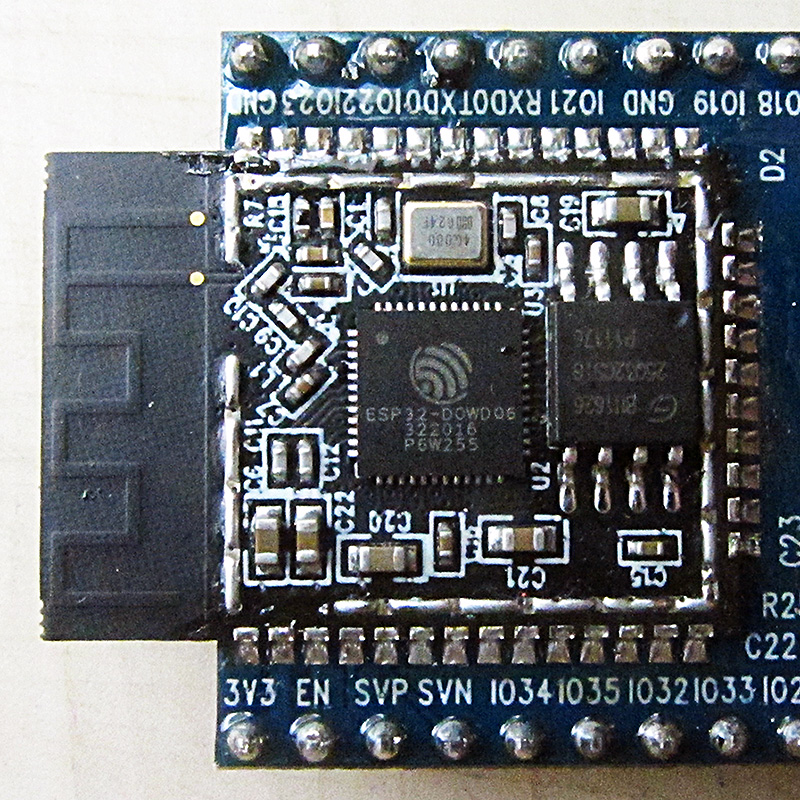 🇨🇳 ChinaESP32
Low-cost Wi-Fi and Bluetooth microcontroller family by EspressifMicrocontroller · RISC · 2016
🇨🇳 ChinaESP32
Low-cost Wi-Fi and Bluetooth microcontroller familyMicrocontroller · RISC · 2016
🇨🇳 ChinaESP32
Low-cost Wi-Fi and Bluetooth microcontroller family by EspressifMicrocontroller · RISC · 2021
