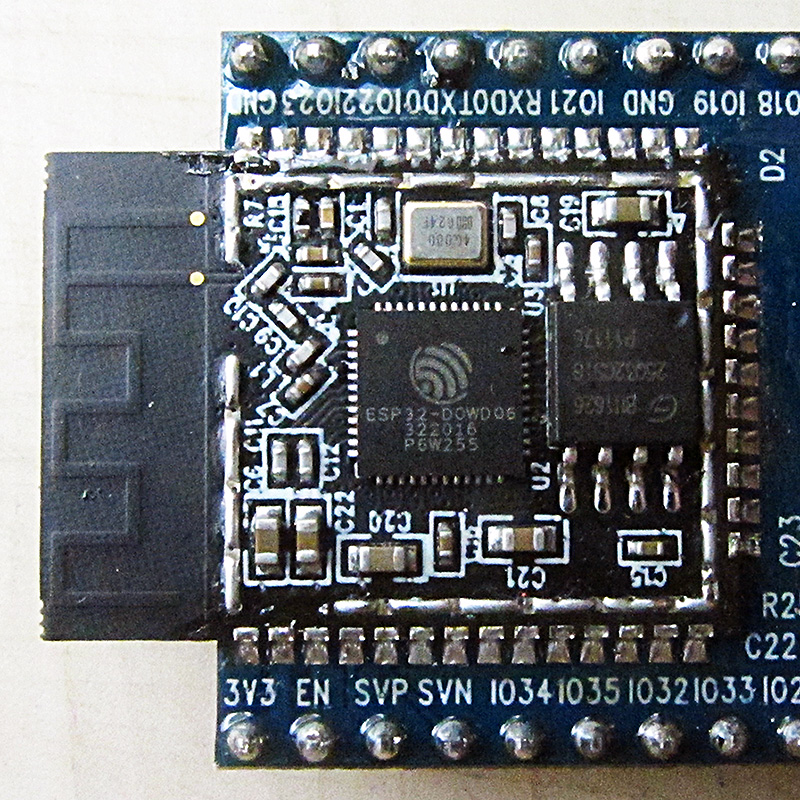
ESP32
Low-cost Wi-Fi and Bluetooth microcontroller family
Espressif Systems designed the ESP32, a family of energy-efficient microcontrollers with integrated wireless connectivity. Released in 2016, it succeeded the ESP8266 and supports Wi-Fi and Bluetooth using Tensilica or RISC-V cores.
- Integrates Wi-Fi and Bluetooth on a single chip
- Manufactured by TSMC on a 40 nm process node
- Features Tensilica Xtensa or RISC-V processor cores
- Successor to the widely used ESP8266 microcontroller
- Supports multiple languages including Python and Rust
What it is
The ESP32 is a series of low-cost system on a chip microcontrollers created by Espressif Systems. It integrates Wi-Fi and Bluetooth radios directly onto the silicon, removing the need for external communication modules. The chip runs on a 3.3 volt supply and includes power management circuits. It serves as a successor to the popular ESP8266, offering more processing power and dual-mode wireless support. Developers use it for internet of things projects due to its small size and energy efficiency.
How it came about
Espressif Systems launched the original ESP32 in September 2016. It was built to replace the ESP8266, adding Bluetooth capability alongside Wi-Fi. The design uses a 40 nanometre process from TSMC. Over time, the company released revised versions like the ECO V3 in 2020 to fix bugs. Newer variants such as the ESP32-S3 and ESP32-C6 have since joined the family, expanding the range of available processors and features while keeping software compatibility.
Inside the chip
The chip contains either Tensilica Xtensa LX6 or LX7 cores, or a RISC-V processor. Some models feature dual cores running at 240 MHz. It packs 520 KiB of static RAM for data storage. Wireless functions include antenna switches, power amplifiers, and filters. The physical chip comes in quad-flat no-leads packages with 49 pads. One large pad on the bottom connects to ground for heat dissipation. Modules often add flash memory and crystal oscillators to the base silicon.
How it was made
TSMC manufactures the ESP32 using its 40 nm production process. The bare die is housed in 6 mm by 6 mm or 5 mm by 5 mm QFN packages. For easier integration, Espressif offers system in package modules like the PICO series. These combine the silicon, flash memory, and passive components into a single 7 mm square unit. This approach simplifies circuit board design for manufacturers who want to avoid radio frequency tuning.
Where it went
Devices range from consumer gadgets to industrial controllers. Alibaba used them in LED wristbands for coordinated light shows. The Playdate handheld console and Odroid Go gaming kit rely on this hardware. Smart thermostats like Mysa and energy monitors use the chip for connectivity. Industrial automation firms employ it in modules with digital inputs and relay outputs. Researchers also utilise it in educational drones and low-cost DIY projects.
Versions and family
The family includes the original dual-core models and newer single-core variants. The ESP32-S3 adds USB support, while the ESP32-C6 targets specific wireless standards. Modules like the WROOM and WROVER differ by including extra pseudostatic RAM. The PICO series integrates all necessary components into one small package. All these chips share the same development framework, allowing code to move between them with minimal changes.
Why it matters
This microcontroller helped democratise wireless embedded development. Its low price and strong community support made it a standard choice for hobbyists and professionals. Many programming languages now support it, including Python, JavaScript, and Rust. The extensive ecosystem of development boards and libraries has accelerated prototyping for internet of things applications globally.
Problems and reception
In March 2025, security researchers found undocumented debugging commands in the Bluetooth firmware. These vendor-specific instructions allowed memory writes but required physical access or a serial connection. Espressif clarified they were not remote backdoors but testing tools. The company promised to restrict access in future software updates and improve documentation to address security concerns raised by the community.


Questions people ask about ESP32
What wireless technologies does the ESP32 support?
The ESP32 supports both Wi-Fi and Bluetooth. It includes built-in radio components like antennas switches and power amplifiers, allowing it to handle wireless data communication without extra external modules.
Which companies designed and manufactured the ESP32?
Espressif Systems designed the ESP32 microcontroller family. The physical chips are manufactured by TSMC using their 40 nanometre semiconductor process technology.
Is there a security risk with the ESP32 Bluetooth firmware?
Researchers found undocumented debugging commands in 2025. Espressif stated these require physical access and are not remote backdoors. They plan to restrict access in future software updates.
What kind of processor cores are inside the ESP32?
Depending on the model, the ESP32 uses Tensilica Xtensa LX6 or LX7 cores, or a RISC-V microprocessor. Some variants offer dual-core processing at speeds up to 240 MHz.
Good reading and sources
The facts on this page come from the Wikipedia article "ESP32", written by its contributors and used under the CC BY-SA 4.0 licence, and from its Wikidata record (CC0). EveryChip rewrote the text in its own words, with AI assistance, and compares every page with the article to make sure no passage is copied. It may be reused under the same CC BY-SA 4.0 licence with a link back.
It may contain mistakes, and figures change over time. Nothing here is investment or buying advice. If something is wrong, tell us. Last refreshed 2026-11-15.
Like ESP32
All microcontrollers 🇨🇳 ChinaESP32
Low-cost Wi-Fi and Bluetooth microcontroller family from Espressif SystemsMicrocontroller · RISC · 2016
🇨🇳 ChinaESP32
Low-cost Wi-Fi and Bluetooth microcontroller family by EspressifMicrocontroller · RISC · 2016
🇨🇳 ChinaESP32
Low-cost Wi-Fi and Bluetooth microcontroller family by EspressifMicrocontroller · RISC · 2021
WorldESP32
Low-cost microcontroller with Wi-Fi and Bluetooth made by Espressif Systems.Microcontroller · Arm · 2016
More from Espressif Systems
All of them 🇺🇸 United StatesApple A10 Fusion
Quad-core mobile SoC with heterogeneous computingSoC · Arm · 2016
 WorldGeForce 10 series
Nvidia Pascal graphics cards for desktop and laptop gamingGPU · GPU architecture · 2016
🇺🇸 United StatesGoogle Tensor
Google's own ARM64 system-on-chip family built for Pixel phones and tabletsSoC · Arm · 2016
🇷🇺 RussiaBaikal CPU
Russian microprocessor line using MIPS, ARM and RISC-V coresCPU · MIPS · 2016