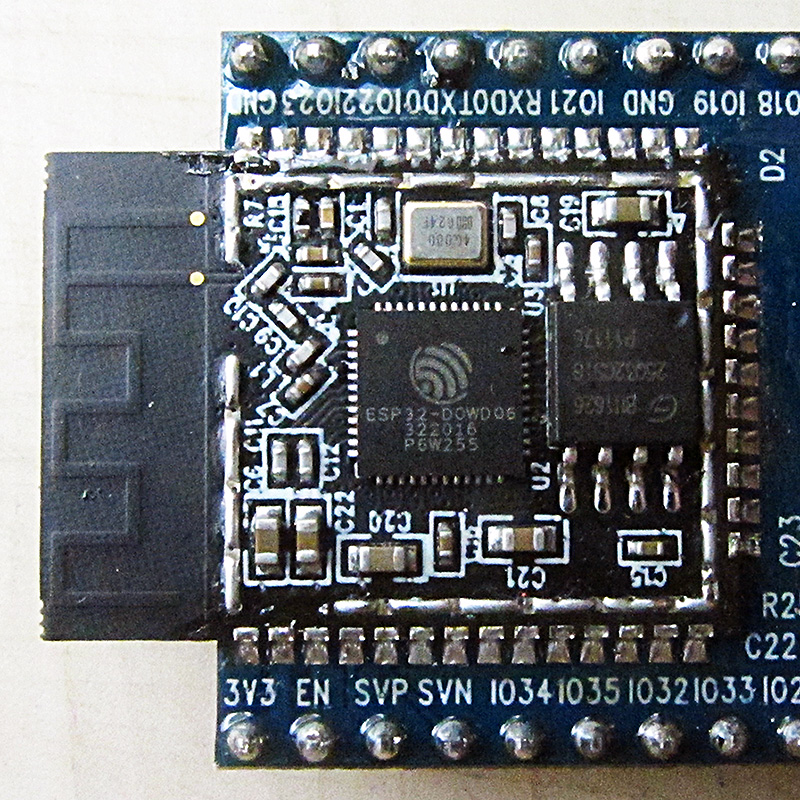
ESP32
Low-cost Wi-Fi and Bluetooth microcontroller family by Espressif
Espressif Systems launched the ESP32 in September 2016 as a successor to the ESP8266. This system on a chip combines wireless connectivity with flexible processing cores for embedded applications.
- Launched in September 2016 by Espressif Systems
- Integrates Wi-Fi and Bluetooth on a single chip
- Manufactured by TSMC on a 40 nm process node
- Features Xtensa or RISC-V processor cores
- Uses a QFN package with 48 side connection pads
What it is
The ESP32 is a series of microcontrollers designed for internet-connected devices. Espressif Systems created this family to provide affordable wireless capabilities. Each chip integrates Wi-Fi and Bluetooth radios alongside a central processor. The design targets battery-powered gadgets and smart home equipment. Manufacturers embed these units into printed circuit boards or use pre-made modules. This approach simplifies hardware development for engineers building connected products.
How it came about
Espressif introduced the original model in late 2016 to replace the older ESP8266. The company sought to add Bluetooth support while keeping costs low. Subsequent revisions addressed early bugs and improved performance. In 2020, the ECO V3 version arrived with fixes for known issues. Later updates expanded the family with new cores and interfaces. These changes maintained code compatibility across the entire product line.
Inside the chip
Processing power comes from Tensilica Xtensa LX6 or LX7 cores. Some variants use RISC-V architecture instead. Chips may have one or two processing units running at 240 MHz. Internal static memory totals 520 KiB for data storage. Wireless functions include antenna switches and power amplifiers built directly onto the silicon. This integration reduces external component counts. The system operates on 3.3 volts direct current.
How it was made
TSMC manufactures the silicon using a 40 nanometre process node. The physical chip sits inside a quad-flat no-leads package. Two common sizes are 6 mm by 6 mm and 5 mm by 5 mm. Forty-eight connection pads line the sides for electrical links. A large thermal pad on the bottom connects to ground. This layout helps dissipate heat during operation.
Where it went
Developers use these chips in smart thermostats and energy monitors. Handheld gaming consoles like the Playdate rely on this hardware. Industrial automation modules employ them for sensor data collection. Educational drones and attendance tracking systems also feature ESP32 units. Alibaba used them in LED wristbands for coordinated light displays. The versatility suits both consumer gadgets and professional equipment.
Versions and family
The family includes the PICO series which packs flash memory and oscillators into one module. The S3 variant adds USB support and extra RAM. C-series models focus on specific wireless standards. All versions share a common software development kit. This consistency allows code written for one chip to run on others. Revisions like the ECO V3 improve reliability without changing the interface.
Why it matters
This microcontroller lowered the barrier for creating internet-enabled devices. Its low price and dual wireless support made it popular among hobbyists. Large companies adopted it for mass-produced consumer electronics. The open software ecosystem encouraged rapid prototyping. It became a standard choice for DIY projects and commercial IoT products alike.
Problems and reception
Security researchers found undocumented debugging commands in the Bluetooth firmware in 2025. These vendor-specific instructions allowed memory writes but required physical access. Espressif clarified they were not remote security risks. The company promised to restrict access in future software updates. The incident highlighted the need for better documentation of testing features.


Questions people ask about ESP32
What wireless technologies does the ESP32 support?
The chip includes built-in hardware for both Wi-Fi and Bluetooth connections. This dual capability allows devices to communicate over local networks and pair with other gadgets without extra components.
Which company designs and makes the ESP32?
Espressif Systems designs the architecture and manages the product line. TSMC manufactures the physical silicon wafers using their 40 nanometre fabrication process.
Is the ESP32 compatible with previous Espressif chips?
It serves as a successor to the ESP8266 but offers more features. While not identical, the software development tools share similarities, though code is not always directly portable without changes.
What type of package does the chip use?
The silicon is housed in a quad-flat no-leads package. It features 48 connection pads along the edges and a central thermal pad on the bottom for grounding and heat dissipation.
Good reading and sources
The facts on this page come from the Wikipedia article "ESP32", written by its contributors and used under the CC BY-SA 4.0 licence, and from its Wikidata record (CC0). EveryChip rewrote the text in its own words, with AI assistance, and compares every page with the article to make sure no passage is copied. It may be reused under the same CC BY-SA 4.0 licence with a link back.
It may contain mistakes, and figures change over time. Nothing here is investment or buying advice. If something is wrong, tell us. Last refreshed 2026-11-15.
Like ESP32
All microcontrollers 🇨🇳 ChinaESP32
Low-cost Wi-Fi and Bluetooth microcontroller family from Espressif SystemsMicrocontroller · RISC · 2016
🇨🇳 ChinaESP32
Low-cost Wi-Fi and Bluetooth microcontroller familyMicrocontroller · RISC · 2016
🇨🇳 ChinaESP32
Low-cost Wi-Fi and Bluetooth microcontroller family by EspressifMicrocontroller · RISC · 2021
WorldESP32
Low-cost microcontroller with Wi-Fi and Bluetooth made by Espressif Systems.Microcontroller · Arm · 2016
More from Espressif Systems
All of them 🇺🇸 United StatesApple A10 Fusion
Quad-core mobile SoC with heterogeneous computingSoC · Arm · 2016
 WorldGeForce 10 series
Nvidia Pascal graphics cards for desktop and laptop gamingGPU · GPU architecture · 2016
🇺🇸 United StatesGoogle Tensor
Google's own ARM64 system-on-chip family built for Pixel phones and tabletsSoC · Arm · 2016
🇷🇺 RussiaBaikal CPU
Russian microprocessor line using MIPS, ARM and RISC-V coresCPU · MIPS · 2016