
ESP32
Low-cost Wi-Fi and Bluetooth microcontroller family from Espressif Systems
ESP32 is a family of inexpensive, low-power microcontrollers with built-in Wi-Fi and Bluetooth, designed by Espressif Systems and fabricated by TSMC on a 40 nm process. Released on 6 September 2016 as the follow-up to the ESP8266, it became a common choice for connected devices, development boards and industrial modules.
- Designed by Espressif Systems, built by TSMC on a 40 nm process
- Wi-Fi and Bluetooth radios integrated on the die
- 520 KiB SRAM; QFN package with 49 pads
- Core choices: Xtensa LX6, Xtensa LX7 or RISC-V
- Launched 6 September 2016 as the ESP8266's successor
What it is
ESP32 is a group of cheap, power-frugal microcontrollers that carry both Wi-Fi and Bluetooth radios on the same piece of silicon. Espressif Systems designed the range and TSMC produces the chips on a 40 nm node. Depending on the variant, the processor core is a Tensilica Xtensa LX6 (in one- or two-core form), a dual-core Xtensa LX7, or a RISC-V design. The die also holds antenna switching, an RF balun, power amplifiers, sensitive receive paths, filters and power management, so a board needs few outside radio parts. It arrived on 6 September 2016 as the replacement for the ESP8266.
How it came about
Espressif Systems built the ESP32 to follow its earlier ESP8266 wireless microcontroller. The design goal was a single, inexpensive part that could handle both Wi-Fi and Bluetooth while staying light on power. The family reached the market on 6 September 2016. From that point the range widened steadily, with new members offering different processor cores and features while keeping one shared software development kit and broad code compatibility. The original chip itself was later reworked, most notably in the revision known as ESP32 ECO V3.
Inside the chip
Every ESP32 pairs a processor core with on-chip radio circuitry. Core options span single- and dual-core Tensilica Xtensa LX6, dual-core Xtensa LX7, and RISC-V. The package is a quad-flat no-leads type with 49 contacts: 48 pads around the edges plus a large ground pad underneath for heat. On-chip memory includes 520 KiB of SRAM, and many modules add flash, with some also carrying pseudostatic RAM. Antenna switches, a balun, amplifiers, low-noise receivers, filters and power management are integrated, so the radio needs little external support.
How it was made
TSMC manufactures the ESP32 line using a 40 nm process. The bare system-on-chip ships in quad-flat no-leads packages measuring either 6 mm × 6 mm or 5 mm × 5 mm. PICO system-in-package parts go further, folding the silicon, a crystal oscillator, flash memory, filter capacitors and RF matching links into one 7 mm × 7 mm QFN. The first of these, ESP32-PICO-D4, paired two 240 MHz CPUs with 4 MiB of internal flash, a 40 MHz oscillator and 34 GPIO lines.
Where it went
The chips appear in consumer products such as Alibaba Group's LED wristbands from its 2017 staff gathering, DingTalk's M1 attendance terminal, the Pium fragrance device, HardKernel's Odroid Go handheld kit, Panic Inc. and Teenage Engineering's Playdate console, Octopus Energy's Mini monitor, Mysa thermostats, Ubiquiti UniFi switches and the Xteink X4 e-reader. Industrial users include TECHBASE's Moduino X1 and X2 and NORVI IIoT units. Schools and researchers adopt them widely, and the DJI Robomaster TT educational drone carries one.
Versions and family
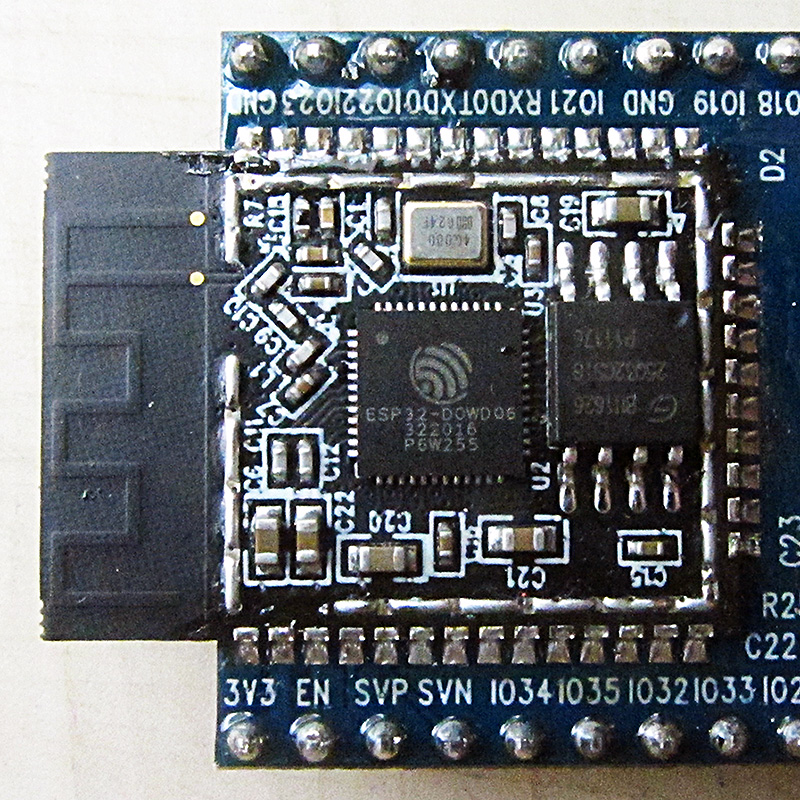
The range has grown well beyond the first chip. ESP32-D0WDQ6 and ESP32-D0WD gained a V3 revision in 2020, called ESP32 ECO V3, which corrected bugs and added improvements. PICO system-in-package modules started with ESP32-PICO-D4, followed in 2020 by ESP32-PICO-V3 and ESP32-PICO-V3-02 on the ECO V3 wafer, then in 2022 by ESP32-S3-PICO-1 with USB OTG and internal PSRAM. Surface-mount module boards carry the SoC plus flash and, in some cases, pSRAM, with a meandered inverted-F PCB antenna. Development and break-out boards add wiring and extras.
Why it matters
ESP32 turned a low-cost, dual-radio microcontroller into a default building block for connected projects. Its reach spans mass-market consumer gadgets, industrial automation hardware, teaching kits and hobbyist builds such as inexpensive drones. Because the whole family shares one SDK and is largely code-compatible, work done on one member carries over to others. That combination of price, integrated radio parts and software continuity helped the range spread across commercial, industrial and academic settings.
Problems and reception
In March 2025, Tarlogic Security researchers found undocumented Host Controller Interface commands inside the ESP32 Bluetooth firmware, presenting the work at RootedCON on 6 March 2025. Commands such as Write Memory (0xFC02) are vendor-specific debugging and test tools, common in Bluetooth controllers and absent from the standard command set. Early reports called them a backdoor; later clarification described them as undocumented debugging features. They cannot be reached over ordinary Bluetooth links, but are reachable with physical access or an HCI-UART setup. Espressif said they pose no risk in normal use, exist only in ESP32 chips (not the C, S or H series), and that future ESP-IDF releases would tighten access and document vendor commands.


Questions people ask about ESP32
What exactly is an ESP32?
It is a family of low-cost, energy-efficient microcontrollers from Espressif Systems with Wi-Fi and Bluetooth built in. The range covers several processor cores and package styles, all sharing one software development kit and largely compatible code, and the chips are made by TSMC on a 40 nm process.
Which processor cores can you get?
Depending on the variant, the core is a Tensilica Xtensa LX6 in single- or dual-core form, a dual-core Tensilica Xtensa LX7, or a RISC-V design. The ESP32-PICO-D4 module runs two CPUs at 240 MHz alongside 4 MiB of internal flash and a 40 MHz oscillator.
How is the chip packaged and used on boards?
The bare SoC comes in quad-flat no-leads packages of 6 mm × 6 mm or 5 mm × 5 mm with 49 pads. PICO modules pack the silicon, oscillator, flash and matching parts into a 7 mm × 7 mm QFN. Surface-mount module boards add flash and sometimes pSRAM plus a PCB antenna, while development boards add wiring for breadboards.
What came before it?
The ESP8266, an earlier 32-bit wireless microcontroller from the same vendor. ESP32 succeeded it on 6 September 2016, adding Bluetooth alongside Wi-Fi and a wider set of processor and memory options.
What was the 2025 security discussion about?
Tarlogic Security reported undocumented Bluetooth HCI commands in ESP32 firmware, such as Write Memory (0xFC02). These are vendor debugging tools, not reachable over normal Bluetooth connections. Espressif said they are harmless in regular use, absent from the ESP32-C, S and H series, and that later ESP-IDF versions would restrict access and document them.
Good reading and sources
The facts on this page come from the Wikipedia article "ESP32", written by its contributors and used under the CC BY-SA 4.0 licence, and from its Wikidata record (CC0). EveryChip rewrote the text in its own words, with AI assistance, and compares every page with the article to make sure no passage is copied. It may be reused under the same CC BY-SA 4.0 licence with a link back.
It may contain mistakes, and figures change over time. Nothing here is investment or buying advice. If something is wrong, tell us. Last refreshed 2026-11-14.
Like ESP32
All microcontrollers
🇨🇳 ChinaESP32
Low-cost Wi-Fi and Bluetooth microcontroller family by EspressifMicrocontroller · RISC · 2016
🇨🇳 ChinaESP32
Low-cost Wi-Fi and Bluetooth microcontroller familyMicrocontroller · RISC · 2016
🇨🇳 ChinaESP32
Low-cost Wi-Fi and Bluetooth microcontroller family by EspressifMicrocontroller · RISC · 2021
WorldESP32
Low-cost microcontroller with Wi-Fi and Bluetooth made by Espressif Systems.Microcontroller · Arm · 2016
More from Espressif Systems
All of them 🇺🇸 United StatesApple A10 Fusion
Quad-core mobile SoC with heterogeneous computingSoC · Arm · 2016
 WorldGeForce 10 series
Nvidia Pascal graphics cards for desktop and laptop gamingGPU · GPU architecture · 2016
🇺🇸 United StatesGoogle Tensor
Google's own ARM64 system-on-chip family built for Pixel phones and tabletsSoC · Arm · 2016
🇷🇺 RussiaBaikal CPU
Russian microprocessor line using MIPS, ARM and RISC-V coresCPU · MIPS · 2016