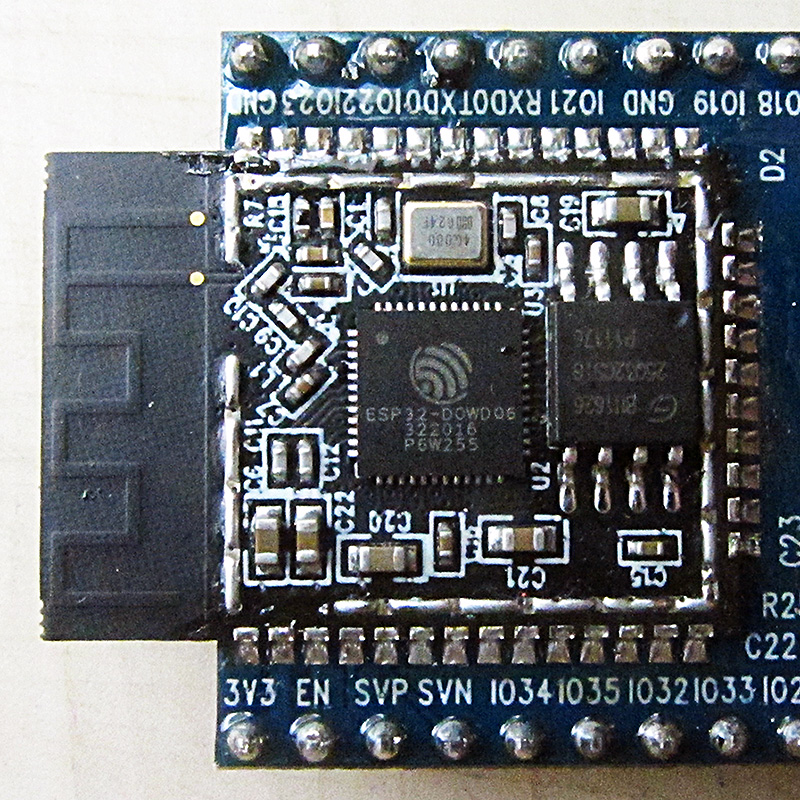
ESP32
Low-cost Wi-Fi and Bluetooth microcontroller family by Espressif
The ESP32 is a series of energy-efficient microcontrollers designed by Espressif Systems. Released in 2016, it integrates Wi-Fi and Bluetooth connectivity with various processor cores. Manufactured by TSMC on a 40 nm process, it serves as a successor to the ESP8266 for Internet of Things applications.
- Integrates Wi-Fi and Bluetooth in a single microcontroller
- Manufactured by TSMC using a 40 nm process node
- Features up to 520 KiB of internal SRAM
- Supports Xtensa and RISC-V processor architectures
- Successor to the widely used ESP8266 chip
What it is
The ESP32 is a family of low-cost system on a chip microcontrollers created by Espressif Systems. These devices combine wireless communication capabilities with general-purpose computing. They support both Wi-Fi and Bluetooth standards, making them suitable for connected devices. The chips integrate essential radio components like antenna switches and power amplifiers directly onto the silicon. This integration reduces the need for external parts in circuit designs. Espressif launched the original model in September 2016 as an upgrade to the earlier ESP8266. The series has since expanded to include variants with different processing cores and feature sets.
How it came about
Espressif Systems designed the ESP32 to succeed the popular ESP8266 microcontroller. The goal was to provide more robust wireless features and processing power for Internet of Things projects. TSMC manufactured the chips using a 40 nanometre process node. Over time, the company introduced revised versions such as the ECO V3 to address bugs and improve performance. New modules like the PICO series combined the silicon with flash memory and oscillators in a single package. This evolution allowed developers to use smaller form factors in their designs without sacrificing functionality.
Inside the chip
The ESP32 architecture offers flexibility through multiple processor options. Some models use dual-core or single-core Tensilica Xtensa LX6 units, while others employ the Xtensa LX7 or RISC-V cores. Each chip includes 520 KiB of static random-access memory for data storage during operation. The system operates at 3.3 volts and can reach clock speeds of 240 MHz. Wireless functions are handled by built-in radio frequency components, including low-noise receivers and filters. The physical chip comes in quad-flat no-leads packages with 49 connection pads. A large thermal pad on the bottom helps dissipate heat during use.
How it was made
TSMC produces the ESP32 silicon wafers using its 40 nm manufacturing process. The bare dies are packaged in quad-flat no-leads formats measuring either 6 mm by 6 mm or 5 mm by 5 mm. These packages feature 48 side pads and one central ground pad. For easier integration, Espressif also offers module versions. The PICO modules, for instance, embed the chip alongside crystal oscillators and flash memory into a 7 mm square package. Surface-mount modules further simplify adoption by including printed circuit board antennas and additional memory options.
Where it went
Developers use ESP32 chips in a wide range of consumer and industrial products. Commercial examples include smart thermostats, biometric attendance systems, and handheld gaming consoles like the Playdate. Industrial automation modules leverage the chip for monitoring and control tasks with digital inputs and outputs. In education, the microcontroller powers drones and robotics kits such as the DJI Robomaster TT. Its support for various programming languages, including Python and C, makes it accessible for hobbyists and professionals alike. Many development boards expose general-purpose input/output pins for easy prototyping.
Versions and family
The ESP32 family has grown to include several distinct series. The original line uses Xtensa cores, while the S series adds USB support and the C series adopts RISC-V architecture. The H series, such as the ESP32-H2 released in 2021, focuses on specific wireless protocols. Modules vary by included memory and antenna design. The PICO series integrates passive components for compact designs, whereas WROOM modules offer standard footprints. Revisions like the ECO V3 improved reliability over initial releases. All variants share a common software development framework, ensuring code compatibility across the family.
Why it matters
The ESP32 became a staple in the Internet of Things ecosystem due to its low cost and dual wireless support. It enabled mass-market smart devices and simplified the creation of connected prototypes. Academic institutions adopted it for teaching embedded systems and wireless networking. The broad community support led to numerous third-party libraries and operating system ports. Its success pressured competitors to offer similar integrated solutions. The chip’s versatility allowed it to appear in products ranging from LED wristbands to energy monitors, demonstrating its wide applicability.
Problems and reception
In March 2025, security researchers identified undocumented debugging commands in the Bluetooth firmware of original ESP32 chips. These vendor-specific instructions allowed memory writes but required physical access or specific serial configurations. Espressif clarified that these were not remote security risks but intended for development troubleshooting. The company promised updates to restrict access and improve documentation. The issue did not affect newer C, S, or H series chips. Despite this, the platform remains widely trusted for its balance of performance and ease of use.


Questions people ask about ESP32
What processors does the ESP32 use?
The ESP32 family supports multiple core types. Original models use Tensilica Xtensa LX6 or LX7 processors, while newer variants like the C series utilize RISC-V cores. These can be configured as single-core or dual-core units depending on the specific chip model.
How much memory does the ESP32 have?
The standard ESP32 microcontroller includes 520 KiB of static random-access memory. Some module variants also integrate external flash memory and pseudostatic RAM to expand storage capabilities for applications and data logging.
Who manufactures the ESP32 chips?
Espressif Systems designs the ESP32 family, but the physical manufacturing is handled by TSMC. They produce the chips using a 40 nanometre process technology, which balances performance with power efficiency for battery-operated devices.
Is the ESP32 compatible with Arduino?
Yes, the ESP32 works with the Arduino environment through the Arduino-ESP32 core. This allows developers to write code using familiar Arduino functions and libraries, making it easier to prototype IoT projects without learning new frameworks.
Good reading and sources
The facts on this page come from the Wikipedia article "ESP32", written by its contributors and used under the CC BY-SA 4.0 licence, and from its Wikidata record (CC0). EveryChip rewrote the text in its own words, with AI assistance, and compares every page with the article to make sure no passage is copied. It may be reused under the same CC BY-SA 4.0 licence with a link back.
It may contain mistakes, and figures change over time. Nothing here is investment or buying advice. If something is wrong, tell us. Last refreshed 2026-11-15.
Like ESP32
All microcontrollers 🇨🇳 ChinaESP32
Low-cost Wi-Fi and Bluetooth microcontroller family from Espressif SystemsMicrocontroller · RISC · 2016
🇨🇳 ChinaESP32
Low-cost Wi-Fi and Bluetooth microcontroller family by EspressifMicrocontroller · RISC · 2016
🇨🇳 ChinaESP32
Low-cost Wi-Fi and Bluetooth microcontroller familyMicrocontroller · RISC · 2016
WorldESP32
Low-cost microcontroller with Wi-Fi and Bluetooth made by Espressif Systems.Microcontroller · Arm · 2016
More from Espressif Systems
All of them 🇬🇧 United KingdomRP2040
Dual-core ARM Cortex-M0+ microcontroller by Raspberry PiMicrocontroller · Arm · 2021
 🇺🇸 United StatesApple A15 Bionic
Six-core ARM system on a chip for Apple mobile devicesSoC · Arm · 2021
 🇺🇸 United StatesApple M1 Pro
Professional ARM system-on-a-chip for Mac laptopsSoC · Arm · 2021
🇺🇸 United StatesApple M1 Max
High-performance ARM system-on-a-chip for professional MacsSoC · Arm · 2021