
ESP32
Low-cost microcontroller with Wi-Fi and Bluetooth by Espressif Systems
The ESP32 is a family of energy-efficient microcontrollers designed by Espressif Systems. Released in September 2016, it succeeded the ESP8266 and is manufactured by TSMC using a 40 nm process.
- Designed by Espressif Systems and made by TSMC at 40 nm
- Supports Wi-Fi, Bluetooth, and multiple CPU architectures
- Successor to the ESP8266 microcontroller released in 2016
- Used in gaming consoles, smart home devices, and industrial tools
- Features 520 KiB SRAM and runs on 3.3 V DC power
What it is
The ESP32 is a series of low-power microcontrollers created by Espressif Systems. It combines processing capabilities with wireless connectivity features. The chips support both Wi-Fi and Bluetooth protocols. This integration allows devices to connect to networks without external components. The family includes various models with different processing cores. They are designed for cost-effective and energy-efficient applications. The original release occurred in September 2016. It replaced the earlier ESP8266 model in the company's lineup.
How it came about
Espressif Systems developed the ESP32 as an evolution of their previous work. The project aimed to provide a more powerful and versatile solution than the ESP8266. Manufacturing is handled by TSMC using a 40 nanometre process node. The design incorporates advanced radio frequency components directly onto the silicon. This approach reduced the need for additional external parts. Subsequent revisions, such as ECO V3, addressed early bugs. New variants like the ESP32-C6 and ESP32-S3 expanded the family options.
Inside the chip
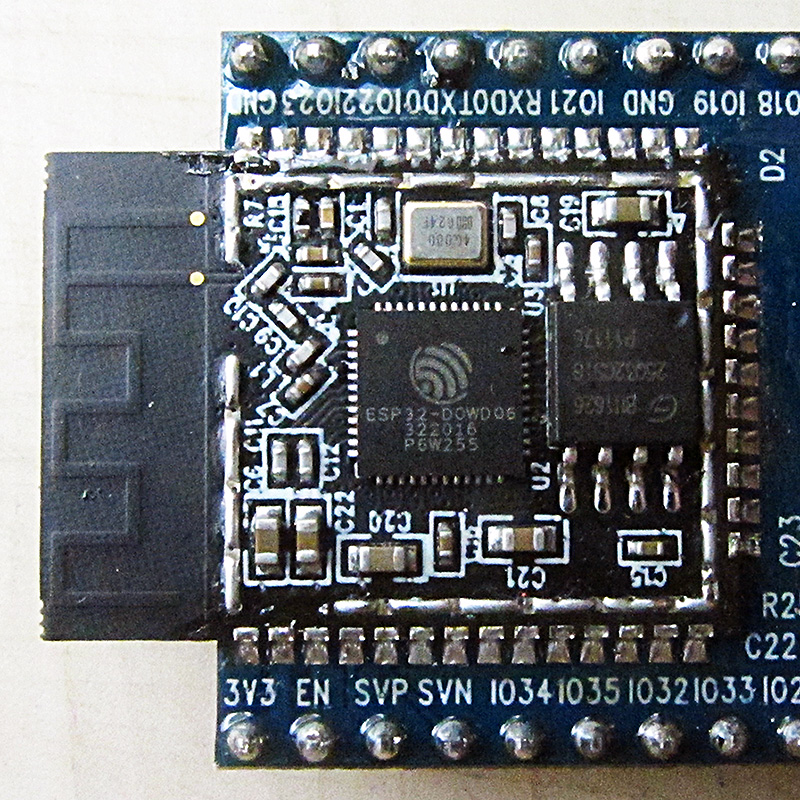
The chip architecture offers flexibility through multiple processor options. Users can choose between Tensilica Xtensa LX6 or LX7 cores. Alternatively, a RISC-V microprocessor is available in newer variants. The system includes built-in antenna switches and power amplifiers. Low-noise receivers and filters manage signal integrity. A balun converts signals for efficient transmission. Memory consists of 520 KiB of static RAM. The package typically uses quad-flat no-leads format. Thermal pads help dissipate heat from the silicon die.
How it was made
TSMC manufactures the silicon using a 40 nm process technology. The chips are packaged in QFN formats of varying sizes. Common dimensions include 6 mm by 6 mm and 5 mm by 5 mm. Modules often combine the SoC with flash memory and crystals. These system-in-package solutions simplify integration for manufacturers. Capacitors and RF matching links are included in module designs. The manufacturing process ensures consistent performance across units. Packaging provides 48 connection pads for circuit board attachment.
Where it went
The ESP32 appears in diverse commercial and industrial products. It powers smart thermostats and energy monitors. Gaming consoles like the Playdate utilize the chip. Educational drones such as the DJI Robomaster TT use it. Industrial automation systems employ it for monitoring tasks. Developers use it for IoT projects and prototypes. The chip supports various programming languages including Python and C. Development boards make it accessible for hobbyists and professionals alike.
Versions and family
The family has grown significantly since the initial launch. Models like ESP32-D0WDQ6 received hardware revisions over time. The PICO modules integrate additional memory and oscillators. Newer members include the ESP32-C3 and ESP32-S3. Each variant targets specific use cases and performance needs. The ESP32-C6 follows the ESP32-C3 in the code-compatible lineup. All models share the same software development kit. This compatibility allows developers to switch between chips easily.
Why it matters
The ESP32 became a staple in the maker and IoT communities. Its low cost and high functionality encouraged widespread adoption. Many open-source projects rely on its capabilities. Academic institutions use it for research and teaching. Commercial products leverage it for connectivity features. The chip demonstrated that complex wireless functions could be cheap. It influenced the design of subsequent microcontroller families. Security researchers later identified undocumented debugging commands in the firmware.
Problems and reception
Users generally praise the chip for its versatility and price. However, security concerns arose regarding hidden firmware commands. Researchers found undocumented HCI commands used for debugging. Espressif clarified these were not remote backdoors. The company promised updates to restrict access in future SDKs. Some early versions had bugs fixed in later revisions. The community values the transparency provided after the discovery. Documentation improvements aim to prevent future confusion.


Questions people ask about ESP32
What processors does the ESP32 use?
The ESP32 family supports Tensilica Xtensa LX6 and LX7 dual-core processors. Newer variants also offer a RISC-V microprocessor option. This allows developers to choose the architecture that best fits their application requirements.
How is the ESP32 manufactured?
The silicon is manufactured by TSMC using a 40 nm process node. The chips are packaged in quad-flat no-leads (QFN) formats. Modules often combine the chip with flash memory and other components.
What happened with the undocumented commands?
Researchers found hidden debugging commands in the Bluetooth firmware. Espressif stated they are not remote security risks. Future SDK updates will restrict access and improve documentation for these vendor-specific features.
Can I program the ESP32 with Python?
Yes, the ESP32 supports MicroPython and CircuitPython. Other options include Arduino, C/C++, Lua, JavaScript, Rust, and Zig. The official ESP-IDF framework is also widely used for development.
Good reading and sources
The facts on this page come from the Wikipedia article "ESP32", written by its contributors and used under the CC BY-SA 4.0 licence, and from its Wikidata record (CC0). EveryChip rewrote the text in its own words, with AI assistance, and compares every page with the article to make sure no passage is copied. It may be reused under the same CC BY-SA 4.0 licence with a link back.
It may contain mistakes, and figures change over time. Nothing here is investment or buying advice. If something is wrong, tell us. Last refreshed 2026-11-15.
Like ESP32
All microcontrollers
WorldESP32
Low-cost microcontroller with Wi-Fi and Bluetooth made by Espressif Systems.Microcontroller · Arm · 2016
 🇨🇳 ChinaESP32
Low-cost Wi-Fi and Bluetooth microcontroller family from Espressif SystemsMicrocontroller · RISC · 2016
🇨🇳 ChinaESP32
Low-cost Wi-Fi and Bluetooth microcontroller familyMicrocontroller · RISC · 2016
🇨🇳 ChinaESP32
Low-cost Wi-Fi and Bluetooth microcontroller family by EspressifMicrocontroller · RISC · 2016
More from Espressif Systems
All of them 🇺🇸 United StatesApple A10 Fusion
Quad-core mobile SoC with heterogeneous computingSoC · Arm · 2016
 WorldGeForce 10 series
Nvidia Pascal graphics cards for desktop and laptop gamingGPU · GPU architecture · 2016
🇺🇸 United StatesGoogle Tensor
Google's own ARM64 system-on-chip family built for Pixel phones and tabletsSoC · Arm · 2016
🇷🇺 RussiaBaikal CPU
Russian microprocessor line using MIPS, ARM and RISC-V coresCPU · MIPS · 2016