🇺🇸 Chips of the United States
733 chips from the United States, best known first.
The United States has launched a major federal programme to rebuild its domestic semiconductor supply chain. New legislation directs tens of billions of dollars toward building fabrication plants, funding research centres, and training engineers. These measures aim to reduce reliance on foreign suppliers while restricting advanced chip production in rival nations.
- Legislation allocates $52.7 billion in direct appropriations for chip manufacturing.
- Subsidy recipients cannot produce transistors smaller than 28 nanometres in China or Russia.
- Tax credits cover 25% of approved fabrication equipment purchases.
- Programmes aim to create between 25,000 and 45,000 new technical jobs.
- Empty factory construction allows firms to secure funding before installing heavy machinery.
Chips in the United States
American semiconductor manufacturing relies on a mix of domestic design houses and international partners. To secure this supply chain, the federal government introduced a sweeping industrial policy focused on local production. The strategy centres on financial incentives for constructing new fabrication facilities, known as foundries, where raw silicon wafers are etched into complex circuit patterns. It also channels money into academic research and technical education. By tying public funds to national security goals, the programme seeks to keep critical hardware development within American borders. This approach reshapes how the nation approaches microelectronics, moving from passive market dependence to active state sponsorship.
History
The legislative framework emerged from two separate proposals merged in early 2022. Lawmakers combined a technology research bill with a manufacturing incentive plan to address growing supply vulnerabilities. Key senators drafted the initial versions after diplomatic efforts encouraged overseas producers to consider American sites. The final package cleared both chambers with cross party backing before receiving presidential approval. Earlier drafts had proposed larger funding pools and broader regional innovation networks, but the enacted version narrowed its scope to focus primarily on microelectronics and allied scientific fields.
Companies
Major manufacturers have adjusted their expansion plans to align with the new funding rules. Some firms are constructing empty factory shells before purchasing heavy machinery, a tactic designed to avoid future market oversupply. International producers previously discussed relocating assembly lines to American soil to access these incentives. Domestic leaders have welcomed the financial support while expressing caution about the restrictions placed on overseas operations. Industry representatives generally back the initiative, though they worry that compliance requirements might slow down rapid facility upgrades.
Fabs and places
New fabrication plants, or foundries, will concentrate on producing logic chips and memory devices. The legislation encourages construction across multiple states, with several existing industrial zones selected for redevelopment. Recipients must commit to maintaining these facilities for a decade and cannot expand advanced node production in certain Asian markets. Advanced nodes refer to transistor sizes smaller than 28 nanometres, which require precise lithography equipment. The rules also mandate that funded sites hire local workers and partner with technical colleges to build a steady talent pipeline.
Policy and support
Federal agencies distribute grants and loan guarantees through a structured application process. Companies receive tax credits covering 25% of their equipment costs, alongside direct cash awards for facility construction. A portion of the budget supports university programmes, public research institutes, and workforce development initiatives. The law also establishes ethics guidelines and security protocols for all funded laboratories. Recipients face strict export controls, including a 10-year prohibition on developing cutting edge processors for restricted countries. Bureaucratic processing times remain lengthy, and some research allocations have faced congressional reductions.
Today
Recent assessments indicate that the programme has triggered dozens of proposed manufacturing and research ventures. Analysts project hundreds of billions in private capital will follow the initial public commitments. Employment forecasts suggest 25,000–45,000 new technical roles will emerge across engineering and plant operations. Implementation continues to navigate administrative bottlenecks and labour market gaps. Despite these friction points, the funding architecture remains active, guiding capital toward domestic semiconductor infrastructure and sustaining long term investment cycles in the national electronics sector.
The facts in this overview come from the Wikipedia article "CHIPS and Science Act", written by its contributors and used under the CC BY-SA 4.0 licence. EveryChip rewrote the text in its own words, with AI assistance, and compares every page with the article to make sure no passage is copied. It may be reused under the same CC BY-SA 4.0 licence with a link back.
 🇺🇸 United StatesIntel 8251
Universal synchronous and asynchronous receiver transmitter chip by IntelNetwork chip · Other · 1975
🇺🇸 United StatesLM3875
56-watt audio amplifier integrated circuitAnalog
 🇺🇸 United StatesLM13700
Dual operational transconductance amplifier for analog audio circuitsAnalog
 🇺🇸 United StatesSilvermont
Intel's 22 nm low-power Atom core design, used across four SoC familiesCPU · x86 · 2013
 🇺🇸 United StatesApple A7
First 64-bit system on a chip for consumer smartphonesSoC · Arm · 2013
 🇺🇸 United StatesApple A14 Bionic
Apple's 5 nm phone and tablet chip with six CPU cores and a 16-core Neural EngineSoC · Arm · 2020
🇺🇸 United StatesApple A19
64-bit ARM-based system on a chip for iPhone and Apple TV devices.SoC · Arm · 2025
 🇺🇸 United StatesApple A4
Apple's first in-house SoC: one Cortex-A8 core plus PowerVR graphics, built at 45 nm.SoC · Arm · 2010
 🇺🇸 United StatesAMD Am29000
32-bit RISC microprocessor family for embedded systems and printersCPU · RISC · 1988
 🇺🇸 United StatesI.MX
ARM-based system-on-chip family for multimedia and embedded systems by NXP Semiconductors.SoC · Arm
 🇺🇸 United States and 1 moreAMD Am2900
AMD's 1975 bipolar bit-slice IC family for building custom control unitsCPU · Other · 1975
 🇺🇸 United StatesNetBurst
Intel's Pentium 4-era x86 CPU design, built for very high clock speedsCPU · x86 · 2000
 🇺🇸 United StatesPIC microcontroller
Microchip's long-running family of 8-bit to 32-bit microcontrollersMicrocontroller · MIPS · 1976
 🇺🇸 United StatesMSP430
A 16-bit mixed-signal microcontroller family designed for very low power use.Microcontroller · Other · 1992
 🇺🇸 United StatesQualcomm Snapdragon
Qualcomm's brand of ARM-based systems on chip, modems and wireless controllersSoC · Arm · 2007
 🇺🇸 United StatesHewlett-Packard Nanoprocessor
An 8-bit control microcontroller with no arithmetic unit, released by HP in 1974Microcontroller · Other · 1974
 🇺🇸 United StatesApple M2
Apple's second-generation ARM SoC family for Macs, iPads and Vision ProSoC · Arm · 2022
🇺🇸 United StatesWDC 65C816
16-bit microprocessor from the 6502 family with 24-bit addressingCPU · Other · 1985
 🇺🇸 United StatesGeneral Instrument CP1600
A 16-bit microprocessor from 1975, best known inside the Intellivision consoleCPU · Other · 1975
 🇺🇸 United StatesPowerPC 970
IBM's 64-bit PowerPC desktop CPU family, sold by Apple as the G5.CPU · Power · 2002
 🇺🇸 United States and 1 moreNS32000
National Semiconductor's 32-bit CISC microprocessor family from the 1980sCPU · Other · 1982
🇺🇸 United StatesAT&T Hobbit
A C-optimised microprocessor from AT&T with a stack cache instead of registersCPU · Other · 1992
 🇺🇸 United States and 1 moreMCP-1600
A 1975 multi-chip 16-bit microprocessor from Western DigitalCPU · Other · 1975
 🇺🇸 United StatesElectronic Arrays 9002
An 8-bit CPU with on-chip RAM, sold briefly in the mid-1970s.CPU · Other · 1976
 🇺🇸 United StatesHaswell
Intel's 2013 x86-64 CPU microarchitecture on 22 nm FinFETCPU · x86 · 2013
 🇺🇸 United StatesAMD Am9080
AMD's reverse-engineered clone of the Intel 8080, made from 1975CPU · 8-bit · 1975
 🇺🇸 United StatesNational Semiconductor PACE
First commercial single-chip 16-bit microprocessor, from National Semiconductor in 1974CPU · Other · 1974
🇺🇸 United StatesPenryn
Intel's 45 nm shrink of the Core microarchitecture, from 2007CPU · x86 · 2007
 🇺🇸 United StatesCannon Lake
Intel's 10 nm Core microarchitecture, shipped in one laptop CPU onlyCPU · x86 · 2018
 🇺🇸 United States and 1 moreSignetics 8X300
A 1976 bipolar microcontroller and signal processor from SigneticsCPU · Other · 1976
 🇺🇸 United StatesPentium III
Intel's 32-bit P6 desktop and server CPU line, launched in 1999 with SSE.CPU · x86 · 1999
 🇺🇸 United StatesZilog Z8000
16-bit microprocessor family from Zilog, launched in 1979CPU · Other · 1979
 🇺🇸 United StatesPentium
Intel's long-running x86 processor brand, from the 1993 P5 to 2023 budget partsCPU · x86 · 1993
 🇺🇸 United States and 1 moreIntel Core 2
Intel's 2006 x86-64 desktop and laptop CPU family, from single-core to quad-core.CPU · x86 · 2006
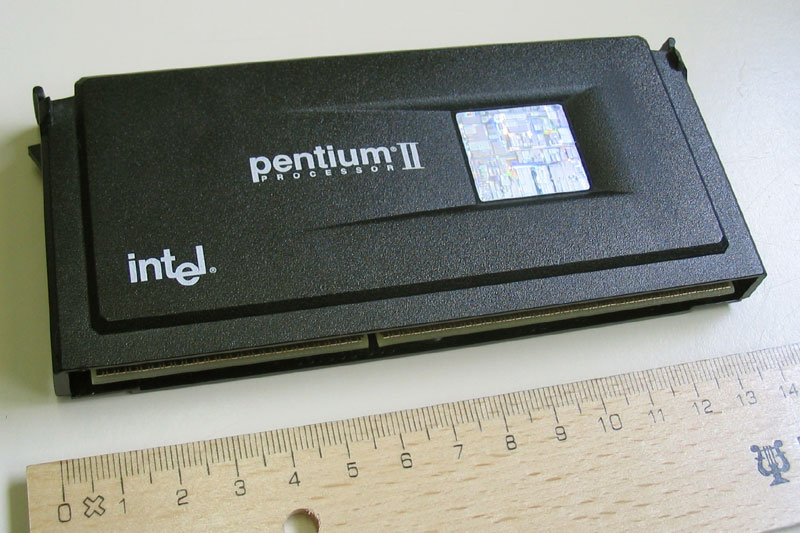 🇺🇸 United StatesPentium II
Intel's 1997 P6 desktop CPU line with MMX, sold in a slot cartridgeCPU · x86 · 1997
 🇺🇸 United StatesPentium 4
Intel's single-core desktop CPU line built on the NetBurst microarchitectureCPU · x86 · 2000
 🇺🇸 United StatesIntel 80386
Intel's 32-bit x86 CPU from 1985, the base of the IA-32 instruction setCPU · x86 · 1985
 🇺🇸 United StatesCeleron
Intel's budget x86 desktop and mobile CPU line, sold from 1998 to 2023CPU · x86 · 1998
 🇺🇸 United StatesIntel 8008
Early 8-bit microprocessor from Intel, launched April 1972CPU · 8-bit · 1972
 🇺🇸 United StatesMotorola 68000
A 16/32-bit CISC microprocessor introduced by Motorola in 1979CPU · 68k · 1979
 🇺🇸 United StatesIntel iAPX 432
Intel's first 32-bit processor, a two-chip stack machine built for AdaCPU · Other · 1981
 🇺🇸 United StatesXeon Phi
Intel's x86 manycore coprocessor family for supercomputers and HPCCPU · x86 · 2010
🇺🇸 United StatesNE612
Radio frequency mixer and oscillator integrated circuitAnalog
 🇺🇸 United StatesWestmere
Intel's 32 nm shrink of Nehalem, with six and ten core parts and AES instructionsCPU · x86 · 2010
 🇺🇸 United StatesSignetics 2650
8-bit microprocessor from 1975 modelled on the IBM 1130 minicomputerCPU · 8-bit · 1975
 🇺🇸 United StatesPentium
Intel's first superscalar x86 chip, with dual integer pipelines and a faster FPUCPU · x86 · 1993
 🇺🇸 United StatesIntel Core
Intel's multi-core x86 CPU line for laptops, desktops and workstationsCPU · x86 · 2006
🇺🇸 United StatesWhiskey Lake
Intel's third-generation 14 nm Skylake low-power mobile processors, announced 2018.CPU · x86 · 2018
Photo credits on this page
The small pictures above come from Wikimedia Commons under free licences. Some are cropped to fit.
- WD16: RastaKins, CC BY-SA 4.0, source
- NetBurst: mitopencourseware, CC BY-SA 4.0, source
- Intel 8251: Myself User:ZyMOS, CC BY-SA 4.0, source
- LM13700: Retired electrician, CC0, source
- Silvermont: Raimond Spekking, CC BY-SA 4.0, source
- Apple A7: Henriok, Public domain, source
- Apple A14 Bionic: Henriok, CC0, source
- Apple A4: Raimond Spekking, CC BY-SA 4.0, source
- AMD Am29000: Unknown author, CC BY-SA 3.0, source
- I.MX: Raimond Spekking, CC BY-SA 4.0, source
- AMD Am2900: Konstantin Lanzet (with permission), CC BY-SA 3.0, source
- PIC microcontroller: Raimond Spekking, CC BY-SA 4.0, source
- MSP430: Travis Goodspeed, CC BY 2.0, source
- Qualcomm Snapdragon: Raimond Spekking, CC BY-SA 4.0, source
- Hewlett-Packard Nanoprocessor: Pauli Rautakorpi, CC BY 3.0, source
- Apple M2: Henriok, CC0, source
- General Instrument CP1600: Evan-Amos, CC BY-SA 3.0, source
- PowerPC 970: Henriok, CC0, source
- NS32000: Konstantin Lanzet, CC BY-SA 3.0, source
- Electronic Arrays 9002: Electronics Arrays, Inc., Public domain, source
- Haswell: Intel Free Press, CC BY 2.0, source
- AMD Am9080: Mister rf, CC BY-SA 4.0, source
- National Semiconductor PACE: Pauli Rautakorpi, CC BY 3.0, source
- Cannon Lake: Fritzchens Fritz, CC0, source
- Signetics 8X300: Konstantin Lanzet, GFDL, source
- Pentium III: Konstantin Lanzet, CC BY-SA 3.0, source
- Zilog Z8000: Myself User:ZyMOS, CC BY-SA 4.0, source
- Pentium: Konstantin Lanzet, GFDL, source
- Intel Core 2: Raimond Spekking, CC BY-SA 4.0, source
- Pentium II: Unknown author, Public domain, source
- Pentium 4: László Szalai (Beyond silence), Public domain, source
- Intel 80386: Mister rf, CC BY-SA 4.0, source
- Celeron: Qurren, CC BY-SA 3.0, source
- Intel 8008: Konstantin Lanzet, CC BY-SA 4.0, source
- Motorola 68000: en:User:ArnoldReinhold, CC BY-SA 3.0, source
- Intel iAPX 432: _brouhaha_, CC BY-SA 2.0, source
- Xeon Phi: Capitalistcakes, CC0, source
- Westmere: smial ( talk ), FAL, source
- Signetics 2650: Konstantin Lanzet, GFDL, source
- Pentium: Pdesousa359, CC BY-SA 3.0, source
- Intel Core: Intel Corporation, Public domain, source