
PowerPC 970
IBM's 64-bit PowerPC desktop CPU family, sold by Apple as the G5.
The PowerPC 970 is a family of 64-bit PowerPC processors from IBM, first announced in 2002 and built on a core derived from the POWER4. Apple sold it as the PowerPC G5 in its Power Mac, iMac and Xserve lines, while IBM used it in blade modules and workstations.
- Announced by IBM in October 2002
- Apple sold it as the PowerPC G5
- Core derived from the POWER4 server processor
- 970MP paired two cores, each with 1 MB L2 cache
- Built at IBM's East Fishkill plant in New York
What it is
The PowerPC 970 line covers three related processors from IBM: the original 970, the 970FX and the dual-core 970MP. All handle both 32-bit and 64-bit PowerPC code natively. Apple marketed them as the fifth generation of PowerPC, the G5, inside its Power Mac, iMac and Xserve machines. IBM also shipped them in blade modules and low-end workstations. The design grew out of the POWER4 server core, adapted for desktop and embedded use. Clock speeds across the family ran from 1.0 GHz up to 2.7 GHz, with one or two cores depending on the model.
How it came about
IBM and Apple worked together on the family after having created the PowerPC architecture in the early 1990s through the AIM alliance. The project carried the codename GP-UL, short for Giga Processor Ultra Light, with Giga Processor being the codename for the POWER4 that supplied the core. Apple described the Power Mac G5 launch as the result of a five-year joint effort with a multi-generation roadmap. That promise did not hold: Apple withdrew a pledge to reach 3 GHz within a year, and IBM could not bring power draw down far enough for laptops. Apple ended up using just three versions of the chip.
Inside the chip
The 970 is a single-core offshoot of the POWER4. Its front end runs nine stages and can pull in and decode as many as eight instructions per cycle, dispatch five to reservation stations, issue eight to execution units and retire five. Eight execution units handle the work: integer arithmetic, double-precision floating point, memory access and AltiVec SIMD operations. One AltiVec unit handles integer and floating-point SIMD, the other only permutes. Pipeline depth varies by task, from 10 stages for simple integer and permute work up to 16 for floating point. A hardware prefetcher and three-way branch prediction help keep the pipeline fed. Two unidirectional 32-bit DDR buses link the chip to the northbridge at a quarter of core speed, giving 6.4 GB/s peak at 450 MHz, or 3.2 GB/s per direction.
How it was made
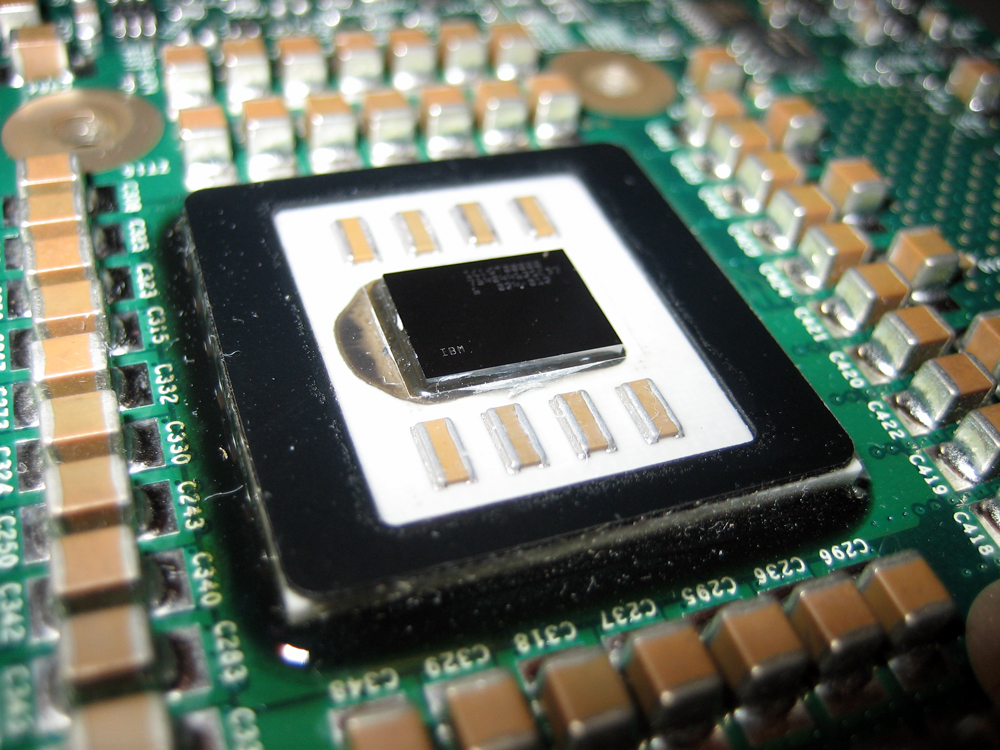
Every generation of the 970 was produced at IBM's East Fishkill plant in New York, mounted on the white ceramic substrate IBM used for its high-end processors of that era. The first chips used a 130 nm process; the 970FX and 970MP moved to 90 nm. The 970FX drew as little as 11 W at 1 GHz and up to 48 W at 2 GHz, while the dual-core 970MP reached 75 W at 1.8 GHz and 100 W at 2.0 GHz. IBM stopped offering parts above 2.0 GHz because of that power demand.
Where it went
Apple put the 970 into the Power Mac G5 from June 2003, then followed with the Xserve G5, an updated Power Mac and the iMac G5 during 2004. IBM built the BladeCenter JS20 and JS21 blade modules around the chip, along with the Intellistation POWER 185 workstation and some System p servers. Fixstars Solutions used the 970MP in its YDL PowerStation. High-end embedded designs also took the part, such as Mercury's Momentum XSA-200. Supercomputers including System X, plus earlier machines in the Spanish Supercomputing Network such as Magerit version 1 and MareNostrum version 2, ran on PowerPC processors of this kind. IBM licensed the core for custom uses as well.
Versions and family
The original 970 arrived in October 2002 with 512 KB of full-speed L2 cache and clocks from 1.6 to 2.0 GHz. The 970FX, built at 90 nm, added a lower power profile and reached 2.5 GHz in liquid-cooled Power Macs, later 2.7 GHz. The 970MP, codenamed Antares and announced in July 2005, paired two cores on one die, each with 1 MB of L2 cache, and added partitioning and virtualisation support plus a doze state for idle cores. Apple kept the 970FX in the iMac G5 and older PCI-X Power Macs while the 970MP took over the high-end Power Mac.
Why it matters
The family gave Apple a 64-bit desktop platform and marked the fifth generation of PowerPC in its product naming. IBM gained a desktop and blade part drawn from its server silicon, and licensed the core outward. The chips powered supercomputers and workstations as well as consumer desktops. Apple's roadmap for the line did not last, and the G5 era ended after three processor variants.
Problems and reception
Apple had to withdraw its promise of a 3 GHz part within a year of the Power Mac G5 launch. IBM could not cut power use enough for notebook use, so no G5 PowerBook appeared. The 970FX lowered thermal design power to roughly 30 W at 1.5 GHz and raised hopes among users, but several obstacles blocked a laptop version: the chip offered little advantage over the G4 at that clock, the companion northbridge chips drew too much power for portables, and idle power stayed too high for decent battery life.


Questions people ask about PowerPC 970
What is the PowerPC 970?
It is a family of 64-bit PowerPC processors from IBM, introduced in 2002. The design came from the POWER4 server core and ran both 32-bit and 64-bit code. Apple sold the chips as the PowerPC G5 in its desktop and server machines.
Who made the chips and where?
IBM designed and manufactured them at its East Fishkill plant in New York. Apple worked with IBM on the project, which carried the codename GP-UL. The parts sat on a white ceramic substrate, the style IBM used for high-end processors at the time.
Why was there no G5 laptop?
Power draw was the main barrier. The original 970 used far too much energy for a portable. The 970FX cut thermal design power to about 30 W at 1.5 GHz, but it offered little speed gain over the G4, its companion chips drew too much, and idle power stayed too high for good battery life.
What is the difference between the 970, 970FX and 970MP?
The 970 was the first single-core part, with 512 KB of L2 cache and clocks from 1.6 to 2.0 GHz. The 970FX moved to 90 nm and reached higher clocks at lower power. The 970MP, codenamed Antares, put two cores on one die with 1 MB of L2 cache each and added virtualisation support.
Good reading and sources
The facts on this page come from the Wikipedia article "PowerPC 970", written by its contributors and used under the CC BY-SA 4.0 licence, and from its Wikidata record (CC0). EveryChip rewrote the text in its own words, with AI assistance, and compares every page with the article to make sure no passage is copied. It may be reused under the same CC BY-SA 4.0 licence with a link back.
It may contain mistakes, and figures change over time. Nothing here is investment or buying advice. If something is wrong, tell us. Last refreshed 2026-11-14.
Like PowerPC 970
All CPUs and microprocessors 🇺🇸 United StatesPowerPC 600
Early PowerPC processor family for PCs, workstations and embedded gearCPU · Power · 1993
 🇺🇸 United StatesPowerPC G4
32-bit PowerPC microprocessor family with AltiVec vector processingCPU · Power · 1999
 🇺🇸 United StatesXeon
Intel's x86 processor brand for servers, workstations and embedded systems since 1998CPU · x86 · 1998
 🇺🇸 United StatesIntel Core
Intel's multi-core x86 CPU line for laptops, desktops and workstationsCPU · x86 · 2006
More from IBM
All of them 🇺🇸 United StatesRAD750
Radiation-hardened PowerPC processor for spacecraft and satellitesCPU · Power · 2001
 🇺🇸 United States and 1 moreMicrosoft XCPU (Xenon)
Three-core PowerPC CPU at the heart of the Xbox 360 consoleCPU · Power · 2003
 🇺🇸 United StatesPOWER4
First dual-core non-embedded microprocessor from IBMCPU · Power · 2001