
Apple A4
Apple's first in-house SoC: one Cortex-A8 core plus PowerVR graphics, built at 45 nm.
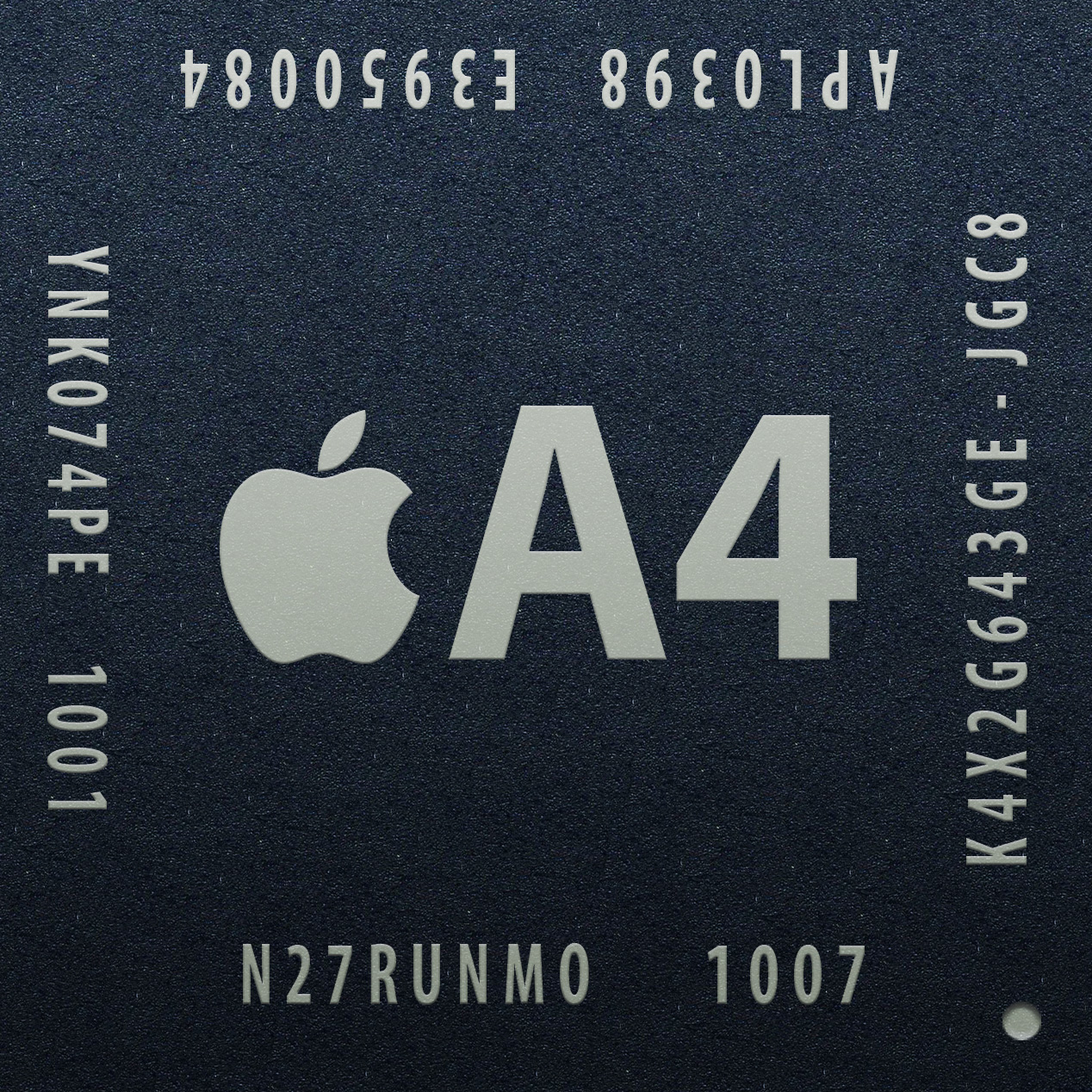
The Apple A4 is a 32-bit system on a chip that Apple designed in-house and Samsung manufactured on a 45 nm process. It first shipped in the first-generation iPad in April 2010 and later powered the iPhone 4, iPod Touch and Apple TV. It matters because it marked the start of Apple's own chip design work.
- First SoC designed in-house by Apple
- Single ARM Cortex-A8 core, up to 1 GHz
- Built by Samsung on a 45 nm process
- Die area of 53.3 mm2
- RAM stacked on top in a package on package
What it is
The Apple A4 is a 32-bit system on a chip, or SoC: a single piece of silicon that carries the main processor, graphics and memory interface together. Apple designed it and Samsung built it on a 45 nm process. It was the first SoC Apple designed itself, since the chips in the earliest iPhones came from Samsung. The A4 appeared first in the first-generation iPad in April 2010, then in the iPhone 4, the fourth-generation iPod Touch and the second-generation Apple TV. Production ran until September 2013.
How it came about
Apple's engineers set out to make a chip that was both very fast and very light on power. They worked with Samsung and with Intrinsity, a chip design firm whose performance work Apple later bought outright. The result was a Cortex-A8 core called Hummingbird, which reached higher clock speeds than earlier Cortex-A8 parts while staying fully compatible with ARM's design. The same core also appeared in Samsung's own S5PC110A01 chip.
Inside the chip
The A4 has one ARM Cortex-A8 CPU core and one PowerVR SGX535 graphics core. The Cortex-A8 is a 32-bit design from ARM. Cache memory sits close to the core: 32 KB for instructions and 32 KB for data, with a larger 512 KB second-level cache behind them. The chip runs at 1 GHz in the first iPad, but the iPhone 4 and iPod Touch versions run at 800 MHz, a deliberate slowdown from 1 GHz. The silicon die measures 53.3 mm2.
How it was made
Samsung fabricated the A4 on its 45 nm process. The die occupies 53.3 mm2. Memory is stacked on top using package on package, or PoP, where RAM sits in a separate layer above the processor package. The iPad, iPod Touch and Apple TV versions carry two 128 MB LPDDR chips for 256 MB total, while the iPhone 4 version carries two 256 MB chips for 512 MB. RAM links to the chip over ARM's 64-bit AMBA 3 AXI bus.
Where it went
Four Apple products used the A4. It debuted in the first-generation iPad, then appeared in the iPhone 4, the fourth-generation iPod Touch and the second-generation Apple TV. Software support ended at different times: the iPad stopped at iOS 5.1.1 in May 2012, the iPod Touch at iOS 6.1.6 in February 2014, and the iPhone 4 at iOS 7.1.2 in June 2014. The second-generation Apple TV last received Apple TV Software 6.2.1 in September 2014.
Versions and family
The A4 replaced the Samsung S5L8920 used in earlier iPhones. Clock speed and RAM varied by product: 1 GHz with 256 MB in the iPad, 800 MHz with 512 MB in the iPhone 4, and 800 MHz with 256 MB in the iPod Touch. Apple's next phone chip was the A5, and the iPad line moved to the A5X. The A4 belongs to the Apple A series of mobile chips.
Why it matters
The A4 was Apple's first self-designed SoC, and it opened the company's own chip design programme that later produced the whole Apple silicon range. Apple bought Intrinsity, the firm behind the Hummingbird performance work, and also acquired P.A. Semi to build its in-house chip team. The chip showed that a consumer device processor could be tuned for both speed and battery life in a stacked package.
Problems and reception
The A4 drew attention as Apple's first own-brand processor, with coverage focusing on what the move meant for the iPad and for Apple's independence from Samsung designs. No bugs, recalls or controversies are recorded here.

Questions people ask about Apple A4
What is the Apple A4?
It is a 32-bit system on a chip that puts a processor, graphics and a memory link on one piece of silicon. Apple designed it and Samsung built it. It first appeared in the first-generation iPad in April 2010 and later went into the iPhone 4, iPod Touch and Apple TV.
Who actually made the chip?
Apple designed the A4, while Samsung manufactured it on a 45 nm process. Performance work on the CPU core came from Intrinsity, a chip design firm working with Samsung that Apple later acquired.
How fast is it?
The Cortex-A8 core runs at 1 GHz in the first-generation iPad. In the iPhone 4 and fourth-generation iPod Touch it runs at 800 MHz, slowed down from 1 GHz. The clock rate used in the second-generation Apple TV is not stated.
How much memory does it have?
RAM sits on top of the processor in a stacked package. The iPad, iPod Touch and Apple TV versions carry 256 MB of LPDDR, while the iPhone 4 version carries 512 MB. On-chip cache is 32 KB for instructions, 32 KB for data and 512 KB at the second level.
What came after it?
The A4 was replaced by the Apple A5 in the iPhone line and the Apple A5X in the iPad line. It had itself replaced the Samsung S5L8920 used in earlier iPhones.
Good reading and sources
The facts on this page come from the Wikipedia article "Apple A4", written by its contributors and used under the CC BY-SA 4.0 licence, and from its Wikidata record (CC0). EveryChip rewrote the text in its own words, with AI assistance, and compares every page with the article to make sure no passage is copied. It may be reused under the same CC BY-SA 4.0 licence with a link back.
It may contain mistakes, and figures change over time. Nothing here is investment or buying advice. If something is wrong, tell us. Last refreshed 2026-11-14.
Like Apple A4
All systems on a chip 🇺🇸 United StatesApple silicon
Arm-based chips designed by Apple for its devicesSoC · Arm · 2010
 🇺🇸 United StatesApple A series
ARM-based system on a chip family for iPhone and iPadSoC · Arm · 2010
 🇺🇸 United StatesApple A5
32-bit dual-core system on a chip for early Apple mobile devicesSoC · Arm · 2011
 🇬🇧 United KingdomARM Cortex-A9
32-bit multi-core processor core for mobile and embedded systemsCPU · Arm · 2007
More from Apple Inc.
All of them 🇰🇷 South KoreaExynos
Samsung's Arm-based system-on-chip series for phones, wearables, cars and IoTSoC · Arm · 2009
 🇺🇸 United StatesApple A6
32-bit mobile system on a chip for iPhone 5SoC · Arm · 2012