
Pentium
Intel's first superscalar x86 chip, with dual integer pipelines and a faster FPU
The Pentium is a 32-bit x86 microprocessor that Intel introduced in 1993 as the fifth generation of its processor family, and the first chip to carry the Pentium name. Built on the P5 microarchitecture, it ran at 60 to 300 MHz and stayed in production until July 1999, giving way to the Celeron in low-end lines.
- First superscalar x86 processor, often completing two instructions per clock
- Dual integer pipelines, U and V, each with its own ALU and address hardware
- Separate 8 KiB code and data caches on chip, using the MESI protocol
- First x86 CPU with hardware multiprocessing support, defined with IBM
- Made from 800 nm down to 250 nm, 3.1M to 4.5M transistors, 60 to 300 MHz
What it is
The Pentium is a 32-bit microprocessor that Intel launched in 1993 as the fifth generation of the x86 family, and the first chip to use the Pentium brand. It replaced the i486 as Intel's flagship desktop processor and was also called the i586. Inside, its design is known as P5. It kept binary compatibility with older 32-bit x86 chips such as the i386 and i486, so existing software ran unchanged. What set it apart was its superscalar design: two integer pipelines let it finish two instructions per clock cycle in many cases. A redesigned floating-point unit ran far faster than the i486's. Clock speeds ranged from 60 to 300 MHz, and production ran from March 1993 to July 1999.
How it came about
The Santa Clara team that had built the 386 and 486 started P5 work in June 1989. Vinod Dham pushed the idea of folding RISC techniques into the x86 line, aiming for roughly three to five times the floating-point speed of the i486. The first simulation ran in 1990, and the layout followed. Space on the die was tight, so the circuitry was slimmed twice, in late 1990 and again in spring 1991. Tape-out came in February 1992 and finished that April, after which beta testing began. A planned PC Expo demo in June 1992 was cancelled because of design problems, and the launch slipped to spring 1993. John H. Crawford co-managed the design with Donald Alpert, Dror Avnon led the FPU, and Dham ran the group.
Inside the chip
P5 was the first superscalar x86 processor. Two pipelines, called U and V, share the work: U takes any instruction, V takes common simple ones, and each has its own ALU and address hardware. A 64-bit external bus doubles the data moved per memory access, while the inside works at 32 bits. Separate 8 KiB caches hold code and data, each two-way associative and using the MESI consistency protocol. The floating-point unit has an eight-stage pipeline and handles at least one operation per clock, with FMUL up to 15 times faster than on the 486. A four-input address adder, hardware multiplier, branch prediction and microcode tuned for both pipes all cut cycle counts. New instructions include CPUID, CMPXCHG8B and RDTSC.
How it was made
The first P5 chips used an 800 nm process and held 3.1 million transistors. Later cores shrank the process to 600 nm and then 350 nm, with counts rising to 3.2 million and 3.3 million; the P55C reached 4.5 million at 350 nm, and the range extended down to 250 nm. Intel made the parts itself, sending mask layouts to its Fab 5 in Oregon. Chips fitted Socket 4, then Socket 5 and Socket 7. Each device is a single-core part.
Where it went
The first Pentium systems reached shops in summer 1993. Advanced Logic Research shipped its Evolution V workstation in the first week of July that year. From there the chip spread through desktop PCs and workstations across the 1990s. Intel also pushed compilers, tools and operating systems to make better use of the dual pipelines, though gains varied by application. The design later resurfaced in other Intel work: the Larrabee multicore project used a P54C-derived core with multithreading and vector hardware, and the low-power Bonnell core in early Atom chips reused a similar in-order dual pipeline.
Versions and family
The line began with the P5 core (80501), then moved through P54C, P54CQS, P54CS and P54LM, and the P55C and P55LM cores, plus Tillamook and the P24T. In January 1997 Intel released Pentium MMX, officially Pentium with MMX Technology, adding the MMX integer SIMD extension and larger caches. MMX shares registers with the x87 FPU, so the two cannot run at once. The i486 came before the family. Pentium Pro took the workstation and server role in November 1995, Pentium II became the high-performance brand, and Celeron covered the low end when P5 output stopped in July 1999.
Why it matters
The Pentium showed that a complex x86 instruction set could be pipelined twice over, something RISC advocates had doubted. It was the first x86 CPU with hardware multiprocessing support, defined with IBM. Its brand became so well known that Intel kept the Pentium name across many later generations. The 66 MHz part reached 112 V1.1 Dhrystone MIPS, with SPECint92 of 64.5 and SPECfp92 of 56.9. Rivals at the time included PowerPC 601, SuperSPARC, DEC Alpha 21064, AMD 29050 and Motorola's 88110 and 68060.
Problems and reception
The name came from the Greek pente, for five, with a Latin ending, because a court had ruled in 1991 that "386" was generic and could not be trademarked. Intel hired Lexicon Branding to find a non-numeric replacement. Early parts carried errata, and design problems forced the 1992 show demo to be dropped and the launch to be pushed back. Once shipping, the chip was widely adopted, and the 60 and 66 MHz versions sat about 10% apart in performance.


Questions people ask about Pentium
What made the Pentium different from the i486?
It was the first x86 chip that could often run two instructions at once, using two integer pipelines. It also had a much faster floating-point unit, split code and data caches, a 64-bit external bus and hardware multiprocessing support, while still running old 32-bit x86 software.
Why is it called Pentium rather than 80586?
A court ruled in 1991 that "386" was a generic number Intel could not trademark, so the company hired Lexicon Branding for a new name. Pentium comes from the Greek pente, meaning five, with a Latin ending, marking it as the fifth x86 generation.
What did Pentium MMX add?
Released in January 1997 as Pentium with MMX Technology, it brought the MMX integer SIMD extension aimed at multimedia, plus larger caches and some microarchitectural changes. MMX reuses the x87 FPU registers, so MMX and floating-point code cannot run at the same time.
How long was the Pentium made?
Production began on 22 March 1993 and ended on 15 July 1999. Clock speeds climbed from 60 MHz to 300 MHz over that period, across cores built on processes from 800 nm down to 250 nm.
What replaced it?
Pentium Pro took over workstations and servers from November 1995, and Pentium II became the mainstream high-performance brand. In the low-end line, P5 Pentium production continued until July 1999, when it was dropped in favour of the Celeron.
Good reading and sources
- Intel® Microprocessor Quick Reference GuideIntel, Article
- Checking your browserAnandTech, Article
- The History Of Intel CPUs: Updated!Tom's Hardware, Article
- Pentium (original) on WikipediaEncyclopedia
- More photos on Wikimedia CommonsPhotos
- Wikidata recordOpen data
The facts on this page come from the Wikipedia article "Pentium (original)", written by its contributors and used under the CC BY-SA 4.0 licence, and from its Wikidata record (CC0). EveryChip rewrote the text in its own words, with AI assistance, and compares every page with the article to make sure no passage is copied. It may be reused under the same CC BY-SA 4.0 licence with a link back.
It may contain mistakes, and figures change over time. Nothing here is investment or buying advice. If something is wrong, tell us. Last refreshed 2026-11-14.
Like Pentium
All CPUs and microprocessors 🇺🇸 United StatesP6
Intel's sixth x86 design, first with out-of-order executionCPU · x86 · 1995
 🇺🇸 United StatesIntel 80486SX
A 1991 Intel 486 CPU sold without a working floating-point unitCPU · x86 · 1991
 🇺🇸 United StatesIntel 80486
32-bit x86 CPU with pipelined execution and on-chip cache, launched 1989CPU · x86 · 1989
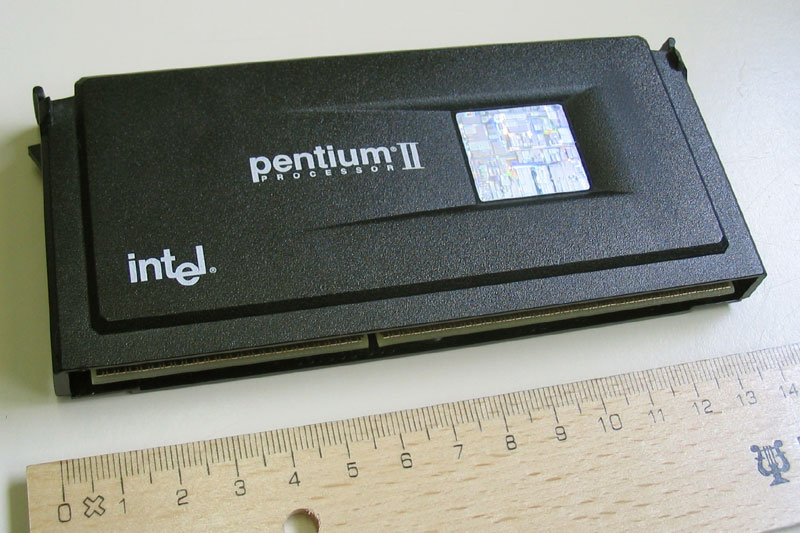 🇺🇸 United StatesPentium II
Intel's 1997 P6 desktop CPU line with MMX, sold in a slot cartridgeCPU · x86 · 1997
More from Intel
All of them 🇺🇸 United StatesPentium
Intel's long-running x86 processor brand, from the 1993 P5 to 2023 budget partsCPU · x86 · 1993
 🇺🇸 United StatesPentium
Intel's first superscalar x86 microprocessor, introducing dual pipelines and the Pentium brand in 1993.CPU · x86 · 1993
 🇺🇸 United StatesIntelDX4
Clock-tripled i486 CPU with 16 KB cache, at 75 or 100 MHzCPU · x86 · 1994
 🇺🇸 United StatesIntel 486DX2
A 486 CPU whose internal clock ran at twice the bus speedCPU · x86 · 1992