Analog, power and mixed-signal
The 555 timer, the 741 op-amp, voltage regulators, data converters and power chips. 121 chips on EveryChip so far.
Analog chips handle signals that vary smoothly, such as sound, temperature, voltage and radio, rather than ones and zeros. Amplifiers, voltage regulators, timers, data converters and power-management chips are all analog or mixed-signal parts. Some designs are decades old and still sold in billions, such as the 555 timer of 1972 and the 741 operational amplifier of 1968. Texas Instruments and Analog Devices are the largest makers.
Classic parts
An operational amplifier (op-amp) boosts the difference between two voltages and, with a few resistors, can amplify, filter or add signals. Fairchild's μA741 became the standard op-amp. The 555, designed by Hans Camenzind for Signetics, makes pulses and delays with a few outside parts. Linear regulators such as the 78xx series and the LM317 turn a rough supply into a steady voltage.
Power and data converters
Today the largest analog markets are power management, which converts and distributes battery or mains power inside every device, and data converters, which turn sensor voltages into numbers and back. Analog chips are often made on older, larger nodes, where transistors handle higher voltages and less noise, and in-house fabs such as TI's 300 mm analog fabs keep costs down.
Famous analog chips


Further reading
 🇺🇸 United StatesPeripheral Interface Adapter
Parallel I/O chip for early microprocessor systemsAnalog · Other · 1976
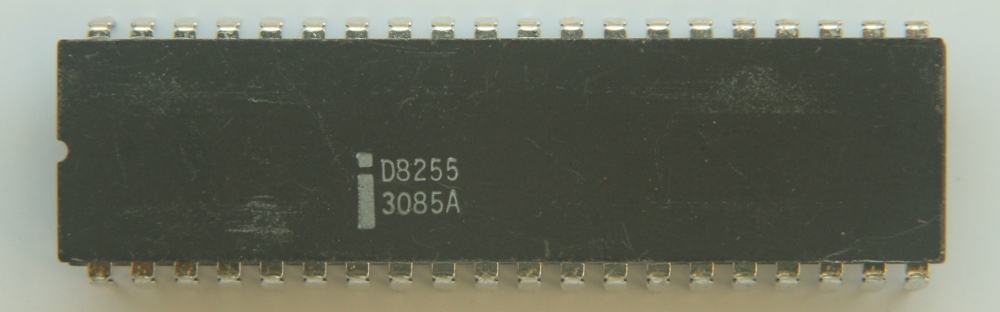 🇺🇸 United StatesIntel 8255
Programmable parallel input/output interface chip for early microprocessorsAnalog · 1970
 WorldMotorola 68851
External memory management unit for Motorola 68020 processorsAnalog · 68k
WorldCMD640
IDE interface controller for PCI and VLB buses with known data corruption bugsAnalog
🇺🇸 United StatesIntel 8284
Clock generator chip for early Intel processorsAnalog · 1986
🇺🇸 United StatesSN76489
Programmable sound generator chip for 1980s computers and consolesAnalog · 1979
 🇯🇵 JapanYamaha OPN
Family of FM synthesis sound chips for computers and gamesAnalog · 1984
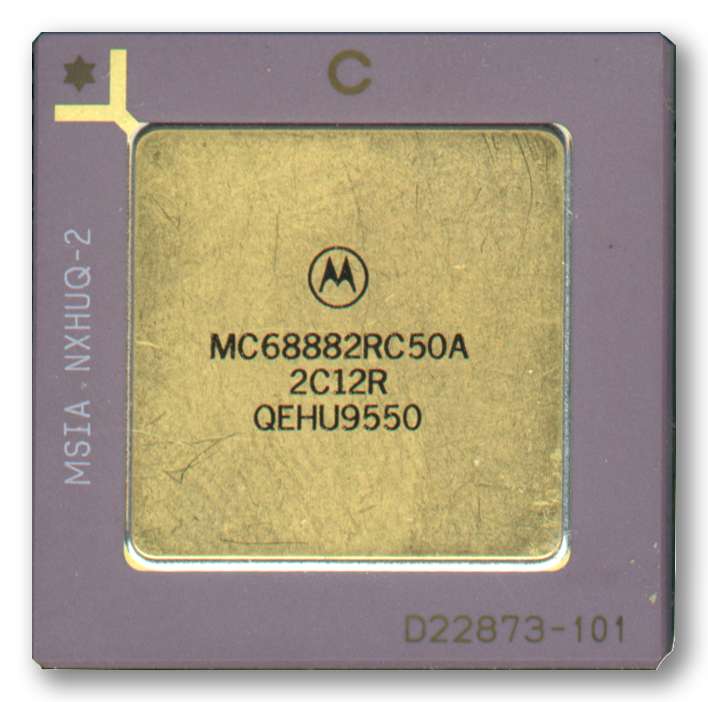 🇺🇸 United StatesMotorola 68881
External floating-point coprocessor for Motorola 68020 and 68030 CPUsAnalog · 68k · 1984
 🇺🇸 United StatesNCR 5380
First single-chip SCSI-1 controller for early computersAnalog
🇺🇸 United StatesNCR 53C9x
SCSI controller family for workstations and consolesAnalog
 🇺🇸 United States7400 series
Standardised transistor-transistor logic integrated circuits for digital electronics.Analog · 1964
🇺🇸 United StatesIntel 8237
Four-channel DMA controller for early IBM PCsAnalog · Other · 1980
 🇺🇸 United StatesIntel 8259
Programmable interrupt controller for early Intel microprocessorsAnalog · Other · 1976
 🇺🇸 United StatesIntel 8282
8-bit latch for Intel 8086 and 8080 systemsAnalog · Other
 🇺🇸 United States8250 UART
Serial communication chip for early personal computersAnalog · Other · 1978
 🇺🇸 United States16550 UART
Serial communication chip with FIFO buffer for PCsAnalog · 1987
🇺🇸 United StatesMOS Technology 6551
UART companion chip for the 6502 microprocessorAnalog
 🇺🇸 United StatesFD1771
Single-density floppy disk controller chip by Western DigitalAnalog
 🇺🇸 United StatesNEAT chipset
Four-chip set for IBM PC/AT compatible control logicAnalog · x86 · 1986
 WorldMOS Technology 8563
Video chip for the Commodore 128 computerAnalog · 1985
🇳🇱 NetherlandsSAA1099
Six-voice stereo sound generator chip from PhilipsAnalog · 1987
 🇯🇵 JapanYM2608
Yamaha FM synthesis sound chip for NEC computersAnalog
🇬🇧 United KingdomVIDC1
Video and sound controller for Acorn Archimedes computersAnalog · Other
 🇯🇵 JapanYamaha OPL
Family of FM synthesis sound chips by Yamaha for PCs and games.Analog · 1984
WorldNForce
Nvidia motherboard chipset with integrated graphics and dual-channel memoryAnalog · 2001
🇺🇸 United StatesIntel X58
I/O hub for Nehalem processors with QuickPath InterconnectAnalog · 2008
 🇺🇸 United StatesMOS Technology CIA
I/O controller chip for 6502-based home computersAnalog
🇬🇧 United KingdomVIDC20
Video and sound controller for Acorn RiscPC systemsAnalog · Arm
🇺🇸 United StatesIntel 8288
Bus controller for early Intel x86 processorsAnalog · x86
 🇺🇸 United StatesOriginal Chip Set
Custom chipset for early Commodore Amiga computersGPU · Other · 1985
 🇺🇸 United StatesDigital micromirror device
MEMS chip of tiny tilting mirrors that forms images in DLP projectorsSensor · Other · 1990
 🇺🇸 United StatesIntel 8253
Programmable interval timer for early microcomputers and PCsAnalog · 1980
 WorldRAMDAC
Chip converting digital color data to analog signals for monitorsAnalog · 1987
 WorldNorthbridge
Legacy chipset component managing high-speed CPU data pathsAnalog
 WorldSuper I/O
Integrated circuit for low-bandwidth PC peripheralsAnalog
🇯🇵 JapanYamaha YM3812
FM synthesis sound chip for PC audioAnalog · 1985
 🇺🇸 United StatesPlatform Controller Hub
Intel single-chip chipset for I/O controlAnalog · 2009
 WorldFloppy disk controller
Chip that manages reading and writing data to floppy disksAnalog · 1976
 🇺🇸 United StatesI/O Controller Hub
Intel southbridge chips managing motherboard data flowAnalog · 1999
🇯🇵 JapanYM3526
First Yamaha FM synthesis sound chip for computers and gamesAnalog · 1984
WorldNForce2
Chipset for AMD Socket A processors with DDR memory supportAnalog · 2002
🇺🇸 United StatesNForce 500
Motherboard chipset series for AMD and Intel PCsAnalog · 2006
WorldNForce 700
Nvidia chipset series for Intel and AMD desktopsAnalog · 2007
WorldNForce 600
Nvidia chipset series for Intel and AMD PCsAnalog · 2006
🇯🇵 JapanYMF262
FM synthesis sound chip for PC audioAnalog · 1990
 🇯🇵 JapanYamaha YMF278
Sound chip combining FM and PCM synthesis by Yamaha.Analog · 1995
🇺🇸 United StatesIntel P45 Express
Mainstream desktop chipset for LGA 775 processorsAnalog · 2008
 WorldAMD 900 chipset series
Chipset family for Socket AM3+ desktop processorsAnalog · 2011
Photo credits on this page
The small pictures above come from Wikimedia Commons under free licences. Some are cropped to fit.
- LM317: Raimond Spekking, CC BY-SA 4.0, source
- 555 timer IC: Raimond Spekking, CC BY-SA 4.0, source
- 78xx: Raimond Spekking, CC BY-SA 4.0, source
- Peripheral Interface Adapter: Swtpc6800 en:User:Swtpc6800 Michael Holley, Public domain, source
- TL431: Raimond Spekking, CC BY-SA 4.0, source
- Intel 8255: Myself User:ZyMOS, CC BY-SA 4.0, source
- Motorola 68851: Pauli Rautakorpi, CC BY 3.0, source
- LM386: Raimond Spekking, CC BY-SA 4.0, source
- Yamaha OPN: TYalaA, CC BY-SA 4.0, source
- Yamaha YMF278: Higs, CC BY-SA 3.0, source
- ICH9: Raimond Spekking, CC BY-SA 4.0, source
- ΜA741: Teravolt ( talk ), CC BY 3.0, source
- Motorola 68881: NaSH at French Wikipedia, CC BY-SA 3.0, source
- NCR 5380: Alecv, CC BY-SA 4.0, source
- 7400 series: User:Stefan506 ( dewiki userpage ), CC BY-SA 3.0, source
- Intel 8259: Nixdorf, CC BY-SA 3.0, source
- Intel 8282: JWBE, CC BY-SA 3.0, source
- 8250 UART: Nixdorf, CC BY-SA 3.0, source
- 16550 UART: Drahtlos, CC BY-SA 4.0, source
- FD1771: Western Digital Corp., Public domain, source
- NEAT chipset: User Smial on de.wikipedia, CC BY-SA 2.0 de, source
- MOS Technology 8568: Unknown author, Public domain, source
- Agnus: Raimond Spekking, CC BY-SA 4.0, source
- YM2608: rance3, CC BY-SA 3.0, source
- Yamaha OPL: Original uploader was Shiru at ru.wikipedia, CC BY-SA 3.0, source
- MOS Technology CIA: MOS6502, CC BY-SA 3.0, source
- RAMDAC: Alecv, CC BY-SA 3.0, source
- Super I/O: Raimond Spekking, CC BY-SA 4.0, source
- Platform Controller Hub: Raimond Spekking, CC BY-SA 4.0, source
- Floppy disk controller: Raimond Spekking, CC BY-SA 4.0, source
- AMD 900 chipset series: Brit robin, CC BY-SA 4.0, source
- Northbridge: Raimond Spekking, CC BY-SA 4.0, source
- Digital micromirror device: mitopencourseware, CC BY-SA 4.0, source
- Intel 8253: Myself User:ZyMOS, CC BY-SA 4.0, source