
78xx
Family of fixed positive linear voltage regulator integrated circuits
The 78xx series comprises self-contained fixed linear voltage regulators used to provide stable power in electronic circuits. Known for low cost and ease of use, these chips include built-in protection against overheating and short circuits, with the 7805 being the most common variant.
- Output voltage is indicated by the last two digits of the part number
- Includes built-in protection against overheating and short circuits
- Typical current output ranges from 1 to 1.5 amperes
- Requires input voltage to be at least 2.5 V higher than output
- Commonly available in TO-220, TO-92, and SOT-23 packages
What it is
The 78xx family consists of integrated circuits that act as fixed linear voltage regulators. These components are designed to maintain a constant output voltage regardless of changes in input voltage or load conditions. They are widely employed in electronic designs where a regulated power source is needed due to their simplicity and affordability. The name indicates the output voltage, such as 5 volts for the 7805 model. These devices are positive regulators, meaning they output a voltage higher than the common ground reference.
How it came about
These regulators have been standard components in electronics for decades, with datasheets from companies like National Semiconductor dating back to at least 1989. The series was developed to offer a simple alternative to complex discrete regulator circuits. Over time, various manufacturers including STMicroelectronics and Texas Instruments have produced compatible versions. The design has remained largely consistent, focusing on reliability and ease of integration into printed circuit boards for both hobbyist and industrial applications.
Inside the chip
The chips feature three terminals and require external capacitors for stability but no other components to set the output voltage. They include internal protection mechanisms against excessive current draw, overheating, and short circuits. This makes them robust for general use. However, they operate by dissipating excess power as heat, which means the input voltage must always exceed the output by at least 2.5 volts. This linear operation results in lower efficiency compared to switching regulators, especially when the input voltage is much higher than the target output.
How it was made
Manufacturers produce these ICs in several package types to suit different mounting needs. The TO-220 form factor is common for higher current applications, while TO-92 and SOT-23 packages are used for surface-mount or smaller designs. Through-hole options like the TO-3 are also available. Typical current ratings range from 1 to 1.5 amperes, though lower-power variants exist.
Where it went
The 7805 model is particularly popular for powering TTL logic components that require a stable 5-volt supply. It has also been used in ATX computer power supplies for the standby voltage rail. Other variants like the 7812 provide 12 volts, often paired with negative regulators from the 79xx family to create dual-polarity supplies. These chips are found in consumer electronics, embedded systems, and educational kits where simple power regulation is sufficient and heat dissipation can be managed.
Versions and family
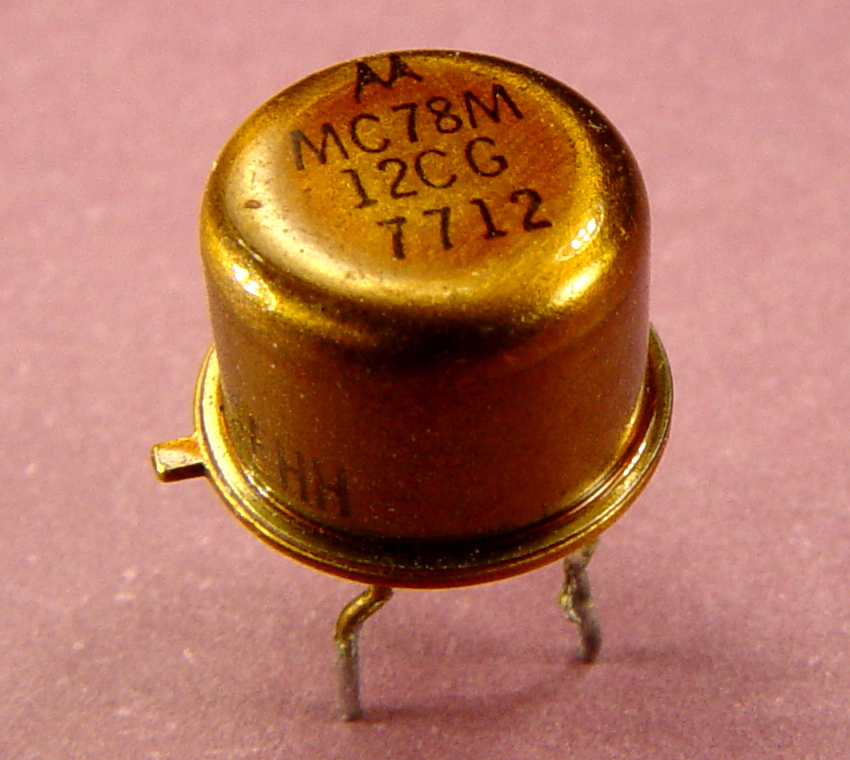
The family includes standard models like the 7806, 7808, 7809, 7810, 7812, 7815, 7818, and 7824, corresponding to their output voltages. Lower-current versions include the LM78Mxx series at 500 mA and the LM78Lxx series at 100 mA. Some specialized parts offer non-standard voltages, such as 6.2 V or 3.3 V. The complementary 79xx series provides negative voltage regulation. Devices like the LM78S40 and 7803SR are not part of this linear family, as they use switching regulator topologies.
Why it matters
The 78xx series established a standard for fixed voltage regulation that persists in many modern designs. Its widespread adoption is due to the balance of cost, availability, and built-in safety features. While switching converters are now preferred for high-efficiency applications, linear regulators remain relevant for low-noise or simple power tasks. The continued production by multiple semiconductor firms ensures long-term availability for maintenance and new designs requiring basic power management solutions.



Questions people ask about 78xx
What does the number in 78xx stand for?
The xx in the name represents the fixed output voltage in volts. For instance, a 7805 chip provides 5 volts, while a 7812 provides 12 volts. This naming convention allows engineers to quickly identify the regulation target.
Why do 78xx regulators get hot?
They are linear regulators, meaning they dissipate excess energy as heat. The difference between the input and output voltage multiplied by the current flow generates thermal energy. If the input voltage is much higher than the output, significant heat is produced.
Can I use a 7805 with a 6-volt battery?
No, because the input voltage must be at least 2.5 volts higher than the regulated output. A 6-volt source is only 1 volt above the 5-volt target, which is insufficient for the 7805 to regulate properly. A low-dropout regulator would be needed instead.
Good reading and sources
The facts on this page come from the Wikipedia article "78xx", written by its contributors and used under the CC BY-SA 4.0 licence, and from its Wikidata record (CC0). EveryChip rewrote the text in its own words, with AI assistance, and compares every page with the article to make sure no passage is copied. It may be reused under the same CC BY-SA 4.0 licence with a link back.
It may contain mistakes, and figures change over time. Nothing here is investment or buying advice. If something is wrong, tell us. Last refreshed 2026-11-14.
Like 78xx
All analog, power and mixed-signal 🇺🇸 United StatesLM386
Low-voltage audio power amplifier integrated circuitAnalog
 🇺🇸 United StatesLM3914
Analog display driver for LED bar graphs and dot metersAnalog
 🇺🇸 United StatesLM358
Low-power dual operational amplifier for single-supply circuitsAnalog
 🇺🇸 United StatesULN2003A
Seven-channel high-voltage Darlington transistor array driverAnalog
More from National Semiconductor
All of them 🇺🇸 United StatesLM13700
Dual operational transconductance amplifier for analog audio circuitsAnalog
🇺🇸 United StatesNE612
Radio frequency mixer and oscillator integrated circuitAnalog
🇺🇸 United StatesLM3875
56-watt audio amplifier integrated circuitAnalog
🇺🇸 United StatesHercules
ARM-based safety microcontrollers for critical systemsMicrocontroller · Arm