
YM3526
First Yamaha FM synthesis sound chip for computers and games
The YM3526, also known as OPL or OPL1, is a sound chip developed by Yamaha in 1984. It uses frequency modulation synthesis to generate audio for early PC sound cards and arcade games. This chip established a standard for affordable digital music in home computing before wavetable synthesis became common.
- Introduced by Yamaha in 1984 as the first OPL chip
- Provides 9 channels of two-operator FM synthesis
- Uses look-up tables to avoid hardware multipliers
- Requires external YM3014B DAC for analog output
- Powered AdLib and early Sound Blaster sound cards
What it is
The YM3526 is the first member of the OPL family of sound chips, introduced by Yamaha in 1984. It provides nine channels of two-operator frequency modulation synthesis. The chip generates digital audio signals that require an external digital-to-analog converter, typically the YM3014B, to produce analog sound. It became a key component in early IBM PC compatible sound cards and various arcade machines.
How it came about
Yamaha developed the chip to offer low-cost FM synthesis for computing and video game applications. Its release in 1984 preceded the widespread adoption of sound cards in personal computers. A closely related variant, the Y8950, added ADPCM recording capabilities for the MSX computer platform. The YM3526 laid the groundwork for the OPL2 and OPL3 chips that followed.
Inside the chip
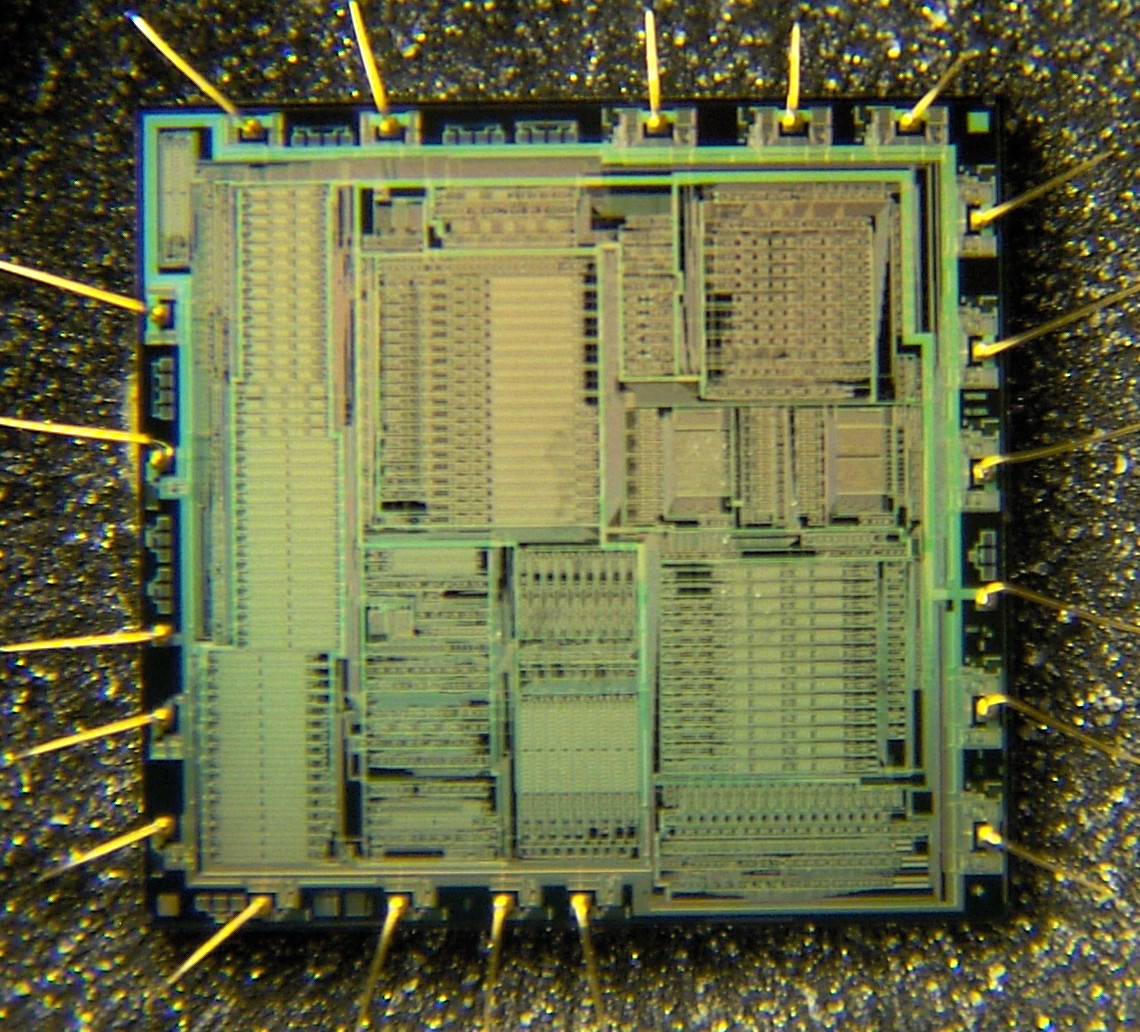
Internal operations are fully digital, using direct digital synthesis for each tone. The chip avoids complex multiplication by using logarithmic look-up tables stored in read-only memory. One table holds log-sine values, while another stores exponential functions. These allow the processor to calculate output using additions instead of multipliers. Each channel features two oscillators with independent envelope generators for attack, decay, sustain, and release parameters.
How it was made
The chip relies on two 256-entry look-up tables for its mathematical operations. These tables are stored as pairs of values rounded to whole numbers. The design minimizes hardware complexity by exploiting the symmetry of sine waves and logarithmic properties.
Where it went
This chip powered the Commodore 64 Sound Expander and arcade titles like Bubble Bobble and Terra Cresta. It served as the audio engine for the AdLib and original Sound Blaster sound cards in the late 1980s. The Y8950 variant was used in MSX computers as an audio expansion module. Its architecture became the de-facto standard for PC audio until wavetable synthesis replaced it in the mid-1990s.
Versions and family
The Y8950, also called MSX-AUDIO, is a variant that includes ADPCM playback features. It shares the core synthesis engine of the YM3526 but adds recording capability. The YM3812, known as OPL2, succeeded this chip in 1985 with improved waveform options. Later derivatives like the YMF262 expanded the channel count and operator modes significantly.
Why it matters
The YM3526 enabled affordable high-quality audio for home computers during the 1980s. It helped establish FM synthesis as a dominant method for generating music in video games and PC software. Its register structure influenced subsequent sound chip designs from competitors. The chip's legacy persists in emulation software and modern FPGA implementations of the OPL architecture.


Questions people ask about YM3526
What type of synthesis does the YM3526 use?
The chip uses frequency modulation synthesis, specifically implemented via phase modulation of digital oscillators. It generates sound using two operators per channel, allowing for complex timbres through mathematical interaction of sine waves.
Does the YM3526 produce analog audio directly?
No, the YM3526 outputs a sequence of floating-point digital numbers. It requires an external digital-to-analog converter chip, such as the YM3014B, to convert these digital signals into analog audio for speakers or headphones.
How many sound channels can the YM3526 produce?
The chip provides nine independent channels of sound. Alternatively, it can operate in a percussion mode where three channels are used to generate five different percussion instruments, leaving six channels for melodic notes.
Good reading and sources
The facts on this page come from the Wikipedia article "Yamaha OPL", written by its contributors and used under the CC BY-SA 4.0 licence, and from its Wikidata record (CC0). EveryChip rewrote the text in its own words, with AI assistance, and compares every page with the article to make sure no passage is copied. It may be reused under the same CC BY-SA 4.0 licence with a link back.
It may contain mistakes, and figures change over time. Nothing here is investment or buying advice. If something is wrong, tell us. Last refreshed 2026-11-14.
Like YM3526
All analog, power and mixed-signal 🇯🇵 JapanYamaha OPN
Family of FM synthesis sound chips for computers and gamesAnalog · 1984
🇯🇵 JapanYamaha OPL
Family of FM synthesis sound chips by Yamaha for PCs and games.Analog · 1984
🇯🇵 JapanYamaha YM3812
FM synthesis sound chip for PC audioAnalog · 1985
🇳🇱 NetherlandsSAA1099
Six-voice stereo sound generator chip from PhilipsAnalog · 1987
More from Yamaha
All of them
🇯🇵 JapanYamaha YM2151
Eight-channel FM synthesis sound chip by YamahaAnalog · 1984
 🇯🇵 JapanYamaha V9938
Video display processor for MSX2 home computersGPU · Other · 1985
WorldYamaha DSP-1
A 1986 digital signal processor for synthesizing multi-channel surround sound from stereo sources.DSP · 1986
🇯🇵 JapanYamaha YM2610
FM synthesis sound chip for arcade and home consolesAnalog · 1987