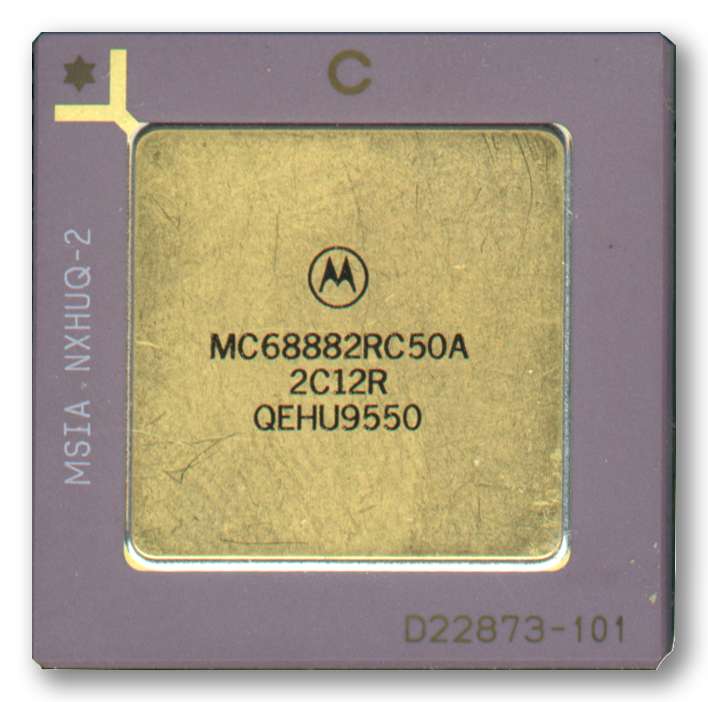
Motorola 68881
External floating-point coprocessor for Motorola 68020 and 68030 CPUs
The Motorola 68881 is a dedicated floating-point unit released in 1984 to accelerate mathematical calculations for Motorola microprocessors. It operates alongside the 68020 or 68030 CPU, handling complex numeric tasks while the main processor manages other instructions.
- Contains 155,000 transistors on-chip
- Supports IEEE 754 floating-point standard
- Released in 1984 for 68020 and 68030 CPUs
- Features eight 80-bit data registers
- Successor 68882 offers improved pipelining
What it is
The Motorola 68881 is a specialized integrated circuit designed to perform floating-point arithmetic. Introduced in 1984, it serves as an external coprocessor for the Motorola 68020 and 68030 central processing units. Before such math capabilities became standard within main processors, this chip provided the necessary hardware acceleration for scientific and engineering applications. It handles complex numeric representations while the primary CPU manages address calculations and general instruction flow.
How it came about
Motorola developed the 68881 to complement its 32-bit microprocessors. The 68020 and 68030 architectures reserved specific instruction codes, known as the F-line, to communicate with an external unit. If no coprocessor was present, the operating system would either emulate the math in software or trigger an error. This design allowed systems to scale performance based on user needs. The later 68882 model improved upon this foundation with better pipelining and higher clock speeds.
Inside the chip
The chip features eight data registers, each 80 bits wide. These store a 64-bit mantissa, a sign bit, and a 15-bit exponent. It supports seven numeric modes, including single, double, and extended precision formats defined by the IEEE 754 standard. It also handles integer quantities and binary-coded decimal values. The architecture allows parallel operation; the main CPU hands off operands to the coprocessor and continues executing subsequent instructions without waiting for the calculation to finish.
How it was made
The original 68881 contains 155,000 transistors on its silicon die. It was produced in several speed grades, including 12 MHz, 16 MHz, 20 MHz, and 25 MHz variants. The successor, the 68882, increased the transistor count to 176,000. This newer version offered improved internal pipelining, allowing it to execute certain instructions faster at identical clock frequencies. Both chips were manufactured by Motorola using proprietary processes typical of the era.
Where it went
This coprocessor appeared in various high-performance workstations and personal computers of the late 1980s and early 1990s. Notable systems include the Sun Microsystems Sun-3, IBM RT PC, and the NeXT Computer. Home computer enthusiasts found it in the Amiga 3000 and Atari TT and Falcon models. Apple included it in the Macintosh II family. Some third-party upgrades even added it to older 68000-based systems as a memory-mapped peripheral for enhanced mathematical capability.
Versions and family
The 68882 is the direct successor to the 68881. It shares the same instruction set and pin layout, making it a drop-in replacement for most hardware designs. However, software managing multitasking operating systems like UNIX required updates because the 68882 uses a larger state save frame. Performance claims suggested a 40 percent speed increase for some operations, though real-world gains were often more modest. Floating-point support eventually moved directly into the Motorola 68040 CPU.
Why it matters
The 68881 established a standard for external mathematical acceleration in the Motorola ecosystem. By adhering to the IEEE 754 standard, it ensured consistent numeric results across different machines. Its integration into workstations and high-end personal computers enabled more sophisticated graphics, scientific simulations, and engineering software. The transition from external coprocessors to integrated units in the 68040 marked a significant shift in microprocessor design philosophy.

Questions people ask about Motorola 68881
What does the Motorola 68881 do?
It is a floating-point unit that accelerates mathematical calculations involving decimal numbers. It works alongside the main CPU to handle complex arithmetic while the processor manages other tasks.
Which computers used this chip?
It was used in Sun-3 workstations, Macintosh II models, Amiga 3000, Atari TT, NeXT Computer, and IBM RT PC systems. It provided essential math hardware for these platforms.
How is the 68882 different from the 68881?
The 68882 has better pipelining and runs at higher clock speeds. It uses more transistors and requires a larger state save frame in software, but it is pin-compatible with the original.
Good reading and sources
The facts on this page come from the Wikipedia article "Motorola 68881", written by its contributors and used under the CC BY-SA 4.0 licence, and from its Wikidata record (CC0). EveryChip rewrote the text in its own words, with AI assistance, and compares every page with the article to make sure no passage is copied. It may be reused under the same CC BY-SA 4.0 licence with a link back.
It may contain mistakes, and figures change over time. Nothing here is investment or buying advice. If something is wrong, tell us. Last refreshed 2026-11-14.
Like Motorola 68881
All analog, power and mixed-signal 🇺🇸 United States16550 UART
Serial communication chip with FIFO buffer for PCsAnalog · 1987
🇺🇸 United StatesIntel 8237
Four-channel DMA controller for early IBM PCsAnalog · Other · 1980
 🇺🇸 United StatesIntel 8253
Programmable interval timer for early microcomputers and PCsAnalog · 1980
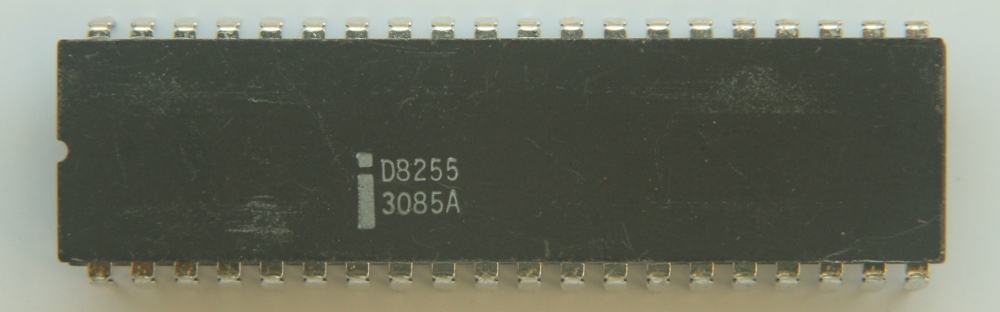 🇺🇸 United StatesIntel 8255
Programmable parallel input/output interface chip for early microprocessorsAnalog · 1970
More from Motorola
All of them 🇺🇸 United StatesMotorola 68020
32-bit microprocessor with on-chip cache and full data pathsCPU · 68k · 1984
 🇺🇸 United StatesMotorola 68HC11
8-bit microcontroller family for embedded systemsMicrocontroller · 68k · 1984
 🇯🇵 JapanHitachi 6309
Hitachi's CMOS 8-bit microprocessor, a faster and richer 6809CPU · 8-bit · 1985
🇺🇸 United StatesIntel 8061
Automotive microcontroller for Ford engine control unitsMicrocontroller · Other · 1983