
Motorola 68020
32-bit microprocessor with on-chip cache and full data paths
Released in 1984 by Motorola, the 68020 was a 32-bit microprocessor that introduced a true instruction cache and full external data buses. It powered workstations and personal computers before being quickly superseded by the faster 68030.
- First 68k series chip with a 256-byte on-chip instruction cache
- Full 32-bit internal and external data and address buses
- Supports up to eight external coprocessors for math and memory
- Used in Eurofighter Typhoon flight control and TGV train systems
- Initial manufacturing yields were zero due to factory equipment faults
What it is
The Motorola 68020 is a 32-bit microprocessor launched in June 1984. It marked a significant shift from the hybrid 16/32-bit design of its predecessors to a fully 32-bit architecture for both data and address buses. This chip introduced a 256-byte on-chip instruction cache, the first in its family, and supported external coprocessors for floating-point math and memory management. It was designed to overcome the memory limitations of earlier chips and provide better performance for Unix workstations and high-end personal computers.
How it came about
Motorola began developing the 68020 after receiving customer feedback requesting a fully 32-bit implementation. The company had previously used older fabrication techniques for the 68000 but moved to newer HMOS processes licensed from Intel for this project. Design work finished in mid-1983, but initial manufacturing yields were zero due to equipment failures at the MOS-8 factory. After management changes and repairs to a tungsten silicide machine, volume production started in late 1985. The chip faced a short market life as the 68030 arrived in 1987 with integrated features and lower costs.
Inside the chip
The processor features a native 32-bit arithmetic logic unit, allowing it to complete 32-bit operations in a single clock cycle. It uses a three-stage pipeline and includes a direct-mapped instruction cache with 64 entries. Unlike earlier models, it imposes no alignment restrictions on data access, though unaligned reads are slower. The chip supports up to eight external coprocessors via an asynchronous interface, enabling the use of floating-point units and paged memory management units. It also includes instructions for multiprocessing support and bit field manipulation.
How it was made
Manufactured using HMOS technology on 5-inch wafers, the 68020 contains approximately 200,000 transistors. It is housed in a 169-pin pin grid array package, although only 114 pins are actively used. The larger package allowed for the necessary 32-bit address and data buses, which were not possible with the older dual inline packages. Initial production suffered from severe yield issues until factory processes were corrected. In 2014, Rochester Electronics restarted manufacturing to keep the chip available for legacy systems.
Where it went
This microprocessor powered the Apple Macintosh II and Macintosh LC, as well as Sun-3 and Apollo DN3000 workstations. It was used in the Amiga 1200 via the lower-cost 68EC020 variant, which featured a 24-bit address bus. Industrial applications included Hewlett-Packard network analyzers and digital oscilloscopes from LeCroy and Tektronix. Beyond computing, it decoded signalling information for TGV trains and managed flight control systems in the Eurofighter Typhoon aircraft. It also served as the core processor for Nortel telephone switches.
Versions and family
The primary variant is the 68EC020, a cost-reduced version with a 24-bit address bus instead of 32-bit. This limitation restricted memory access to 16 MB but lowered pin count and price. The standard 68020 supports the full 4 GB address space. Both versions run at clock speeds between 12.5 MHz and 33 MHz. The 68020 was succeeded by the 68030, which integrated a memory management unit and larger caches, making it a drop-in replacement for many designs.
Why it matters
The 68020 enabled the transition to 32-bit clean software environments, forcing developers to stop using high-order address bits for flags. Its introduction of on-chip caching reduced bus traffic and improved performance in systems using direct memory access. Although it was quickly replaced by the 68030, it established the architectural foundation for later members of the 68000 family. Its longevity in industrial and aerospace sectors demonstrates its reliability beyond the consumer PC market.


Questions people ask about Motorola 68020
What is the main difference between the 68020 and the 68000?
The 68020 has full 32-bit data and address buses, while the 68000 has a 16-bit data bus and 24-bit address bus. The 68020 also includes an on-chip instruction cache and a native 32-bit arithmetic logic unit, allowing faster processing of 32-bit operations.
Why was the 68EC020 variant created?
The 68EC020 was a lower-cost version designed with a 24-bit address bus instead of 32-bit. This reduced the number of pins required and lowered the price, making it suitable for embedded systems like the Amiga 1200 that did not need more than 16 MB of memory.
Did the 68020 have a built-in floating-point unit?
No, the 68020 did not have an internal floating-point unit. It supported external coprocessors, such as the MC68881 or MC68882, through a dedicated interface. This allowed systems to add floating-point capabilities as needed without increasing the base cost of the CPU.
Good reading and sources
- Motorola 68020 on WikipediaEncyclopedia
- More photos on Wikimedia CommonsPhotos
- Wikidata recordOpen data
The facts on this page come from the Wikipedia article "Motorola 68020", written by its contributors and used under the CC BY-SA 4.0 licence, and from its Wikidata record (CC0). EveryChip rewrote the text in its own words, with AI assistance, and compares every page with the article to make sure no passage is copied. It may be reused under the same CC BY-SA 4.0 licence with a link back.
It may contain mistakes, and figures change over time. Nothing here is investment or buying advice. If something is wrong, tell us. Last refreshed 2026-11-14.
Like Motorola 68020
All CPUs and microprocessors 🇺🇸 United StatesI386
First 32-bit x86 microprocessor by IntelCPU · x86 · 1985
 🇺🇸 United StatesMotorola 68010
16/32-bit microprocessor with virtual memory support from 1982CPU · 68k · 1982
 🇺🇸 United StatesMotorola 68008
8-bit bus variant of the Motorola 68000 microprocessorCPU · 68k · 1982
🇺🇸 United StatesR2000
Early 32-bit RISC microprocessor chipset from MIPSCPU · MIPS · 1986
More from Motorola
All of them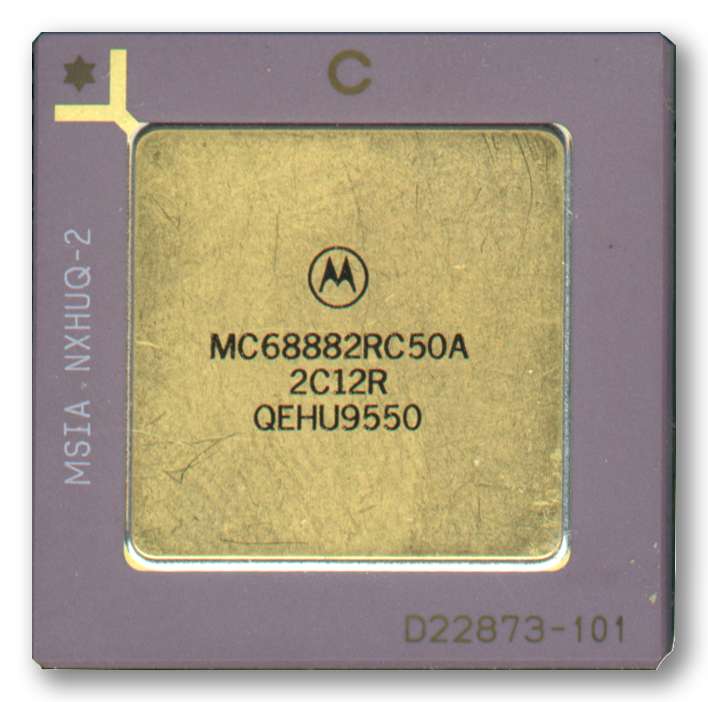 🇺🇸 United StatesMotorola 68881
External floating-point coprocessor for Motorola 68020 and 68030 CPUsAnalog · 68k · 1984
 🇺🇸 United StatesMotorola 68HC11
8-bit microcontroller family for embedded systemsMicrocontroller · 68k · 1984
 🇯🇵 JapanHitachi 6309
Hitachi's CMOS 8-bit microprocessor, a faster and richer 6809CPU · 8-bit · 1985
🇺🇸 United StatesIntel 8061
Automotive microcontroller for Ford engine control unitsMicrocontroller · Other · 1983