
I386
First 32-bit x86 microprocessor by Intel
The i386 is a 32-bit microprocessor launched by Intel in 1985. It extended the x86 architecture with 32-bit registers and memory addressing while keeping compatibility with older 16-bit software. This chip powered early workstations and personal computers, establishing the foundation for modern PC computing.
- First 32-bit x86 processor with 4 GB memory support
- Introduced CMOS technology to Intel microprocessors
- Sole-sourced by Intel for 4.7 years until 1991
- Production continued for embedded use until 2007
- Enabled virtual 8086 mode for multitasking legacy apps
What it is
The i386, originally known as the 80386, is a 32-bit microprocessor introduced by Intel in October 1985. It represents the third generation of the x86 family. The chip added 32-bit registers and addressing capabilities while maintaining full backward compatibility with 16-bit software. This design allowed it to run existing applications while supporting new operating systems that required more memory and protection features. It served as the central processing unit for many high-end personal computers and workstations during the late 1980s and early 1990s.
How it came about
Development began in 1982 under the internal code name P3. Engineers Gene Hill and Robert Childs worked on the project secretly after the previous 286 chip received poor reviews. Intel shifted from NMOS to CMOS technology for this design. Pre-production samples reached developers in October 1985, with mass production starting in June 1986. The Compaq Deskpro 386 became the first personal computer to use the chip in September 1986. Intel kept production exclusive to itself for nearly five years, a strategy that boosted its profits and market control.
Inside the chip
The processor features eight independent pipelined functional units that operate in parallel. It includes an on-chip memory management unit to support virtual memory and paging. Three operating modes are available: real mode, protected mode, and virtual 8086 mode. The protected mode allows addressing up to 4 GB of physical memory. Virtual 8086 mode enables running multiple legacy programs simultaneously within a protected environment. The instruction set was expanded with new commands for bit manipulation and data movement. Two additional segment registers, FS and GS, were added for general use.
How it was made
Initial versions contained 275,000 transistors manufactured using a 1.5 micrometre process. Later shrinks reduced the feature size to 1 micrometre, increasing transistor counts up to 855,000. The chip was packaged in 132-pin pin grid arrays or plastic quad flat packages. Intel was the sole manufacturer until 1991. AMD and IBM later produced compatible versions under license or after legal resolutions. The move to CMOS logic helped reduce power consumption compared to earlier NMOS designs.
Where it went
This microprocessor powered many workstations and high-end personal computers in the late 1980s. It remained common in embedded systems long after newer chips replaced it in PCs. Applications included aerospace technology, electronic musical instruments, and early mobile phones like the Nokia 9000 Communicator. Linux kernel support for the i386 lasted until December 2012. The chip's longevity in embedded roles led Intel to continue production until September 2007.
Versions and family
Several models were released, including the DX with full 32-bit data paths and the SX with 16-bit external buses. The SL variant offered low-power features for portable devices. Embedded versions like the 386EX integrated peripheral controllers. AMD produced the Am386, which became popular for its low cost and power efficiency. Chips and Technologies also attempted a reverse-engineered version, though it faced technical issues. The RapidCAD package combined a 386DX core with an 80387 math coprocessor.
Why it matters
The i386 established the 32-bit x86 architecture as the standard for personal computing. Its single-source strategy allowed Intel to dominate the market and increase profits significantly. The chip enabled the growth of the PC clone industry by allowing companies like Compaq to lead hardware innovation instead of IBM. It provided the hardware foundation for early multitasking operating systems and Unix ports. The instruction set defined here remains the baseline for all subsequent 32-bit x86 processors.
Problems and reception
The chip was widely acclaimed upon release, with many industry awards given to 386-based systems in 1986. Critics noted its superior performance over the 286 and its ability to run Unix effectively. Some initial mainboards were expensive and complex, but costs dropped as adoption grew. Legal battles delayed compatible clones from AMD, but these eventually offered cheaper alternatives. Enthusiasts valued the 40 MHz AMD parts for their low power draw and overclocking potential.


Questions people ask about I386
What is the maximum memory the i386 can address?
The i386 can address up to 4 GB of physical memory in protected mode. It also supports up to 64 TB of virtual memory through its paging translation unit. This was a significant increase over the 16 MB limit of the previous 286 processor.
Why was the i386 only made by Intel for several years?
Intel CEO Andy Grove decided not to license the design to other manufacturers initially. This single-source strategy lasted for 4.7 years and allowed Intel to retain greater control over development and capture higher profits before AMD and IBM entered the market.
Is the i386 still used in modern systems?
It is no longer used in personal computers. However, it remained in production for embedded systems until 2007. Some aerospace devices and electronic instruments still use derivatives of the chip. Linux stopped supporting i386-specific instructions in 2012.
What was the first computer to use the i386?
The Compaq Deskpro 386, introduced in September 1986, was the first personal computer to feature the i386. This marked a shift where a clone manufacturer led hardware innovation rather than IBM, helping to legitimize the PC clone industry.
Good reading and sources
The facts on this page come from the Wikipedia article "I386", written by its contributors and used under the CC BY-SA 4.0 licence, and from its Wikidata record (CC0). EveryChip rewrote the text in its own words, with AI assistance, and compares every page with the article to make sure no passage is copied. It may be reused under the same CC BY-SA 4.0 licence with a link back.
It may contain mistakes, and figures change over time. Nothing here is investment or buying advice. If something is wrong, tell us. Last refreshed 2026-11-14.
Like I386
All CPUs and microprocessors 🇺🇸 United StatesIntel 80386
Intel's 32-bit x86 CPU from 1985, the base of the IA-32 instruction setCPU · x86 · 1985
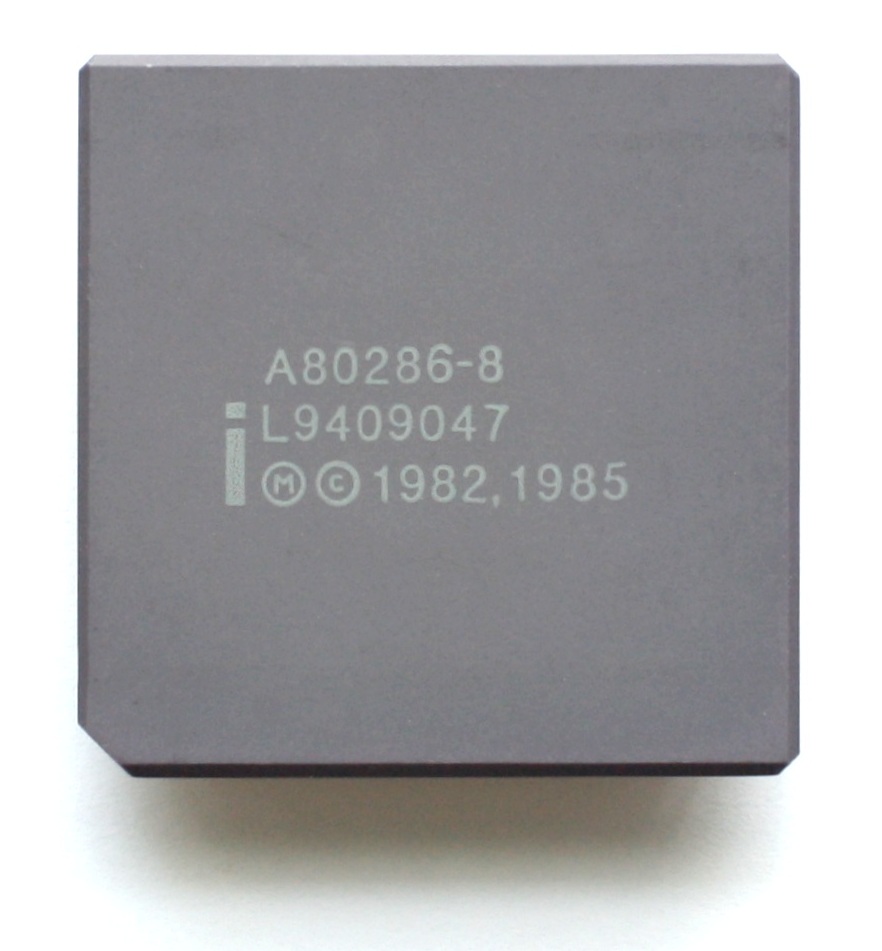 🇺🇸 United StatesIntel 80286
16-bit x86 CPU with protected mode and 24-bit addressing, launched in 1982CPU · x86 · 1982
 🇺🇸 United StatesIntel 80186
16-bit microprocessor with integrated peripherals for embedded systemsCPU · x86 · 1982
🇺🇸 United StatesIntel 80286
16-bit microprocessor with protected mode and 16 MB memory supportCPU · x86 · 1982
More from Intel
All of them 🇺🇸 United StatesAm7990
Ethernet media access controller introduced in 1985Network chip · Other · 1985
 🇺🇸 United StatesROMP
IBM RISC microprocessor for workstations and office systemsCPU · RISC · 1986
🇺🇸 United StatesIntel 8284
Clock generator chip for early Intel processorsAnalog · 1986
🇺🇸 United StatesIntel 8061
Automotive microcontroller for Ford engine control unitsMicrocontroller · Other · 1983