Analog, power and mixed-signal
The 555 timer, the 741 op-amp, voltage regulators, data converters and power chips. 121 chips on EveryChip so far.
Analog chips handle signals that vary smoothly, such as sound, temperature, voltage and radio, rather than ones and zeros. Amplifiers, voltage regulators, timers, data converters and power-management chips are all analog or mixed-signal parts. Some designs are decades old and still sold in billions, such as the 555 timer of 1972 and the 741 operational amplifier of 1968. Texas Instruments and Analog Devices are the largest makers.
Classic parts
An operational amplifier (op-amp) boosts the difference between two voltages and, with a few resistors, can amplify, filter or add signals. Fairchild's μA741 became the standard op-amp. The 555, designed by Hans Camenzind for Signetics, makes pulses and delays with a few outside parts. Linear regulators such as the 78xx series and the LM317 turn a rough supply into a steady voltage.
Power and data converters
Today the largest analog markets are power management, which converts and distributes battery or mains power inside every device, and data converters, which turn sensor voltages into numbers and back. Analog chips are often made on older, larger nodes, where transistors handle higher voltages and less noise, and in-house fabs such as TI's 300 mm analog fabs keep costs down.
Famous analog chips


Further reading
 🇺🇸 United StatesPeripheral Interface Adapter
Parallel I/O chip for early microprocessor systemsAnalog · Other · 1976
 🇺🇸 United StatesPOKEY
Atari I/O chip for sound, keyboard and paddlesAnalog · Other · 1979
🇯🇵 JapanYamaha YM2610
FM synthesis sound chip for arcade and home consolesAnalog · 1987
🇺🇸 United StatesSN76489
Programmable sound generator chip for 1980s computers and consolesAnalog · 1979
 🇯🇵 JapanYM2413
Cost-reduced FM synthesis sound chip by YamahaAnalog · Other · 1986
 🇯🇵 JapanYamaha OPN
Family of FM synthesis sound chips for computers and gamesAnalog · 1984
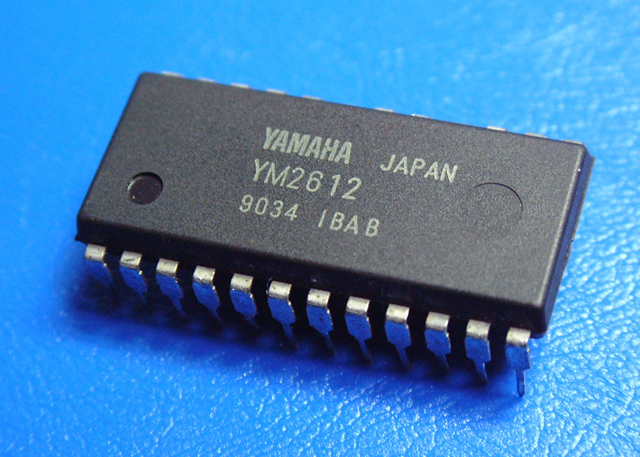 🇯🇵 JapanYM2612
Six-channel FM synthesis sound chip for Sega Mega DriveAnalog
🇯🇵 JapanYamaha YM2151
Eight-channel FM synthesis sound chip by YamahaAnalog · 1984
 🇯🇵 JapanYM2608
Yamaha FM synthesis sound chip for NEC computersAnalog
 🇯🇵 JapanYamaha YM2203
Six-channel FM synthesis and SSG sound chip by YamahaAnalog
 🇯🇵 JapanYamaha OPL
Family of FM synthesis sound chips by Yamaha for PCs and games.Analog · 1984
 🇺🇸 United StatesMOS Technology SID
Programmable sound generator chip for Commodore home computersAnalog · 1982
🇺🇸 United StatesNCR 53C9x
SCSI controller family for workstations and consolesAnalog
 🇺🇸 United StatesTMS9918
Texas Instruments video display controller from 1979Analog · 1979
 🇺🇸 United StatesAY-3-8910
Three-voice programmable sound generator chip from 1978Analog · 1978
 🇺🇸 United StatesSP0256
Voice synthesis chip by General Instrument from the early 1980sAnalog · Other · 1981
 🇺🇸 United StatesSN76477
Analog sound chip for arcade games and toysAnalog · Other · 1978
🇳🇱 NetherlandsSAA1099
Six-voice stereo sound generator chip from PhilipsAnalog · 1987
🇯🇵 JapanYamaha YM3812
FM synthesis sound chip for PC audioAnalog · 1985
🇯🇵 JapanYM3526
First Yamaha FM synthesis sound chip for computers and gamesAnalog · 1984
🇯🇵 JapanYMF262
FM synthesis sound chip for PC audioAnalog · 1990
🇯🇵 JapanYamaha YMZ280B
Eight-channel PCM sound chip for arcade gamesAnalog
 🇯🇵 JapanYamaha YMF292
Sound chip for Sega Saturn and arcade boardsAnalog
🇺🇸 United StatesSN76477
Analog sound chip for arcade games and toysAnalog · Other · 1978
Photo credits on this page
The small pictures above come from Wikimedia Commons under free licences. Some are cropped to fit.
- LM317: Raimond Spekking, CC BY-SA 4.0, source
- 555 timer IC: Raimond Spekking, CC BY-SA 4.0, source
- 78xx: Raimond Spekking, CC BY-SA 4.0, source
- Peripheral Interface Adapter: Swtpc6800 en:User:Swtpc6800 Michael Holley, Public domain, source
- POKEY: RodCastler, CC BY-SA 3.0, source
- TL431: Raimond Spekking, CC BY-SA 4.0, source
- LM386: Raimond Spekking, CC BY-SA 4.0, source
- YM2413: Baz1521, CC BY-SA 3.0, source
- Yamaha OPN: TYalaA, CC BY-SA 4.0, source
- Yamaha YMF292: Unknown author, CC BY-SA 3.0, source
- ΜA741: Teravolt ( talk ), CC BY 3.0, source
- TMS9918: Baz1521 at Japanese Wikipedia, CC BY-SA 3.0, source
- AY-3-8910: Seanriddle, CC BY-SA 4.0, source
- SP0256: Myself User:ZyMOS, CC BY-SA 4.0, source
- SN76477: Leomil72, Public domain, source
- YM2612: Baz1521 at Japanese Wikipedia, CC BY-SA 3.0, source
- YM2608: rance3, CC BY-SA 3.0, source
- Yamaha YM2203: Shiru at Russian Wikipedia, Public domain, source
- Yamaha OPL: Original uploader was Shiru at ru.wikipedia, CC BY-SA 3.0, source
- MOS Technology SID: Taras Young, CC BY-SA 4.0, source