
MOS Technology SID
Programmable sound generator chip for Commodore home computers
The MOS Technology SID is a programmable sound generator chip designed by Bob Yannes for Commodore home computers. Introduced in 1982 with the Commodore 64, it offered advanced synthesis features like filters and envelope controls, distinguishing it from simpler contemporary sound chips.
- Designed by Bob Yannes in five months during 1981
- Features three voices with ADSR envelopes and filters
- Used 7-micrometer NMOS process for high yield
- 8580 revision reduced power use to 9V DC
- Central to the Commodore 64 success and demoscene
What it is
The MOS Technology SID, or Sound Interface Device, is a mixed-signal integrated circuit that serves as a programmable sound generator. It was built into several Commodore home computers, including the Commodore 64, Commodore 128, and MAX Machine. Unlike basic sound chips of its era, the SID functioned as a single-chip music synthesizer. It featured advanced capabilities such as ADSR envelope controls, filters, and modulation options. These features allowed it to produce complex musical tones and effects, contributing significantly to the popularity of the Commodore 64.
How it came about
Engineer Bob Yannes designed the SID in the latter half of 1981. He led a small team consisting of two technicians and a CAD operator. They completed the chip in five months. Yannes was dissatisfied with existing computer sound chips, which he viewed as primitive. He aimed to create a high-quality instrument chip inspired by professional synthesizers. The design process was rapid, with specifications written as development progressed. The chip was ready for the Consumer Electronics Show in January 1982. Yannes later left Commodore to co-found Ensoniq, a digital synthesizer company.
Inside the chip
The SID contains both digital and analog circuitry. Control ports are digital, while output ports are analog. It features three independent audio oscillators, each with four waveform types: triangle, sawtooth, pulse, and noise. Users can combine waveforms to create complex sounds. Each voice has an ADSR volume envelope. The chip includes a multi-mode filter with low-pass, band-pass, and high-pass settings. External capacitors help construct the filter. An external audio input allows mixing with outside signals. The system uses a 5-bit address bus and an 8-bit data bus for programming.
How it was made
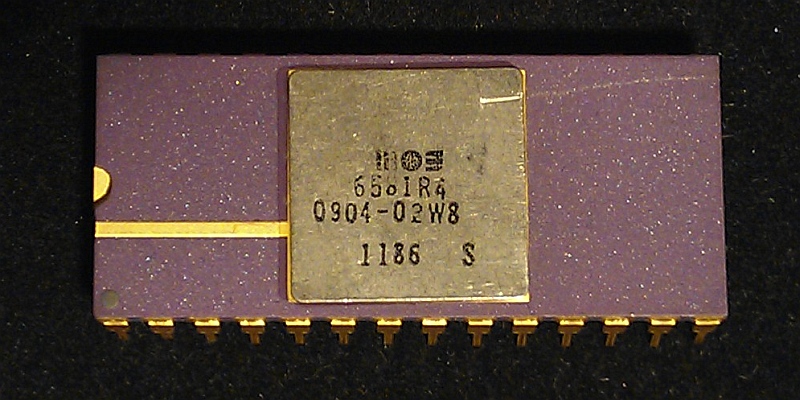
The original 6581 model was manufactured using 7-micrometer NMOS technology. This process was chosen to ensure high yield, even though 6-micrometer technology was available. The later 8580 revision used HMOS-II process technology. This change reduced power consumption from 12V to 9V DC, making the chip run cooler and last longer. Production of the 8580 continued until around 1992. Some chips were marked with the Commodore Semiconductor Group logo, while others retained the MOS label. Variations in markings occurred across different factories and production lines.
Where it went
The SID was central to audio in Commodore 64 games and software. Composers like Rob Hubbard and Martin Galway used its features to create complex music. The chip was also used in the SidStation, an electronic musical instrument released in 1997 by Elektron. Innovation Computer included a SID chip in their SSI-2001 sound card for IBM PC compatibles. Enthusiasts have preserved authentic SID sounds through projects like the High Voltage SID Collection, which records tracks from real hardware.
Versions and family
Two main models were produced: the 6581 and the 8580. The 6581 was used from 1982 to around 1986 and underwent minor revisions labeled R2 through R4. The 8580, or R5, replaced it in later machines. The 8580 offered a more linear filter response and less distortion than the 6581. Some 8580 chips were labeled as 6582. The 6581 is known for non-linear filter behavior and variability between units, while the 8580 is more consistent. Software techniques developed for the 6581 often do not work correctly on the 8580.
Why it matters
The SID helped make the Commodore 64 the best-selling home computer in history. Its advanced sound capabilities influenced the demoscene, a subculture focused on demonstrating programming skills. The chip is regarded as a musical instrument in its own right by many composers. Emulation software like PlaySID and reSID was developed to replicate its sound on other platforms. The unique audio characteristics of the SID have led to a dedicated community that values original hardware over software emulators.
Problems and reception
Fake SID chips appeared in the market after production ended. Unscrupulous sellers remarked defective or unrelated chips as new SIDs. These fakes often had broken filters or channels. The original chips became highly sought after by collectors and musicians. Some users prefer the specific distortions of the 6581 model, while others value the clarity of the 8580. The discrepancy between published specifications and actual hardware behavior led to varied usage in early software.

Questions people ask about MOS Technology SID
What makes the SID different from other sound chips of its time?
The SID included advanced synthesizer features like ADSR envelope controls, filters, and modulation. Unlike simple beep generators, it could produce complex musical tones and was considered a single-chip music synthesizer.
What are the main differences between the 6581 and 8580 models?
The 6581 used 12V NMOS technology and had a non-linear filter. The 8580 used 9V HMOS-II technology, ran cooler, and had a more linear, consistent filter with less distortion.
Who designed the SID chip?
Bob Yannes designed the SID. He led a small team at MOS Technology and completed the chip in five months. He later co-founded Ensoniq, a company known for digital synthesizers.
Can the SID play digital audio samples?
Programmers discovered ways to manipulate the SID via software to play digital samples. This technique requires significant CPU and memory usage and is not compatible with all SID models.
Good reading and sources
- MOS Technology 6581 on WikipediaEncyclopedia
- More photos on Wikimedia CommonsPhotos
- Wikidata recordOpen data
The facts on this page come from the Wikipedia article "MOS Technology 6581", written by its contributors and used under the CC BY-SA 4.0 licence, and from its Wikidata record (CC0). EveryChip rewrote the text in its own words, with AI assistance, and compares every page with the article to make sure no passage is copied. It may be reused under the same CC BY-SA 4.0 licence with a link back.
It may contain mistakes, and figures change over time. Nothing here is investment or buying advice. If something is wrong, tell us. Last refreshed 2026-11-14.
Like MOS Technology SID
All analog, power and mixed-signal 🇺🇸 United StatesSP0256
Voice synthesis chip by General Instrument from the early 1980sAnalog · Other · 1981
 🇺🇸 United StatesPOKEY
Atari I/O chip for sound, keyboard and paddlesAnalog · Other · 1979
 🇯🇵 JapanYM2413
Cost-reduced FM synthesis sound chip by YamahaAnalog · Other · 1986
 🇺🇸 United StatesAY-3-8910
Three-voice programmable sound generator chip from 1978Analog · 1978
More from MOS Technology
All of them 🇺🇸 United StatesVIC-II
Video and graphics chip for the Commodore 64 home computer.GPU · Other · 1982
 🇯🇵 JapanRicoh 2A03
8-bit CPU and sound chip for the Nintendo Entertainment SystemCPU · 68k · 1983
 🇺🇸 United StatesMOS Technology VIC
Video and sound chip for the Commodore VIC-20 computerGPU · Other · 1979
🇺🇸 United StatesWDC 65C816
16-bit microprocessor from the 6502 family with 24-bit addressingCPU · Other · 1985