
TMS9918
Texas Instruments video display controller from 1979
The TMS9918 is a video display controller made by Texas Instruments in 1979. It introduced advanced sprite and colour features to home computers and consoles, using dedicated video memory to achieve arcade-like graphics.
- Introduced by Texas Instruments in 1979
- Supports 32 hardware sprites with layering
- Uses up to 16 KB of dedicated video RAM
- Features a 15-colour palette plus transparency
- Powered the ColecoVision and MSX computers
What it is
The TMS9918 is a video display controller produced by Texas Instruments in 1979. Often called a Video Display Processor in manuals, it manages screen output for various home computers and game consoles. The chip supports multiple graphics modes, including text and pixel-based displays, with a resolution of 256 by 192 pixels. It features a fixed palette of 15 colours plus transparency. A key capability is hardware sprite support, allowing 32 single-colour objects to move independently on screen. This design enabled more vibrant and dynamic visuals than many contemporaries, bringing arcade-style graphics to consumer electronics.
How it came about
Texas Instruments introduced the chip in 1979 as an advanced solution for video generation. It was designed to handle complex graphical tasks without burdening the main central processing unit. The architecture required a separate pool of dynamic random access memory, known as video RAM, to store display data. This separation allowed for faster screen updates but meant the main processor had to communicate over a dedicated eight-bit bus. The design prioritised visual fidelity, resulting in a system that could produce colourful displays similar to arcade machines, though it required additional memory hardware.
Inside the chip
The chip organises graphics into layers, including sprites, a background, and an external video input. Sprites are small movable images stored in video memory, with lower-numbered sprites appearing on top. The system checks each pixel from top to bottom to determine the final colour. It offers four primary graphics modes. Text mode uses a grid of character blocks. Graphics modes allow for pixel-level control, with varying levels of colour detail per block. Multicolor mode provides low resolution but high colour variety. The chip lacks hardware fine scrolling, so movement occurs in cell-sized steps. Programmers often used tricks like swapping sprite orders to create depth effects.
How it was made
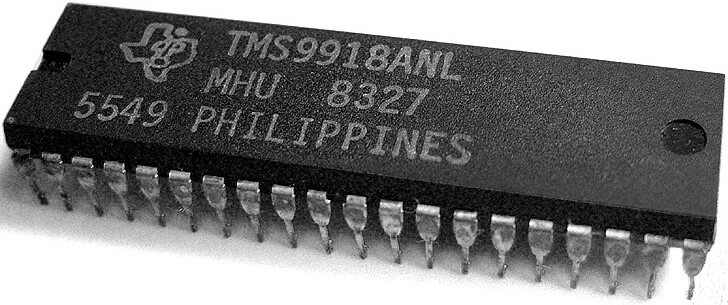
The component comes in a 40-pin dual in-line package. It operates on a five-volt power supply and uses a quartz crystal running at 10.7386 MHz for timing. This frequency is three times the NTSC colour burst standard. The chip connects to up to 16 kilobytes of dedicated video RAM via separate address and data buses. Communication with the host computer happens through an eight-bit data bus. The chip increments memory addresses automatically after transfers to speed up bulk data writing. This dedicated memory approach avoids the need for the video chip to refresh main system memory.
Where it went
This controller powered many notable systems in the early 1980s. It was the video heart of the Texas Instruments TI-99/4 home computer. Game consoles like the ColecoVision and Sega SG-1000 relied on it for their graphics. The MSX standard, popular in Japan and Europe, also adopted this chip. Other users included the Casio PV-2000, Memotech MTX, and Tomy Tutor. It even appeared in add-ons for the Apple II and BBC Micro. Its widespread adoption helped define the look of early home gaming and computing, providing a consistent set of graphical capabilities across different hardware platforms.
Versions and family
The Yamaha V9938 is an enhanced version of this design. While the original chip supported four documented modes, later revisions like the TMS9918A supported undocumented combinations. These hidden modes allowed for bitmap text and half-bitmap displays by modifying how the screen was divided. Clones and emulators sometimes struggle with these unofficial features. The basic architecture remained influential, with subsequent chips building on its sprite and layering concepts. The successor models expanded on the colour palette and resolution limits established by this initial release.
Why it matters
The TMS9918 set a benchmark for home computer graphics in its era. By offloading video tasks to dedicated hardware and memory, it freed up the main processor for other calculations. Its sprite system allowed for smooth animation and layering, which became standard in video games. The requirement for separate video memory influenced later system designs, highlighting the trade-off between cost and performance. Its presence in the MSX standard ensured its longevity in international markets. The chip demonstrated that affordable home systems could deliver near-arcade visual quality.


Questions people ask about TMS9918
What is the maximum resolution of the TMS9918?
The chip supports a maximum underlying layout of 256 by 192 pixels. This resolution is typical for systems using analog video signals and progressive scan displays of that era.
How many sprites can the TMS9918 display?
It supports 32 single-colour sprites. However, only four sprites can appear on any single horizontal scan line. If more are present, the chip skips the extras, which can cause flickering.
Does the TMS9918 share memory with the CPU?
No, it requires a dedicated pool of dynamic random access memory called video RAM. The central processing unit communicates with this memory over a separate eight-bit data bus.
What voltage does the TMS9918 require?
The chip operates on a positive five-volt power supply. Pin 33 receives the voltage, while pin 12 is connected to ground.
Good reading and sources
The facts on this page come from the Wikipedia article "TMS9918", written by its contributors and used under the CC BY-SA 4.0 licence, and from its Wikidata record (CC0). EveryChip rewrote the text in its own words, with AI assistance, and compares every page with the article to make sure no passage is copied. It may be reused under the same CC BY-SA 4.0 licence with a link back.
It may contain mistakes, and figures change over time. Nothing here is investment or buying advice. If something is wrong, tell us. Last refreshed 2026-11-14.
Like TMS9918
All analog, power and mixed-signal 🇺🇸 United StatesAY-3-8910
Three-voice programmable sound generator chip from 1978Analog · 1978
 🇺🇸 United StatesPOKEY
Atari I/O chip for sound, keyboard and paddlesAnalog · Other · 1979
🇺🇸 United StatesSN76489
Programmable sound generator chip for 1980s computers and consolesAnalog · 1979
 🇯🇵 JapanHD44780
Alphanumeric dot matrix LCD controller and driver chipAnalog · Other · 1980
More from Texas Instruments
All of them 🇺🇸 United StatesNE5532
Dual low-noise operational amplifier for professional audioAnalog · 1979
 🇺🇸 United StatesSN76477
Analog sound chip for arcade games and toysAnalog · Other · 1978
🇺🇸 United StatesTMS6100
Serial mask ROM for speech synthesis data storageMemory · Other · 1978
 🇺🇸 United StatesTexas Instruments LPC Speech Chips
Digital signal processors for speech synthesis in toys and arcades.DSP · Other · 1978