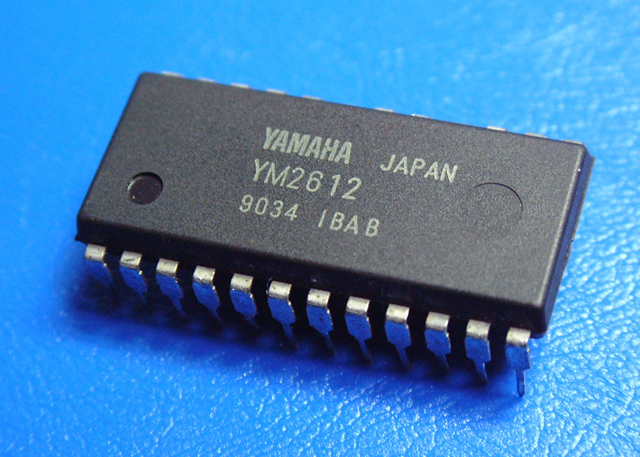
YM2612
Six-channel FM synthesis sound chip for Sega Mega Drive
The YM2612 is a six-channel FM synthesizer developed by Yamaha. It powered the audio in Sega's Mega Drive console and Fujitsu's FM Towns computers. The chip integrates a stereo digital-to-analog converter, allowing direct audio output without external components.
- Six concurrent FM synthesis channels with four operators each
- Integrated stereo nine-bit DAC eliminates need for external chip
- Channel six supports eight-bit PCM sample playback via software
- Original design has low-volume crossover distortion known as ladder effect
- Used in Sega Mega Drive, Genesis, and Fujitsu FM Towns computers
What it is
The YM2612, also known as OPN2, is a sound integrated circuit created by Yamaha. It belongs to the OPN family of frequency modulation synthesis chips. This component generates audio through six independent channels, each using four operators to shape sound waves. It was designed as a simplified version of the earlier YM2608, removing certain legacy features to reduce cost and complexity while retaining core synthesis capabilities. The chip is best known for its role in home video game consoles and personal computers during the late 1980s and early 1990s.
How it came about
Yamaha developed the YM2612 by stripping down the feature set of the YM2608. The design team removed the general-purpose input-output ports and the dedicated adaptive differential pulse-code modulation channels found in larger siblings. They retained the frequency modulation block and added an integrated stereo digital-to-analog converter. This integration allowed system designers to omit separate DAC hardware. The chip became the primary audio engine for Sega's Mega Drive, also known as the Genesis in North America, and was adopted by Fujitsu for its FM Towns computer line.
Inside the chip
The chip provides six simultaneous frequency modulation voices. Each voice uses four operators to modulate sine waves, creating complex timbres. A built-in low frequency oscillator adds vibrato and tremolo effects. Uniquely, the sixth channel can switch from synthesis to playing raw eight-bit pulse-code modulation samples. This mode disables frequency modulation on that channel and relies on the host processor for timing and buffering. The device includes two interval timers and supports per-channel stereo panning. Channel three allows independent frequency settings for its operators, enabling dissonant harmonics not possible on other channels.
How it was made
The original YM2612 contains a nine-bit digital-to-analog converter that uses time-division multiplexing. An error in the amplitude voltage circuitry causes crossover distortion at low volumes, often called the ladder effect. Yamaha later released the YM3438, a CMOS variant with an improved DAC that reduces this distortion. The YMF276, or OPN2L, is a low-power version that requires an external DAC, eliminating the internal distortion issue entirely. Custom application-specific integrated circuits for later Mega Drive revisions integrated the YM3438 core directly with video logic.
Where it went
Sega employed the YM2612 in the Mega Drive and Genesis consoles, where it worked alongside a Texas Instruments programmable sound generator. It also powered arcade boards such as the Mega-Play, System C, and System 32. Fujitsu used the chip in its FM Towns computer series and the FM Towns Marty console. Game composers, including Yuzo Koshiro, exploited the chip's specific distortion characteristics to create unique musical textures. Some early titles were composed specifically to leverage the low-volume quantization artifacts.
Versions and family
The YM3438, or OPN2C, is a CMOS revision with higher signal-to-noise ratio and less distortion. It is not a direct drop-in replacement due to different output impedance. The YMF276, known as OPN2L, comes in a smaller 24-pin package and needs an external DAC like the YM3433B. Yamaha also produced custom ASICs for Sega, such as the FC1004 and FJ3002, which embed the YM3438 core alongside video and central processing units. These later integrations further refined the audio output quality.
Why it matters
The YM2612 defined the sonic character of a generation of video games. Its frequency modulation synthesis allowed for rich, metallic sounds that differed significantly from the sample-based audio of competing systems. The specific quirks of its digital-to-analog converter became part of its artistic identity, with musicians composing around its limitations. Emulators now strive to replicate these imperfections, including the crossover distortion and undocumented register behaviors, to preserve the authentic listening experience of original hardware.
Problems and reception
The low-volume distortion bug caused issues for later hardware revisions and emulations that corrected the error. Games composed to exploit the original chip's exaggerated quantization sounded too quiet or incorrect on the cleaner YM3438 variants. This discrepancy led to efforts in software emulation to artificially reintroduce the crossover distortion. Modern emulators often include options to simulate either the original distorted output or the cleaner revised hardware, allowing users to choose their preferred audio fidelity.

Questions people ask about YM2612
What is the main difference between the YM2612 and YM3438?
The YM3438 is a CMOS version of the YM2612 with an improved digital-to-analog converter. It significantly reduces the crossover distortion present in the original chip and offers a higher signal-to-noise ratio. However, it has higher output impedance, so it is not a direct drop-in replacement for the YM2612 in existing circuits.
Can the YM2612 play recorded audio samples?
Yes, but only on the sixth channel. By enabling a specific register, the chip disables frequency modulation on that channel and allows eight-bit pulse-code modulation playback. The host processor must handle all timing and buffering, as the chip lacks dedicated hardware for sample management unlike its larger siblings.
Why do some Mega Drive games sound different on newer consoles?
Early games were composed to exploit a distortion bug in the original YM2612's digital-to-analog converter. Later consoles used the YM3438 variant or custom ASICs with cleaner audio output. These revised chips do not produce the same low-volume quantization artifacts, causing music written for the original distortion to sound quieter or altered.
What is the ladder effect in YM2612 audio?
The ladder effect, also known as TDM distortion, is a form of crossover distortion caused by an error in the chip's amplitude voltage design. It affects low-volume output, causing exaggerated quantization steps. This artifact creates a distinct gritty texture that some composers used creatively in video game music during the early lifespan of the Mega Drive.
Good reading and sources
- Yamaha YM2612 on WikipediaEncyclopedia
- More photos on Wikimedia CommonsPhotos
- Wikidata recordOpen data
The facts on this page come from the Wikipedia article "Yamaha YM2612", written by its contributors and used under the CC BY-SA 4.0 licence, and from its Wikidata record (CC0). EveryChip rewrote the text in its own words, with AI assistance, and compares every page with the article to make sure no passage is copied. It may be reused under the same CC BY-SA 4.0 licence with a link back.
It may contain mistakes, and figures change over time. Nothing here is investment or buying advice. If something is wrong, tell us. Last refreshed 2026-11-14.
Like YM2612
All analog, power and mixed-signal 🇯🇵 JapanYamaha YM2203
Six-channel FM synthesis and SSG sound chip by YamahaAnalog
 🇯🇵 JapanYamaha YMF292
Sound chip for Sega Saturn and arcade boardsAnalog
 🇺🇸 United StatesPeripheral Interface Adapter
Parallel I/O chip for early microprocessor systemsAnalog · Other · 1976
 🇺🇸 United StatesAY-3-8910
Three-voice programmable sound generator chip from 1978Analog · 1978
More from Yamaha
All of them 🇯🇵 JapanYM2608
Yamaha FM synthesis sound chip for NEC computersAnalog
 🇯🇵 JapanYamaha V9958
Video display processor for MSX2+ and turbo R computersGPU
 🇯🇵 JapanMSX-Engine
Integrated circuit combining MSX computer functions into one chip.SoC · Other
 🇯🇵 JapanYamaha YM2164
FM synthesis sound chip for MIDI synthesizers and expansion cardsAnalog · Other