Consumer electronics
Calculators, TVs, cameras, set-top boxes and wearables. 352 chips on EveryChip so far.
Consumer electronics were the first mass market for chips. Pocket calculators drove early chip design: the Intel 4004 was built for a Busicom calculator, and Texas Instruments' TMS1000 went into calculators, toys and microwave ovens. Since then chips have filled TVs, cameras, music players, set-top boxes, projectors, smart speakers and watches, usually as SoCs designed for one kind of product.
Calculators to cameras
In 1969 the Japanese company Busicom asked Intel for a set of chips for a printing calculator; Intel's answer was the 4004, released in 1971. Calculator prices fell sharply in the 1970s as single-chip designs arrived. Digital cameras were made possible by image sensors and image processors, and Texas Instruments' DLP chips, with millions of tiny mirrors, went into projectors and cinema screens.
Smart devices
Today's TVs, streaming sticks and smart speakers run SoCs from MediaTek, Realtek, Amlogic, Broadcom and others, combining Arm cores with video decoders for formats such as HEVC and AV1. Wearables such as Apple's watch use tiny SoCs in system-in-package modules, in which many chips are sealed together into one small block.
Famous consumer electronics chips
 Intel 4004Built for the Busicom 141-PF calculator, 1971
 TMS1000Microcontroller of calculators and toys
 Texas Instruments LPC Speech ChipsSpeech chips of TI's Speak and Spell toy
 Digital micromirror deviceTI's DLP mirror chip for projectors
 Apple S1The first Apple Watch's system in package, 2015
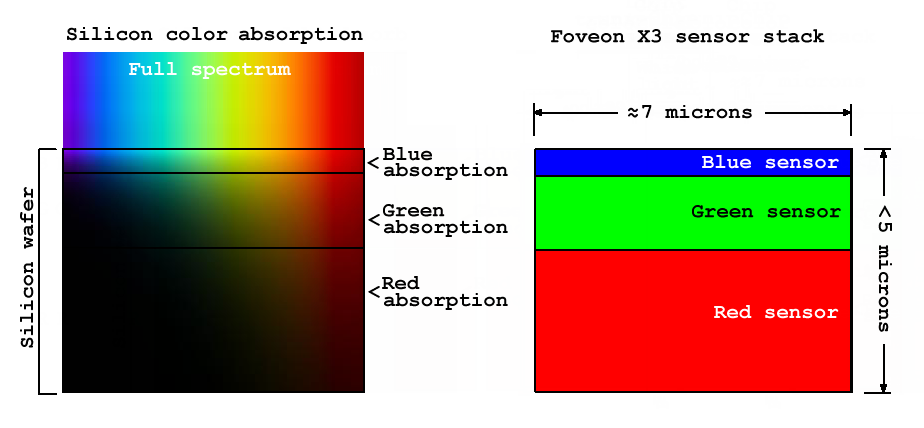 Foveon X3 sensorImage sensor of Sigma cameras
Further reading
 🇯🇵 JapanFujifilm X-Trans sensor
Image sensor with a unique colour filter patternSensor
🇺🇸 United StatesFoveon X3 sensor
Image sensor using stacked photodiodes for colour captureSensor · 2002
🇯🇵 JapanExmor
Sony's CMOS image sensor series with on-chip conversion and noise reductionSensor · Other · 2008
 🇯🇵 JapanSuper CCD
Proprietary image sensor with octagonal pixels by FujifilmSensor · 1999
🇯🇵 JapanMilbeaut
Image and video processing system on a chip for camerasSoC · Arm · 2000
🇺🇸 United StatesDigital micromirror device
MEMS chip of tiny tilting mirrors that forms images in DLP projectorsSensor · Other · 1990
 WorldAPS-C
Image sensor format matching Advanced Photo System Classic film size.Sensor · 1999
🇯🇵 JapanBack-illuminated sensor
Image sensor design that moves wiring behind pixels for better light captureSensor · 1994
 🇯🇵 JapanNikon CX format
Image sensor format for Nikon 1 mirrorless camerasSensor · 2011
WorldStaring array
Two-dimensional image sensor for infrared and optical detectionSensor
WorldNanophotonic coherent imager
Image sensor capturing 3D depth and appearance via LIDAR arraysSensor
 🇺🇸 United StatesMicrobolometer
Uncooled infrared sensor for thermal imaging camerasSensor · 1992
 🇺🇸 United StatesQuantum well infrared photodetector
Infrared sensor using quantum wells for detectionSensor · 1987
🇯🇵 JapanHole accumulation diode
Noise reduction structure for imaging sensorsSensor
 🇺🇸 United StatesCharge-coupled device
Integrated circuit sensor that converts light into digital images.Sensor · 1969
🇯🇵 JapanExmor
A family of CMOS image sensors developed by Sony for cameras and mobile devices.Sensor
🇰🇷 South KoreaSamsung Bio Processor
A low-power health monitoring system on a chip by Samsung.SoC · 2015
Photo credits on this page
The small pictures above come from Wikimedia Commons under free licences. Some are cropped to fit.
- Fujifilm X-Trans sensor: Tomás Freres, CC BY 4.0, source
- Intel 4004: the Science Museum, CC BY 4.0, source
- Foveon X3 sensor: Anoneditor at English Wikipedia, CC BY-SA 3.0, source
- Charge-coupled device: Merzperson ( talk ) ( Uploads ), Public domain, source
- Quantum well infrared photodetector: SK, CC BY-SA 4.0, source
- Apple S1: Henriok, CC0, source
- Super CCD: Ashley Pomeroy, CC BY 3.0, source
- Texas Instruments LPC Speech Chips: Orginal photo © Bill Bertram 2006, editing by user:Tomhannen, CC BY-SA 2.5, source
- APS-C: Outdoor-Bro, CC BY-SA 4.0, source
- Nikon CX format: decltype, CC BY-SA 3.0, source
- Microbolometer: Unknown author, Public domain, source
- Digital micromirror device: mitopencourseware, CC BY-SA 4.0, source
- TMS1000: Pauli Rautakorpi, CC BY 3.0, source