Back-illuminated sensor
Image sensor design that moves wiring behind pixels for better light capture
A back-illuminated sensor is a digital image chip that flips the silicon wafer to place wiring behind the light-sensitive layer. This arrangement boosts low-light performance by allowing more photons to reach the photocathode, a technique pioneered for mass markets by Sony and OmniVision in 2009.
- Captures over 90% of incoming photons compared to 60% in traditional sensors
- First widely used in consumer devices by Sony and OmniVision in 2009
- Improves low-light performance by placing wiring behind the light-sensitive layer
- Used in iPhone 4, GoPro Hero3, and Nikon D850 cameras
What it is
A back-illuminated sensor is a type of digital image sensor that rearranges its internal components to capture more light. Unlike traditional designs where wiring sits in front of the light-sensitive elements, this technology places the wiring behind the photocathode layer. This shift significantly improves the chance of capturing incoming photons, raising efficiency from about 60% to over 90%. The result is superior performance in low-light conditions and partial sun. While the concept dates back to 1994, it became viable for consumer electronics after manufacturers solved complex production issues.
How it came about
The technique was initially limited to niche roles like astronomy and security cameras due to high costs and manufacturing complexity. OmniVision Technologies sampled its first sensors using this method in 2007, though they remained expensive. A major breakthrough occurred in 2009 when Sony introduced its Exmor R CMOS sensor at consumer prices. That same year, OmniVision launched the OV5650, which Apple selected for the iPhone 4 camera. These launches marked the transition of back-illuminated technology from specialized industrial use to widespread adoption in smartphones and compact cameras.
Inside the chip
Traditional sensors place the active matrix and wiring on the front surface, which blocks some incoming light. Back-illuminated designs flip the silicon wafer during production and thin the reverse side. This allows light to strike the photocathode directly without passing through the wiring layer. The benefit is most pronounced in small pixels, where the relative area gained is larger. However, moving transistors behind the sensor can cause crosstalk, leading to image noise and color mixing. Thinning the wafer also makes it more fragile, requiring precise manufacturing to maintain yield and uniformity.
How it was made
Manufacturing these sensors involves flipping the silicon wafer and thinning its back side, a process that historically lowered yields and raised prices. Sony addressed these challenges with new photodiode materials and processes, enabling mass production. Samsung later adopted the technology for larger APS-C sensors. The fabrication requires high precision to avoid defects caused by the fragile thinned silicon. Improvements in the uniformity of the active layer were key to reducing costs and making the technology commercially viable for general consumer devices.
Where it went
These sensors are now standard in many smartphones, including the HTC EVO 4G and iPhone 4. They are also found in action cameras like the GoPro Hero3 Black and mirrorless cameras such as the Sony α7R II and Nikon D850. The technology supports higher resolution without sacrificing low-light capability, making it ideal for mobile photography. It is also used in industrial sensors, microscope cameras, and astronomy systems where light capture is critical. Recent applications include full-frame digital SLR cameras and compact system cameras.
Versions and family
A further development is the stacked CMOS sensor, which layers circuitry and image signal processors behind the pixels. Sony commercialized this as Exmor RS in 2012, claiming a 30% increase in light capture. Partially stacked sensors integrate high-speed memory into the stack, offering faster readout speeds than standard BSI designs at a lower cost than fully stacked versions. The Nikon Z6III uses a partially stacked sensor, while the Nikon Z9 and Canon EOS R3 feature fully stacked variants. These evolutions continue to improve frame rates and autofocus performance.
Why it matters
The introduction of back-illuminated sensors allowed smartphone cameras to achieve better low-light performance, changing consumer expectations for mobile photography. It enabled the megapixel race to continue without the usual drop in sensitivity associated with smaller pixels. By allowing smaller chips to maintain high resolution and light capture, it helped reduce costs and device thickness. The technology has become a major selling point for camera modules in consumer electronics, influencing design choices across the industry from phones to professional interchangeable-lens cameras.
Problems and reception
The iPhone 4 camera received good reviews for its low-light photos, highlighting the benefits of the OmniVision OV5650 sensor. Sony’s Exmor R was praised for improving low-light performance by up to two times. The technology was seen as a solution to the limitations of front-illuminated sensors in compact devices. Adoption by major manufacturers like Apple, Samsung, and Nikon validated the approach, leading to its widespread use in flagship devices. Critics noted early issues with yield and cost, but these were largely resolved through process improvements.
Questions people ask about Back-illuminated sensor
How does a back-illuminated sensor differ from a traditional one?
Traditional sensors have wiring in front of the light-sensitive layer, which blocks some light. Back-illuminated sensors flip the wafer so wiring sits behind the photocathode, allowing more light to reach the pixels and improving efficiency.
Why are back-illuminated sensors better in low light?
By removing the wiring obstruction from the path of incoming light, these sensors capture more photons. This increases the signal available for image creation, resulting in clearer pictures in dim conditions without needing larger pixels.
Which companies pioneered this technology for consumers?
OmniVision Technologies sampled early versions in 2007, but Sony and OmniVision made it widely available in 2009. Sony introduced its Exmor R sensor, while OmniVision supplied the sensor for the Apple iPhone 4.
Good reading and sources
The facts on this page come from the Wikipedia article "Back-illuminated sensor", written by its contributors and used under the CC BY-SA 4.0 licence, and from its Wikidata record (CC0). EveryChip rewrote the text in its own words, with AI assistance, and compares every page with the article to make sure no passage is copied. It may be reused under the same CC BY-SA 4.0 licence with a link back.
It may contain mistakes, and figures change over time. Nothing here is investment or buying advice. If something is wrong, tell us. Last refreshed 2026-11-14.
Like Back-illuminated sensor
All image and other sensors 🇺🇸 United StatesDigital micromirror device
MEMS chip of tiny tilting mirrors that forms images in DLP projectorsSensor · Other · 1990
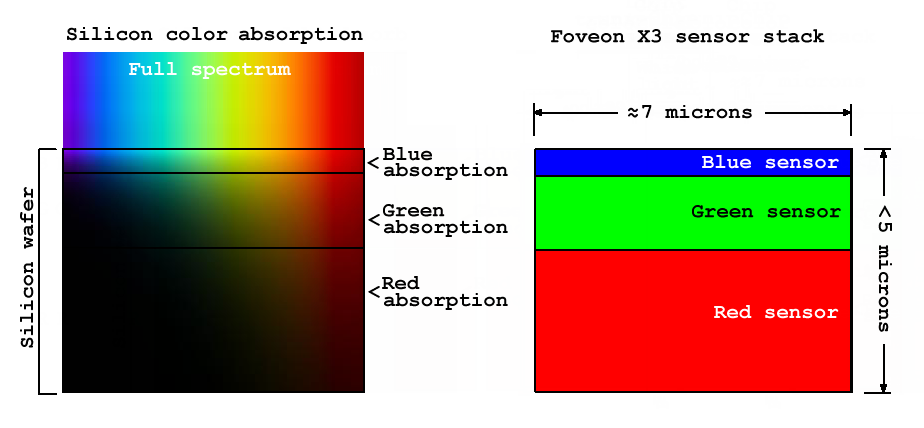 🇺🇸 United StatesFoveon X3 sensor
Image sensor using stacked photodiodes for colour captureSensor · 2002
More from Sony
All of them 🇺🇸 United StatesRDRAM
High-bandwidth serial memory developed by Rambus for PCs and consoles.Memory · 1996
 🇰🇷 South KoreaDDR SDRAM
First generation double data rate memory standard for computers.Memory · 1998
 WorldAPS-C
Image sensor format matching Advanced Photo System Classic film size.Sensor · 1999
 WorldOpenRISC
Open-source RISC processor architecture and reference implementationsCPU · RISC · 2000