Foveon X3 sensor
Image sensor using stacked photodiodes for colour capture
Designed by Foveon and launched in 2002, the X3 sensor captures red, green and blue light at each pixel site. It uses vertically stacked photodiodes instead of a colour filter array, aiming for higher spatial resolution and eliminating demosaicing artifacts.
- Uses three vertically stacked photodiodes per pixel
- Eliminates need for demosaicing and anti-aliasing filters
- First deployed in Sigma SD9 camera in 2002
- Manufactured by Dongbu Electronics for Foveon
- New full-frame development stalled in stage 2 by 2026
What it is
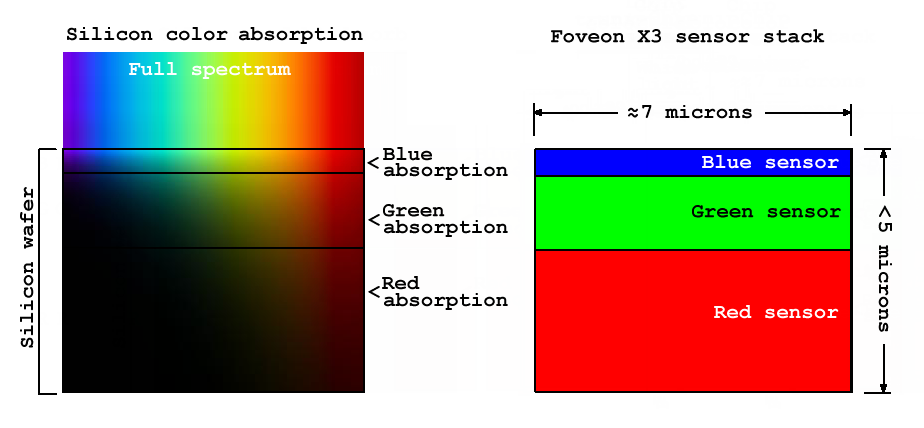
The Foveon X3 is a digital image sensor that records colour information differently from standard chips. Instead of placing a colour filter over a single layer of light detectors, it stacks three photodiodes vertically at each pixel location. Silicon absorbs different wavelengths of light at different depths, allowing the top, middle and bottom layers to detect blue, green and red light respectively. This design removes the need for demosaicing, a computational process used by most sensors to guess missing colour data. The technology was developed by Foveon, Inc., which later became part of Sigma Corporation, and first appeared in consumer cameras in 2002.
How it came about
Kodak patented a similar stacked detector concept in the late 1970s, but Foveon brought the technology to market. The first camera to use the sensor was the Sigma SD9 digital SLR, released in 2002. Polaroid attempted to use the technology in its x530 compact camera in 2005, but recalled the device due to image quality issues. Sigma continued to refine the sensor for its DSLR and compact lines, including the DP1 and DP2 models launched in 2008 and 2009. In 2021, Sigma reported a critical flaw in its next-generation full-frame development, forcing a restart. By March 2026, the new sensor remained in the second stage of prototyping.
Inside the chip
Each photosite on the X3 sensor contains three vertically stacked photodiodes. Light enters the silicon wafer, with shorter wavelengths absorbed near the surface and longer wavelengths penetrating deeper. The signals from these three layers are combined using a matrix process to create standard RGB colour data. Because every pixel captures full colour information, the sensor does not require an anti-aliasing filter to prevent colour moiré patterns. However, the depth required for red light detection can cause electron diffusion, leading to some loss of sharpness in longer wavelengths. The lack of separate colour filters means the sensor can theoretically gather more light, though aggressive processing may increase noise in low-light conditions.
How it was made
Dongbu Electronics manufactured the sensors for Foveon and Sigma. The physical depth of the three sensor layers is less than five micrometres, which minimises effects on focusing. This structure allows the sensor to avoid the interpolation steps needed by Bayer-filter sensors, potentially offering higher effective spatial resolution for a given number of photodiodes.
Where it went
The sensor powered a range of Sigma cameras, starting with the SD9, SD10, SD14 and SD15 DSLRs. It also featured in the mirrorless DP1, DP2 and their successors, as well as the SD Quattro series. The Sigma SD1, aimed at professionals, used a high-resolution APS-C version of the chip. Polaroid briefly used a smaller format in its x530 compact camera. As of 2025, Sigma had discontinued all cameras using the X3 sensor, having shifted focus to developing a new full-frame variant that has faced significant developmental delays.
Versions and family
Early iterations included a 3.54-megapixel array in the SD9 and a 4.64-megapixel version in the SD14. The SD1 introduced a 15.36-megapixel APS-C sensor. Marketing often multiplied the photodiode count by three, leading to debates over whether a 10.2-megapixel claim referred to photosites or total diodes. Independent tests suggested the resolution equated to roughly 5 to 9 megapixels on a standard Bayer sensor. The Quattro series introduced a modified stack, but the core X3 technology remained distinct from conventional CMOS designs.
Why it matters
The X3 sensor challenged industry standards for measuring resolution and colour fidelity. It demonstrated that removing the Bayer filter could eliminate colour artifacts and improve sharpness in specific conditions. Reviewers noted superior colour resolution compared to equivalent Bayer sensors, though monochrome detail sometimes lagged. The technology highlighted the trade-offs between native colour capture and the noise performance of stacked silicon layers. Despite its technical uniqueness, it remained a niche product due to higher costs and lower low-light performance compared to mainstream CMOS sensors.
Problems and reception
Reviewers praised the sensor for its lack of colour moiré and rich colour detail. However, critics pointed out higher noise levels at high ISO settings and during long exposures. The method of specifying megapixels caused confusion, with some arguing the counts were inflated compared to Bayer sensors. The Polaroid x530 recall damaged early confidence in the technology outside of Sigma’s ecosystem. While respected for image quality in good light, the sensor struggled to compete with the improving low-light capabilities and lower costs of standard CMOS alternatives.
Questions people ask about Foveon X3 sensor
How does the Foveon X3 sensor differ from standard sensors?
Standard sensors use a Bayer filter where each pixel detects only one colour. The Foveon X3 stacks three photodiodes at each pixel location, capturing red, green and blue light simultaneously by exploiting how silicon absorbs different wavelengths at different depths.
Why do Foveon megapixel counts seem higher than Bayer equivalents?
Foveon counts each of the three stacked photodiodes as a separate pixel. A sensor with 3.4 million photosites is often marketed as 10.2 megapixels. In practice, independent tests suggest its resolution is comparable to a 5 to 9 megapixel Bayer sensor.
What are the main disadvantages of the X3 sensor?
The sensor tends to produce more noise in low-light conditions and at high ISO settings. Electron diffusion in the deeper red-sensitive layer can reduce sharpness. It is also more expensive to manufacture than standard CMOS sensors with colour filter arrays.
Is the Foveon X3 sensor still in production?
As of 2025, Sigma has discontinued all cameras using the existing X3 sensor. The company is developing a new full-frame version, but as of March 2026, it remains in the second stage of prototyping after earlier flaws forced a restart.
Good reading and sources
The facts on this page come from the Wikipedia article "Foveon X3 sensor", written by its contributors and used under the CC BY-SA 4.0 licence, and from its Wikidata record (CC0). EveryChip rewrote the text in its own words, with AI assistance, and compares every page with the article to make sure no passage is copied. It may be reused under the same CC BY-SA 4.0 licence with a link back.
It may contain mistakes, and figures change over time. Nothing here is investment or buying advice. If something is wrong, tell us. Last refreshed 2026-11-14.
Like Foveon X3 sensor
All image and other sensors 🇯🇵 JapanSuper CCD
Proprietary image sensor with octagonal pixels by FujifilmSensor · 1999