
APS-C
Image sensor format matching Advanced Photo System Classic film size.
APS-C is an image sensor format introduced in 1999. It matches the dimensions of Advanced Photo System Classic film negatives. Manufacturers use these sensors in digital single-lens reflex and mirrorless cameras. The format is smaller than standard 35 mm film, resulting in a cropped field of view.
- Introduced in 1999 based on film standards
- Typical sensor size is 23.5 by 15.6 mm
- Canon uses a 1.6x crop factor
- Most other brands use a 1.5x crop factor
- Used in DSLR and mirrorless cameras
What it is
APS-C stands for Advanced Photo System type-C. It is an image sensor format used in digital cameras. The size approximates the Classic format of Advanced Photo System film negatives. Dimensions are roughly 25.1 by 16.7 millimetres. This format is common in digital single-lens reflex cameras and mirrorless interchangeable-lens cameras. Some digital rangefinders also use APS-C sensors. The format is smaller than standard 35 mm film. Consequently, it captures only part of the image circle from a lens. This effect is known as cropping. Manufacturers produce specific lenses to match this sensor size.
How it came about
The format originated in 1999. It derives its name and dimensions from the Advanced Photo System film standard. The Classic format within that system defined the aspect ratio and size. Digital camera makers adopted these dimensions for their sensors. This allowed them to create cameras smaller than full-frame models. Over time, major brands developed dedicated lens lines. Canon introduced EF-S lenses in 2003. Fujifilm launched its X-mount system in 2012. These developments solidified APS-C as a distinct category in digital photography.
Inside the chip
Sensor sizes vary slightly between manufacturers. Canon sensors typically measure 22.3 by 14.9 millimetres. Other brands often use 23.5 by 15.6 millimetres. The range spans from 20.7 by 13.8 millimetres to 28.7 by 19.1 millimetres. This variation affects the crop factor. Canon uses a multiplier of 1.6 times. Most other manufacturers use 1.5 times. Sigma and some older Canon models use 1.7 times. The crop factor changes the effective focal length of lenses. A 28 mm lens on an APS-C camera acts like a 45 mm lens on a full-frame camera. This results in a narrower angle of view.
How it was made
It notes that sensors exist in many variants. Each manufacturer produces its own versions. The physical dimensions are the defining characteristic. The format is equivalent to Super 35 motion picture film in some aspects. Super 35 measures 24.89 by 18.66 millimetres. APS-C sensors are considerably smaller than 35 mm standard film, which is 36 by 24 millimetres.
Where it went
APS-C sensors appear in many consumer cameras. They are found in digital single-lens reflex bodies. Mirrorless interchangeable-lens cameras frequently use this format. Some large-sensor live-preview digital cameras also employ APS-C. Digital rangefinders occasionally use them too. Lens manufacturers design optics specifically for these sensors. Canon offers EF-S, EF-M, and RF-S lenses. Nikon provides DX format glass. Sony has DT and E-mount options. Fujifilm uses X-mount. Pentax produces DA lenses. Third-party makers like Sigma, Tamron, and Tokina also create compatible lenses.
Versions and family
Several crop factors exist across different models. Canon mostly uses 1.6 times. Nikon, Sony, Pentax, and Fujifilm generally use 1.5 times. Sigma has used 1.7 times and 1.35 times. Some older Canon professional models use 1.3 times. Samsung NX series cameras used 1.54 or 1.53 times. Leica M8 and M8.2 used a 1.3 times factor. Kodak digital camera backs also utilized various multipliers. Each variant requires specific lens designs to avoid vignetting. Full-frame lenses can often be used in crop mode. This reduces resolution but maintains compatibility.
Why it matters
APS-C established a middle ground between compact sensors and full-frame systems. It enabled smaller camera bodies and lighter lenses. The format became standard for entry-level and enthusiast cameras. Many professional photographers use APS-C for its reach advantage. The crop factor effectively extends telephoto lens range. This benefits wildlife and sports photography. The ecosystem of dedicated lenses supports diverse photographic needs. Brands continue to release new models using this sensor size.
Questions people ask about APS-C
What does APS-C stand for?
It stands for Advanced Photo System type-C. The name refers to the Classic format of the Advanced Photo System film standard. The sensor size matches the dimensions of that film negative.
How does APS-C differ from full-frame sensors?
APS-C sensors are smaller than 35 mm full-frame sensors. Full-frame measures 36 by 24 mm. APS-C is typically around 23.5 by 15.6 mm. This smaller size captures a cropped portion of the image.
What is the crop factor?
The crop factor is a multiplier that compares the sensor size to 35 mm film. It determines the effective focal length. A 1.5x factor means a 50 mm lens behaves like a 75 mm lens.
Can I use full-frame lenses on APS-C cameras?
Yes, in many cases. Full-frame lenses often mount on APS-C bodies. The camera may crop the image automatically. Some lenses designed for APS-C cannot mount on full-frame bodies.
Good reading and sources
The facts on this page come from the Wikipedia article "APS-C", written by its contributors and used under the CC BY-SA 4.0 licence, and from its Wikidata record (CC0). EveryChip rewrote the text in its own words, with AI assistance, and compares every page with the article to make sure no passage is copied. It may be reused under the same CC BY-SA 4.0 licence with a link back.
It may contain mistakes, and figures change over time. Nothing here is investment or buying advice. If something is wrong, tell us. Last refreshed 2026-11-14.
Like APS-C
All image and other sensors 🇯🇵 JapanSuper CCD
Proprietary image sensor with octagonal pixels by FujifilmSensor · 1999
🇯🇵 JapanMilbeaut
Image and video processing system on a chip for camerasSoC · Arm · 2000
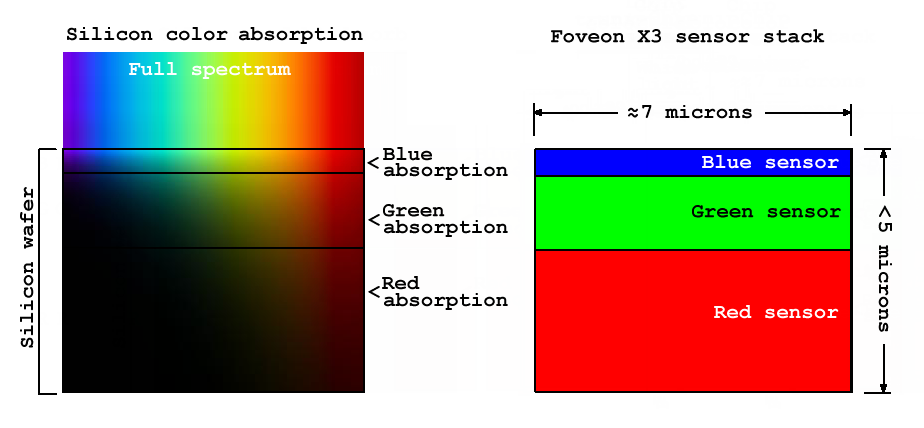 🇺🇸 United StatesFoveon X3 sensor
Image sensor using stacked photodiodes for colour captureSensor · 2002
🇯🇵 JapanBack-illuminated sensor
Image sensor design that moves wiring behind pixels for better light captureSensor · 1994
More from Canon
All of them 🇺🇸 United StatesRDRAM
High-bandwidth serial memory developed by Rambus for PCs and consoles.Memory · 1996
🇺🇸 United StatesPower Processing Element
64-bit PowerPC core for PlayStation 3 and Xbox 360CPU · Power · 2005
 🇯🇵 JapanExpeed
Nikon media processor series for digital camerasSoC · Arm · 2007
 🇺🇸 United StatesCell Broadband Engine
A multi-core RISC processor pairing one PowerPC core with eight vector coprocessors.CPU · Power · 2007