CPUs and microprocessors
The 4004, 8086, 68000, Pentium, Athlon, Core, Ryzen, Xeon and EPYC: general-purpose processors. 505 chips on EveryChip so far.
A central processing unit (CPU) is the general-purpose processor of a computer: it fetches instructions from memory, decodes them and carries them out, one after another, very fast. A microprocessor is a CPU built on a single chip. The first commercial one, the Intel 4004, arrived in 1971 with 2,300 transistors. Today's server CPUs have tens of billions of transistors and up to a few hundred cores.
What is inside
A CPU core has a control unit that decodes instructions, arithmetic units that add, multiply and compare, registers that hold the numbers being worked on, and caches, small fast memories that keep recently used data close. Modern cores run a pipeline, in which several instructions are in different stages at once, and guess which way branches will go so that the pipeline stays full.
From one core to many
For about thirty years CPUs got faster mainly by raising the clock speed. Around 2004 power and heat stopped that climb near 4 GHz, and designers turned to putting several cores on one chip instead. AMD and Intel shipped dual-core PC processors in 2005. Today a phone CPU may mix large fast cores with small efficient ones, and server chips are often built from several chiplets in one package.
Famous CPU chips
 Intel 4004The first commercial microprocessor, 1971
 Intel 80861978; began the x86 line still used in PCs
 Motorola 6800032-bit design inside the first Macintosh
 PentiumIntel's 1993 superscalar x86 chip
 Athlon 64First 64-bit x86 desktop processor, 2003ZenAMD's 2017 core design behind Ryzen and Epyc
 EpycAMD's chiplet server processors
Further reading
 🇺🇸 United StatesGracemont
Intel's fourth-generation low-power Atom core design, used in Alder Lake and Raptor Lake.CPU · x86 · 2021
 🇮🇱 IsraelIntel Core microarchitecture
Intel's 2006 multi-core CPU design that replaced NetBurst across desktops, laptops and serversCPU · x86 · 2006
 🇺🇸 United StatesIntel 486DX2
A 486 CPU whose internal clock ran at twice the bus speedCPU · x86 · 1992
 WorldIntel 80386EX
Embedded variant of the 386 with on-chip peripherals, launched in 1994CPU · x86 · 1994
 🇺🇸 United StatesArrandale
Intel's 2010 dual-core laptop chips with graphics and memory control on packageCPU · x86 · 2010
 🇹🇼 TaiwanVIA C3
Low-power x86 CPU family for budget PCs and embedded systemsCPU · x86 · 2001
 🇺🇸 United StatesEfficeon
Low-power x86 processor using software translationCPU · x86 · 2004
 🇯🇵 JapanNEC V20
Pin-compatible 16-bit microprocessor with Intel 8088 compatibilityCPU · x86 · 1984
 🇮🇱 IsraelIce Lake
Intel 10 nm mobile and server processors with Sunny Cove coresCPU · x86 · 2019
🇺🇸 United StatesEmerald Rapids
Fifth-generation Xeon server processors from IntelCPU · x86 · 2023
 🇺🇸 United StatesIntel 80186
16-bit microprocessor with integrated peripherals for embedded systemsCPU · x86 · 1982
 🇹🇼 TaiwanVIA CoreFusion
Low-power x86 system-on-chip line by VIA TechnologiesSoC · x86 · 2003
 🇺🇸 United StatesI486
32-bit microprocessor with on-chip cache and FPUCPU · x86 · 1989
 🇹🇼 TaiwanUMC Green CPU
Pin-compatible x86 alternative to the Intel 80486 from UMCCPU · x86 · 1990
 🇺🇸 United StatesCyrix Cx486
x86 desktop microprocessor competing with Intel 486CPU · x86 · 1993
🇺🇸 United StatesSandy Bridge-E
32 nm server and workstation processors from IntelCPU · x86 · 2011
 🇺🇸 United StatesIntel Core
Multi-core x86 CPUs for PCs and servers by Intel.CPU · x86 · 2006
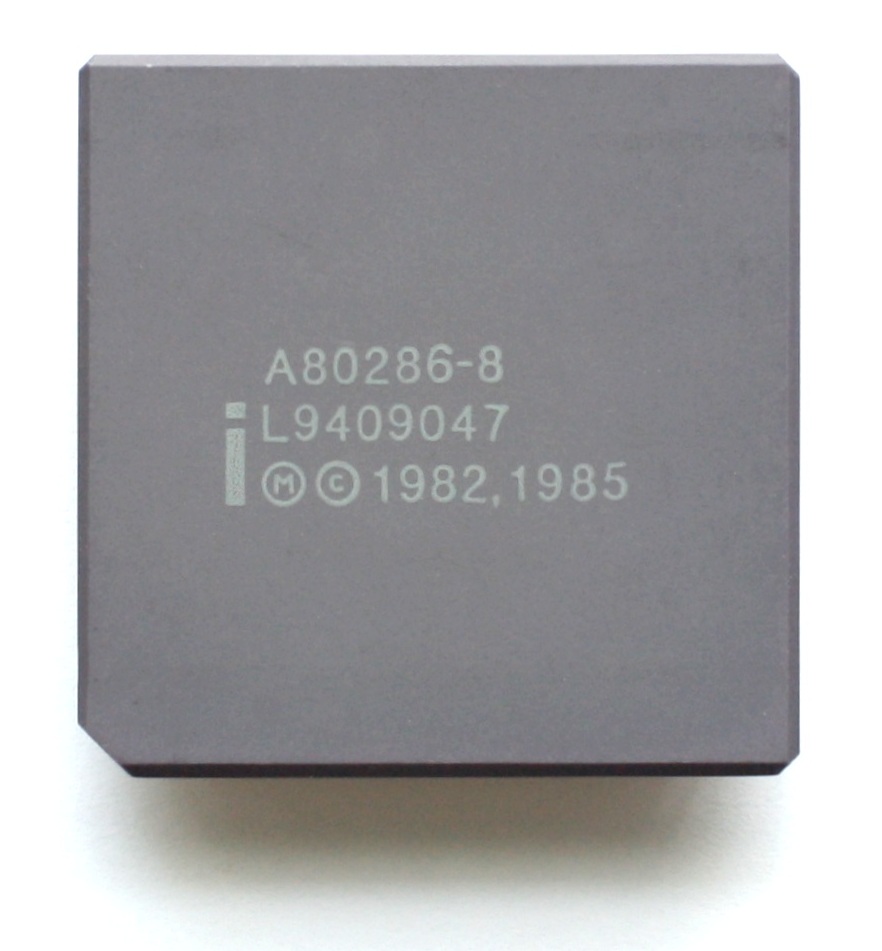 🇺🇸 United StatesIntel 80286
16-bit microprocessor with protected mode and 16 MB memory supportCPU · x86 · 1982
 🇯🇵 JapanNEC V20
Pin-compatible 16-bit microprocessor with Intel 8088 compatibilityCPU · x86 · 1982
 🇺🇸 United StatesI386
First 32-bit x86 microprocessor by IntelCPU · x86 · 1985
🇺🇸 United StatesIntel 80286
16-bit microprocessor with protected mode and 16 MB memory supportCPU · x86 · 1982
WorldIAPX
A short-lived Intel marketing prefix for 8086-family and iAPX 432 chips.CPU · x86
WorldSandy Bridge-E
High-end desktop and server processors based on the 32 nm Sandy Bridge architecture.CPU · x86
Photo credits on this page
The small pictures above come from Wikimedia Commons under free licences. Some are cropped to fit.
- Epyc: Smial ( talk ), FAL, source
- Intel 8086: Thomas Nguyen, CC BY-SA 4.0, source
- Intel 80286: Konstantin Lanzet (with permission), CC BY-SA 3.0, source
- Intel 4004: the Science Museum, CC BY 4.0, source
- Motorola 68000: en:User:ArnoldReinhold, CC BY-SA 3.0, source
- Pentium: Pdesousa359, CC BY-SA 3.0, source
- Gracemont: Saneandsad, CC BY-SA 4.0, source
- Intel Core microarchitecture: Eric Gaba ( Sting - fr:Sting ), CC BY-SA 4.0, source
- Intel 486DX2: Unknown author, CC BY-SA 2.0, source
- Intel 80386EX: Konstantin Lanzet, CC BY 3.0, source
- Arrandale: Ptrump16, CC BY 4.0, source
- VIA C3: Endorphin, CC BY-SA 2.5, source
- Efficeon: Photographed by Qurren ( talk ), with IXY Digital 10 compact digital c, CC BY-SA 3.0, source
- NEC V20: Myself User:ZyMOS, CC BY-SA 4.0, source
- Ice Lake: Fritzchens Fritz, CC0, source
- UMC Green CPU: Pauli Rautakorpi, CC BY 3.0, source
- Cyrix Cx486: Appaloosa, CC BY-SA 3.0, source
- Intel 80186: Armin Kübelbeck, CC BY-SA 3.0, source
- VIA CoreFusion: Konstantin Lanzet, CC BY-SA 3.0, source
- I486: Konstantin Lanzet, GFDL, source
- Intel Core: Köf3, CC BY-SA 3.0, source
- NEC V20: Raimond Spekking, CC BY-SA 4.0, source
- I386: Konstantin Lanzet, CC BY-SA 3.0, source
- Athlon 64: Astraera, CC BY-SA 4.0, source