Sandy Bridge-E
High-end desktop and server processors based on the 32 nm Sandy Bridge architecture.
Intel released these microprocessors in late 2011 for workstations and servers. They succeeded the Gulftown models and offered up to eight physical cores with advanced instruction sets.
- Released in Q4 2011 by Intel Corporation.
- Supports up to 8 physical cores and 16 threads.
- Uses 32 nm manufacturing process.
- Features up to 20 MB of L3 cache.
- Replaced the Gulftown processor generation.
What it is
Sandy Bridge-E refers to a group of Intel microprocessors launched in the fourth quarter of 2011. These chips target high-end desktop enthusiasts, workstations, and server environments. Although marketed under various brand names including Core i7 Extreme Edition, they share architectural roots with Xeon processors. The design supports multiple socket types depending on the specific model variant. This family represents a significant step forward from previous generations by integrating more cores and enhanced features.
How it came about
The Sandy Bridge-E series succeeded the six-core Gulftown and Westmere-EP processors. Those earlier models relied on the older LGA 1366 package format. Intel moved to newer socket standards like LGA 2011 to accommodate increased connectivity and power requirements. The transition marked a shift towards supporting higher core counts and improved memory bandwidth for demanding professional applications.
Inside the chip
Built on the 32 nm Sandy Bridge microarchitecture, these CPUs support the x86 instruction set. They feature up to eight physical cores, which can handle sixteen threads through Hyper-Threading technology. Each core includes a 256 kB level two cache, while the shared level three cache reaches up to 20 MB. Key instructions include AVX for vector processing and AES-NI for encryption. Some lower-end models disable Turbo Boost or Hyper-Threading to meet specific performance tiers.
How it was made
Manufactured using Intel's 32 nm process technology, the die sizes vary across different stepping revisions. For instance, certain steppings show die areas around 216 mm² or 131 mm². The processors are packaged in several formats, primarily LGA 2011 for enthusiast and server boards, alongside LGA 1356 and LGA 1155 options. A mobile embedded variant uses the BGA 1284 package. No external foundry is listed for production.
Where it went
These chips serve diverse computing needs ranging from personal high-performance desktops to enterprise infrastructure. The LGA 2011 variants cater to workstation users requiring multi-threaded performance. Server deployments utilize the EP and EN variants for scalable data center operations. Embedded systems employ the Gladden series for specialized industrial tasks. The absence of integrated graphics in most Xeon models allows for dedicated GPU usage.
Versions and family
The lineup includes five distinct families based on socket type. Sandy Bridge-E targets high-end desktops via LGA 2011. Sandy Bridge-EP serves servers and workstations also on LGA 2011. Sandy Bridge-EN uses LGA 1356 for dual-processor servers. Standard Sandy Bridge Xeon operates on LGA 1155. Finally, Gladden utilizes BGA 1284 for embedded applications. Ivy Bridge-E eventually replaced this entire generation.
Why it matters
This architecture extended the lifespan of the LGA 2011 platform significantly. It allowed users to upgrade from older sockets without changing motherboards immediately. The integration of AVX instructions improved performance for scientific and media workloads. By offering flexible core counts, it bridged the gap between consumer and server markets effectively.
Questions people ask about Sandy Bridge-E
What socket does Sandy Bridge-E use?
It primarily uses the LGA 2011 socket for high-end desktop and server models. Other variants utilize LGA 1356, LGA 1155, or BGA 1284 depending on the specific application tier.
Is it compatible with older motherboards?
No, it requires new platforms. It replaced the Gulftown processors that used LGA 1366. Users must upgrade to LGA 2011 or other supported sockets to run these chips.
Does it support AVX instructions?
Yes, all models in the Sandy Bridge family support Advanced Vector Extensions (AVX). This enhances performance for parallel computing tasks and multimedia processing.
Good reading and sources
The facts on this page come from the Wikipedia article "Intel Sandy Bridge-based Xeon microprocessors", written by its contributors and used under the CC BY-SA 4.0 licence, and from its Wikidata record (CC0). EveryChip rewrote the text in its own words, with AI assistance, and compares every page with the article to make sure no passage is copied. It may be reused under the same CC BY-SA 4.0 licence with a link back.
It may contain mistakes, and figures change over time. Nothing here is investment or buying advice. If something is wrong, tell us. Last refreshed 2026-11-15.
Like Sandy Bridge-E
All CPUs and microprocessors 🇺🇸 United StatesI386
First 32-bit x86 microprocessor by IntelCPU · x86 · 1985
 🇺🇸 United StatesP6
Intel's sixth x86 design, first with out-of-order executionCPU · x86 · 1995
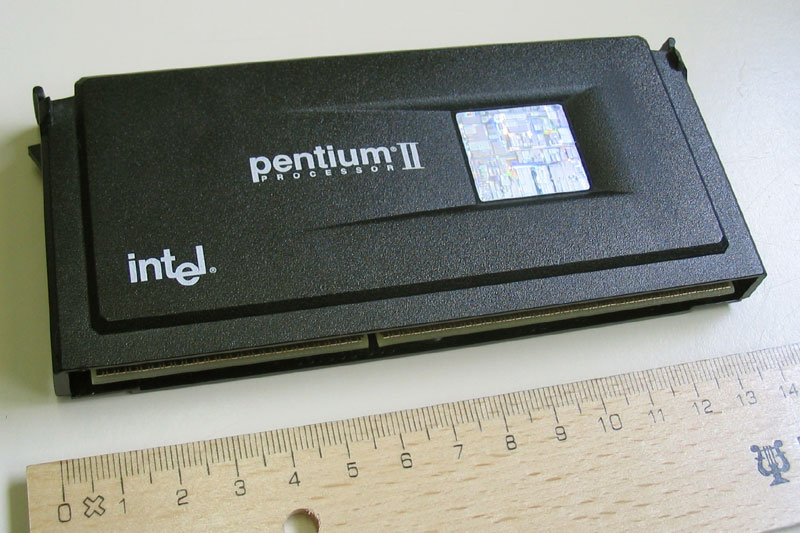 🇺🇸 United StatesPentium II
Intel's 1997 P6 desktop CPU line with MMX, sold in a slot cartridgeCPU · x86 · 1997
 🇺🇸 United StatesXeon
Intel's x86 processor brand for servers, workstations and embedded systems since 1998CPU · x86 · 1998