Internet of things
Wireless microcontrollers and low-power chips for connected devices. 63 chips on EveryChip so far.
Internet of things (IoT) chips connect small devices to networks: smart plugs, door sensors, wearables, trackers, meters and industrial monitors. They combine a low-power microcontroller with a radio for Wi-Fi, Bluetooth Low Energy, Zigbee, Thread or cellular networks such as NB-IoT. Many must run for years on a small battery, waking only to take a reading and send it.
Radio plus controller
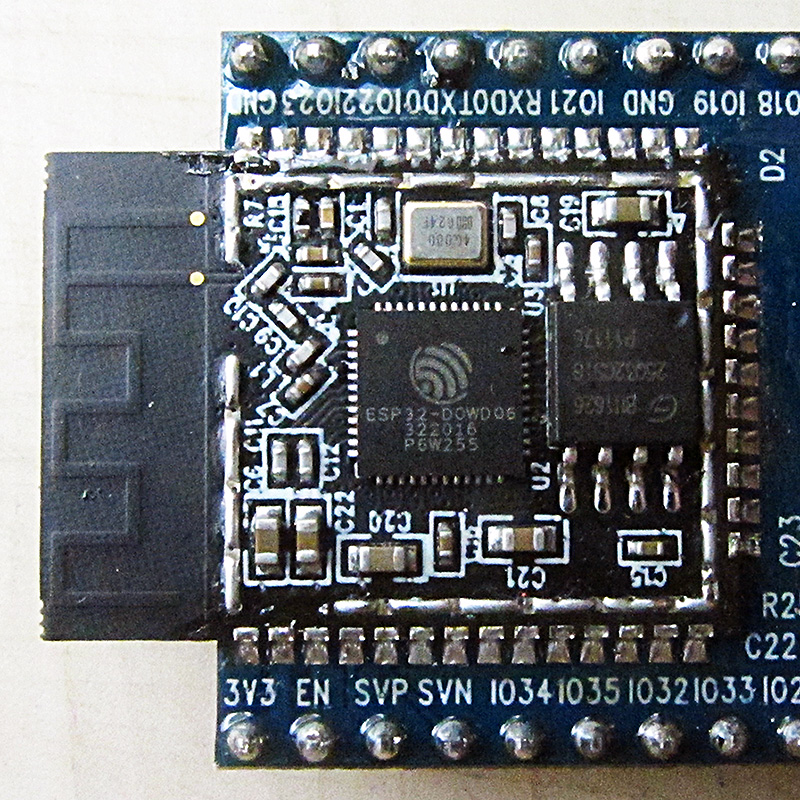
Espressif's ESP8266 of 2014 put Wi-Fi and a processor on one very cheap chip, and its ESP32 of 2016 added Bluetooth and a second core. They became favourites of hobbyists and of makers of smart home gadgets. Nordic Semiconductor, Silicon Labs, TI and NXP make Bluetooth and Thread chips built around Arm Cortex-M cores.
Power and security
An IoT chip saves energy by sleeping almost all the time, drawing microamps, and waking for milliseconds to measure and transmit. Security is a common weakness: many cheap devices shipped with weak passwords or no updates, and were taken over in attacks such as the Mirai botnet of 2016. Newer chips add secure storage for keys and signed firmware updates.
Famous internet of things chips



Further reading
 WorldZilog Z8
Microcontroller architecture with extensive on-chip registersMicrocontroller · Other · 1979
 🇺🇸 United StatesPIC microcontroller
Microchip's long-running family of 8-bit to 32-bit microcontrollersMicrocontroller · MIPS · 1976
 🇺🇸 United StatesMSP430
A 16-bit mixed-signal microcontroller family designed for very low power use.Microcontroller · Other · 1992
 🇺🇸 United StatesATmega88
8-bit AVR microcontroller with 8K flash memoryMicrocontroller · Other
 🇺🇸 United StatesATtiny
Compact 8-bit AVR microcontroller family for simple embedded tasksMicrocontroller · Other · 1999
 WorldBPI:Bit
ESP32-based single-board microcontroller with sensors and LED matrixMicrocontroller · Other · 2018
WorldBASIC Atom
Self-contained microcontrollers with built-in BASIC interpretersMicrocontroller · Other
Photo credits on this page
The small pictures above come from Wikimedia Commons under free licences. Some are cropped to fit.
- ESP32: Brian Krent, CC BY-SA 4.0, source
- ATtiny: Torsten Landschoff, Public domain, source
- PIC microcontroller: Raimond Spekking, CC BY-SA 4.0, source
- MSP430: Travis Goodspeed, CC BY 2.0, source
- ESP8266: Laserlicht, CC BY-SA 4.0, source
- Zilog Z8: Konstantin Lanzet, CC BY-SA 3.0, source
- ATmega88: Raimond Spekking, CC BY-SA 4.0, source
- BPI:Bit: Sinovoip, CC BY-SA 4.0, source
- RP2040: Phiarc, CC BY-SA 4.0, source
- ARM Cortex-M: Viswesr, CC BY-SA 3.0, source