
BPI:Bit
ESP32-based single-board microcontroller with sensors and LED matrix
The BPI:Bit is a compact embedded system board released in 2018 by Banana Pi and Webduino. It uses an ESP32 module with an Xtensa processor, Wi-Fi, Bluetooth, and onboard motion sensors for educational and prototyping tasks.
- Uses ESP32 with Xtensa LX6 processor
- Features 25 RGB LEDs and motion sensors
- Supports Wi-Fi and Bluetooth LE connectivity
- Manufactured using TSMC 40 nm process
- Compatible with Arduino and Webduino code
What it is
The BPI:Bit is a small single-board microcontroller designed for embedded projects and education. Released in 2018, it was developed by Banana Pi and Webduino. The board measures 5 cm by 5 cm and integrates an ESP32 module. This module provides wireless connectivity via Wi-Fi and Bluetooth Low Energy. It features a built-in display of 25 LEDs, two programmable buttons, and various sensors. The device connects to other hardware through a 23-pin edge connector with five ring terminals. It can run on USB power or an external battery pack.
How it came about
Banana Pi and Webduino collaborated to create this board as part of their educational hardware line. The design leverages the ESP32 system-on-chip from Espressif Systems. The board was introduced in 2018 to support both Arduino and Webduino programming environments. Source code for these platforms is available on GitHub. The project aims to simplify access to IoT development for students and hobbyists by combining processing power with onboard sensors and connectivity in a compact form factor.
Inside the chip
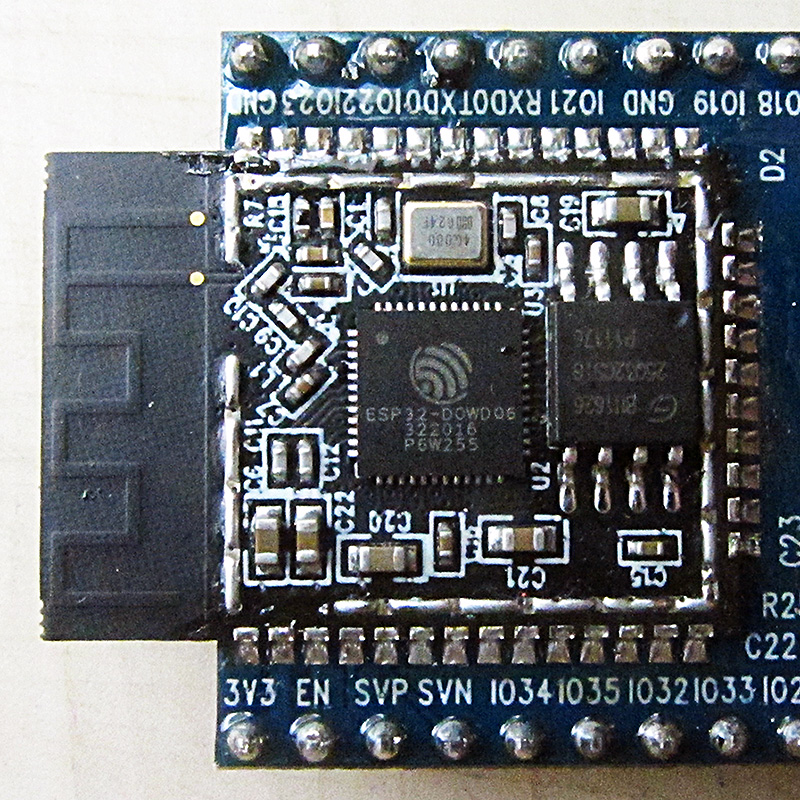
At its core, the board uses an ESP32 module featuring an Xtensa 32-bit LX6 processor. This CPU can operate as a single or dual-core unit with clock speeds up to 240 MHz. It includes 448 KB of read-only memory and 520 KB of static RAM. For motion tracking, it employs an MPU-9250 nine-axis sensor. This component combines a gyroscope, accelerometer, and magnetometer in one package. The board also has a 25-LED RGB matrix capable of displaying over 16 million colors. Interfaces include photosensitive, temperature, and digital compass sensors.
How it was made
The central ESP32 chip is manufactured using TSMC 40 nanometer process technology. This node was chosen for its balance of power consumption and radio frequency performance. The MPU-9250 sensor module is a multi-chip package containing two separate dies. One die holds the motion sensors, while the other contains the magnetometer from Asahi Kasei Microdevices. The board itself is assembled with a 23-pin edge connector for easy integration with expansion boards or breadboards.
Where it went
This microcontroller is suited for Internet of Things prototypes and classroom learning. Its onboard Wi-Fi and Bluetooth allow it to connect to networks without extra shields. The integrated LED matrix and buttons make it useful for simple games or visual feedback projects. Developers use it for applications requiring motion detection, such as gesture control or orientation sensing. It supports coding in Arduino C++ and Webduino block-based languages, lowering the barrier for new programmers.
Versions and family
The BPI:UNO32 is a related board that also uses the ESP32 chip but matches the Arduino UNO R3 form factor. Another variant, the BPI:Smart, uses the older ESP8266 chip and is smaller in size. The BPI:Bit is distinct for its square shape and integrated LED grid. All these boards are supported by the same open-source repositories on GitHub. They share compatibility with Webduino and Arduino ecosystems, allowing code reuse across different hardware layouts.
Why it matters
The board contributes to the ecosystem of low-cost, connected microcontrollers. By integrating complex sensors like the nine-axis motion tracker directly onto the board, it reduces the need for external wiring. This simplification helps educators teach concepts of sensor fusion and wireless communication. The availability of source code on GitHub encourages community modifications and shared learning resources. It serves as a bridge between basic electronics and advanced IoT application development.


Questions people ask about BPI:Bit
What processor does the BPI:Bit use?
It uses an ESP32 module with an Xtensa 32-bit LX6 processor. This CPU can run at speeds up to 240 MHz and operates as either a single or dual-core unit.
Does it have wireless connectivity?
Yes, the board includes built-in 2.4 GHz Wi-Fi and Bluetooth Low Energy. This allows it to connect to networks and other devices without additional hardware modules.
What sensors are included on the board?
It features an MPU-9250 nine-axis motion sensor, which includes a gyroscope, accelerometer, and magnetometer. It also supports interfaces for light and temperature sensors.
How is the board powered?
The BPI:Bit can be powered via a MicroUSB connection or by an external battery pack. This flexibility makes it suitable for both desktop testing and portable projects.
Good reading and sources
The facts on this page come from the Wikipedia article "Webduino", written by its contributors and used under the CC BY-SA 4.0 licence, and from its Wikidata record (CC0). EveryChip rewrote the text in its own words, with AI assistance, and compares every page with the article to make sure no passage is copied. It may be reused under the same CC BY-SA 4.0 licence with a link back.
It may contain mistakes, and figures change over time. Nothing here is investment or buying advice. If something is wrong, tell us. Last refreshed 2026-11-14.
Like BPI:Bit
All microcontrollers 🇨🇳 ChinaESP32
Low-cost Wi-Fi and Bluetooth microcontroller family from Espressif SystemsMicrocontroller · RISC · 2016
 WorldESP32
Low-cost microcontroller with Wi-Fi and Bluetooth by Espressif SystemsMicrocontroller · x86 · 2016
 WorldESP32
Low-cost microcontroller with Wi-Fi and Bluetooth made by Espressif Systems.Microcontroller · Arm · 2016
🇨🇳 ChinaESP32
Low-cost Wi-Fi and Bluetooth microcontroller familyMicrocontroller · RISC · 2016