Other and custom
Transputers, Lisp machines, Soviet and Chinese designs and one-off architectures. 263 chips on EveryChip so far.
Not every processor fits a big family. This group holds one-off and national designs: the British transputer built for parallel computing, Intel's ambitious iAPX 432, machines built to run the Lisp language, the Linn Rekursiv, and the Chinese ShenWei chips of the Sunway supercomputers. Some failed commercially but left ideas that later designs reused.
Ambitious experiments
Intel's iAPX 432 of 1981 tried to build object protection and garbage collection into hardware; it was slow and was dropped, while the stopgap 8086 succeeded. Inmos's transputer put serial links on every chip so that processors could be wired into networks. The Rekursiv, designed for the hi-fi maker Linn in the late 1980s, ran object-oriented programs in microcode.
National designs
Countries cut off from Western chips have built their own. The Soviet Union cloned and extended Western designs. China's ShenWei SW26010, with 260 cores, powered the Sunway TaihuLight, the world's fastest supercomputer from June 2016 to June 2018, made entirely with Chinese-designed processors. Loongson's LoongArch, introduced in 2021, is another home-grown instruction set.
Famous other chips


Further reading
 🇺🇸 United StatesHP FOCUS
First commercial single-chip 32-bit microprocessor from 1982CPU · Other · 1982
 🇯🇵 JapanNEC µPD780C
Zilog Z80 compatible 8-bit microprocessor by NECCPU · Other
 WorldCSG 65CE02
Enhanced 8-bit microprocessor with expanded memory featuresCPU · Other · 1988
🇺🇸 United StatesIBM PALM processor
16-bit CPU module used in early IBM portable computersCPU · Other · 1975
 🇺🇸 United StatesATtiny
Compact 8-bit AVR microcontroller family for simple embedded tasksMicrocontroller · Other · 1999
 WorldZ15
IBM mainframe processor with on-chip compression and eDRAM cacheCPU · Other · 2019
 WorldIBM z10
Quad-core mainframe processor from IBM released in 2008CPU · Other · 2008
 🇳🇱 NetherlandsNexperia
Brand for NXP media and mobile system-on-chipsSoC · Arm · 1999
WorldOOPic
Object-oriented PIC microcontroller with virtual circuitsMicrocontroller · Other
🇺🇸 United StatesZ13
Mainframe microprocessor by IBM using 22 nm processCPU · Other · 2015
🇺🇸 United StatesZEC12
IBM mainframe processor with 5.5 GHz clock speedCPU · Other · 2012
🇺🇸 United StatesZ14
High-frequency mainframe CPU from IBM using 14 nm processCPU · Other · 2017
🇯🇵 JapanR8C Tiny
Low-cost 16-bit microcontroller series by RenesasMicrocontroller · Other
🇺🇸 United StatesIntel i750
Two-chip video processor for early digital video captureGPU · Other · 1991
🇺🇸 United States and 1 moreZ196
High-speed mainframe microprocessor by IBMCPU · Other · 2010
 🇺🇸 United States and 1 moreMC10800
4-bit bit-sliced processor in ECL logic from 1979CPU · Other · 1979
🇺🇸 United StatesAxcent
Audio-visual control microcontroller by AMXMicrocontroller · Other
 🇯🇵 JapanRX Microcontroller Family
32-bit microcontrollers for industrial and automotive controlMicrocontroller · Other · 2009
🇳🇴 NorwayZPU
Open-source stack microprocessor for FPGAsMicrocontroller · Other · 2008
WorldJStik
A microcontroller that runs Java bytecode as native machine code.Microcontroller · Other
WorldNVDLA
Open-source AI accelerator hardware by NvidiaAI accelerator · Other · 2017
 🇯🇵 JapanΜCOM-4
NEC original 4-bit single-chip microprocessor from 1973Microcontroller · Other · 1973
 WorldZ80182
Enhanced Z80 microprocessor with integrated peripheralsMicrocontroller · Other
 🇺🇸 United StatesZilog Z80
An 8-bit microprocessor that powered early personal computers and game consoles.CPU · Other · 1976
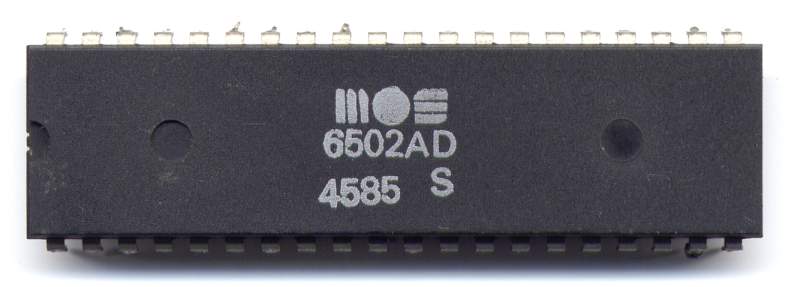 🇺🇸 United StatesMOS Technology 6502
Low-cost 8-bit microprocessor that powered the home computer revolutionCPU · Other · 1975
WorldCSG 65CE02
Enhanced 8-bit microprocessor from Commodore Semiconductor GroupCPU · Other · 1988
 🇺🇸 United StatesZilog Z80
An 8-bit microprocessor that powered early personal computers and game consoles.CPU · Other · 1976
 🇯🇵 JapanMemory Management Controller
Special chips in NES cartridges that expand console memory limitsMicrocontroller · Other · 1985
 🇺🇸 United StatesSuperCPU
Processor upgrade cartridge for Commodore 64 and 128 systemsCPU · Other · 1997
🇨🇦 CanadaNeurochip
Silicon chip for sensing and stimulating neuronal cellsSensor · Other · 2010
 🇺🇸 United StatesTrueNorth
IBM neuromorphic chip mimicking brain structureAI accelerator · Other · 2014
 🇯🇵 JapanYamaha YM2164
FM synthesis sound chip for MIDI synthesizers and expansion cardsAnalog · Other
 🇯🇵 JapanMSX-Engine
Integrated circuit combining MSX computer functions into one chip.SoC · Other
 🇺🇸 United StatesMP944
Custom MOS chipset for the F-14 Tomcat flight computerCPU · Other · 1970
WorldIOIO
Open source microcontroller board for Android hardware controlMicrocontroller · Other · 2011
 🇨🇿 Czech RepublicTurbo SIM
Microcontroller add-on for GSM SIM cards to bypass network locksMicrocontroller · Other · 2004
WorldBASIC Atom
Self-contained microcontrollers with built-in BASIC interpretersMicrocontroller · Other
WorldIAPX
A short-lived Intel marketing prefix for 8086-family and iAPX 432 chips.CPU · x86
🇺🇸 United StatesBlockscale
Intel crypto-mining accelerator ASIC for SHA-256Mining or security · Other · 2022
 WorldBPI:Bit
ESP32-based single-board microcontroller with sensors and LED matrixMicrocontroller · Other · 2018
 🇺🇸 United StatesOPD Mini Processor
Proprietary 16-bit microprocessor for IBM word processorsCPU · Other · 1977
 🇺🇸 United StatesRealityEngine
High-end 3D graphics hardware by Silicon GraphicsGPU · Other · 1992
🇺🇸 United StatesIMPACT
High-end graphics architecture for SGI workstationsGPU · Other · 1995
🇺🇸 United StatesExtreme Graphics
High-end graphics architecture for SGI workstationsGPU · Other · 1993
 🇺🇸 United StatesMasPar MP-2 PE
32-element SIMD processor chip for MasPar supercomputersCPU · Other · 1987
WorldGeometric Arithmetic Parallel Processor
A mesh-connected array of single-bit SIMD processing elements for parallel computing.AI accelerator · Other · 1981
Photo credits on this page
The small pictures above come from Wikimedia Commons under free licences. Some are cropped to fit.
- Transputer: NobbiP, CC BY-SA 3.0, source
- MOS Technology 6502: Dirk Oppelt, CC BY-SA 3.0, source
- F-14 Central Air Data Computer: Camera Operator: SSGT MICHAEL D. GADDIS, USAF, Public domain, source
- HP FOCUS: Thomas Schanz, CC BY-SA 3.0, source
- ATtiny: Torsten Landschoff, Public domain, source
- MasPar MP-2 PE: SmashIt, CC BY-SA 4.0, source
- RealityEngine: Retro-Computing Society of Rhode Island, CC BY-SA 3.0, source
- Intel iAPX 432: _brouhaha_, CC BY-SA 2.0, source
- Zilog Z80: Zilog Inc., Public domain, source
- NEC μCOM series: Konstantin Lanzet, CC BY-SA 3.0, source
- IBM z10: TreyGeek, Public domain, source
- MC10800: Konstantin Lanzet, CC BY-SA 3.0, source
- NEC µPD780C: Konstantin Lanzet, CC BY-SA 4.0, source
- CSG 65CE02: Machine Later versions were uploaded by Chaddy ., CC BY-SA 3.0, source
- RX Microcontroller Family: Cristiano Tomás, CC BY-SA 4.0, source
- Nexperia: Ikknmnmnm, CC BY-SA 4.0, source
- MSX-Engine: Yaca2671, CC BY-SA 3.0, source
- TrueNorth: DARPA SyNAPSE, Public domain, source
- SuperCPU: Thomas Conté, CC BY-SA 2.0, source
- Yamaha YM2164: Metroplex, CC BY-SA 3.0, source
- Turbo SIM: Tom Reynolds, CC BY 2.0, source
- BPI:Bit: Sinovoip, CC BY-SA 4.0, source
- OPD Mini Processor: Norsk Teknisk Museum, CC BY-SA 3.0, source
- Z15: Agiorgio, CC BY-SA 4.0, source
- Memory Management Controller: Evan-Amos, Public domain, source
- Zilog Z80: User Baz1521 on ja.wikipedia, CC BY-SA 3.0, source
- Z80182: Raimond Spekking, CC BY-SA 4.0, source