Data centres and servers
Xeon, EPYC, Graviton, H100 and the chips of the cloud. 296 chips on EveryChip so far.
Data centres and cloud servers use the largest and most power-hungry chips: server CPUs with up to a few hundred cores, AI accelerators drawing 700 W to over 1,000 W each, network chips and DPUs, and huge amounts of memory. Intel's Xeon and AMD's Epyc dominate general-purpose servers, while Arm designs such as Amazon's Graviton have grown fast. Nvidia's GPUs lead in AI.
Server CPUs
A server processor is built for many tasks at once and for long, reliable running. It supports large amounts of error-correcting memory, many PCIe lanes for storage and network cards, and two or more sockets on one board. AMD's Epyc, launched in 2017, used chiplets to fit more cores than single-die designs, and took a large share of the market from Intel's Xeon.
Custom cloud chips
The largest cloud companies now design their own chips. Amazon has Graviton CPUs and Trainium and Inferentia AI chips, Google its TPU and Axion CPU, and Microsoft its Cobalt CPU and Maia accelerator. They buy fewer standard parts this way and tune chips to their own software. The power used by AI servers has become a constraint on where data centres can be built.
Famous data centres and servers chips


Still to be written: AWS Graviton.
Further reading
 WorldDDR5 SDRAM
Fifth-generation synchronous DRAM standard with on-die ECC and dual subchannelsMemory · 2020
WorldHybrid Memory Cube
Stacked DRAM with a serial link interface, built by Samsung and MicronMemory · Other · 2011
 WorldDDR2 SDRAM
Second-generation double data rate memory standard for computersMemory · 2003
 🇰🇷 South KoreaDDR SDRAM
First generation double data rate memory standard for computers.Memory · 1998
 WorldDDR3 SDRAM
Third-generation double data rate memory standard released in 2007Memory · 2007
 🇰🇷 South KoreaSDRAM
Memory chips synchronised to a clock signal for higher bandwidthMemory · 1992
🇺🇸 United StatesMCDRAM
High-bandwidth 3D-stacked memory for Intel Xeon Phi processorsMemory
 WorldNvSRAM
Fast static memory with built-in non-volatile storage for data retention.Memory
WorldZ-RAM
Capacitor-less DRAM technology using the floating body effect.Memory
 WorldMagnetoresistive RAM
Non-volatile memory storing data in magnetic domainsMemory · 1980
 🇰🇷 South KoreaHigh Bandwidth Memory
Stacked memory interface for high-performance computing and graphics.Memory · 2013
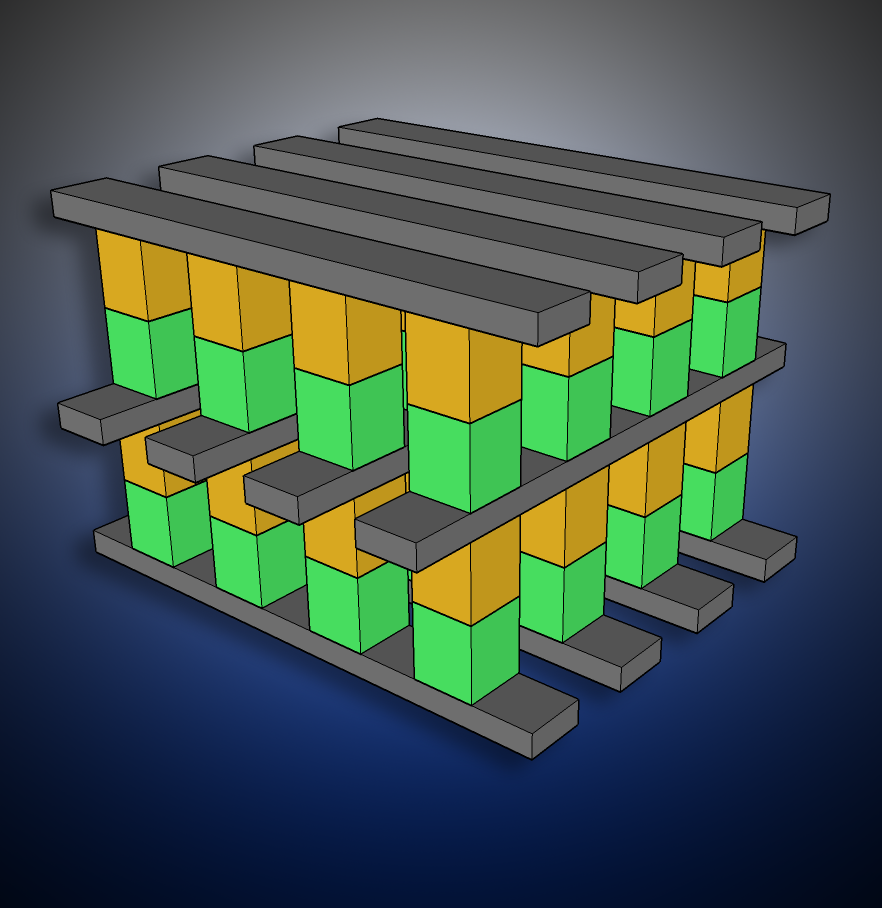 🇺🇸 United States3D XPoint
Non-volatile memory from Intel and Micron, sold as OptaneMemory · 2015
 WorldDDR4 SDRAM
Fourth-generation synchronous dynamic random-access memory standardMemory · 2012
 🇺🇸 United StatesIntel 1103
First commercially available DRAM integrated circuitMemory · 1970
 WorldDRAM
Volatile semiconductor memory using capacitors and transistors for high-density storage.Memory
 🇰🇷 South KoreaDDR2 SDRAM
Second-generation double data rate memory standard for computers.Memory · 2003
🇺🇸 United StatesHyperCloud Memory
High-density DDR3 server memory module by NetlistMemory · 2009
🇺🇸 United StatesIBM 2365 Processor Storage
Magnetic-core memory unit for IBM System/360 mainframesMemory · 1965
 🇺🇸 United StatesIBM 2361
Magnetic core memory expansion for IBM System/360 mainframesMemory
 🇺🇸 United StatesULLtraDIMM
Flash storage module for DDR3 memory slotsMemory
🇺🇸 United StatesIBM 2395 Processor Storage
Main memory unit for IBM System/360 mainframesMemory
 WorldElectrochemical RAM
Non-volatile memory for analog deep learning accelerationMemory · Other
Photo credits on this page
The small pictures above come from Wikimedia Commons under free licences. Some are cropped to fit.
- DDR5 SDRAM: Jacek Halicki, CC BY-SA 4.0, source
- Epyc: Smial ( talk ), FAL, source
- Granite Rapids: Intel Corporation, Public domain, source
- DDR2 SDRAM: An-d, CC BY-SA 3.0, source
- Electrochemical RAM: Goldenvu, CC BY-SA 4.0, source
- PC133: Vitaly Zdanevich, CC0, source
- 3D XPoint: Trolomite, CC BY-SA 4.0, source
- DDR4 SDRAM: smial, FAL, source
- Intel 1103: Thomas Nguyen, CC BY-SA 4.0, source
- DDR SDRAM: CrazyD, CC BY-SA 3.0, source
- DDR3 SDRAM: Kjerish, CC BY-SA 4.0, source
- NvSRAM: Raimond Spekking, CC BY-SA 4.0, source
- Magnetoresistive RAM: Daderot, CC0, source
- Tensor Processing Unit: Norman P. Jouppi, George Kurian, Sheng Li, Peter Ma, Rahul Nagarajan,, CC BY 4.0, source
- High Bandwidth Memory: Fritzchens Fritz, CC0, source
- DRAM: Appaloosa, CC BY-SA 3.0, source
- DDR2 SDRAM: Raimond Spekking, CC BY-SA 4.0, source
- Hopper: 极客湾Geekerwan, CC BY 3.0, source
- IBM 2361: Bubba73 , Jud McCranie, CC BY-SA 4.0, source
- ULLtraDIMM: FlashStorage, CC BY-SA 3.0, source