3D XPoint
Non-volatile memory from Intel and Micron, sold as Optane
3D XPoint is a non-volatile memory technology developed jointly by Intel and Micron Technology, announced in July 2015 and sold on the open market as Intel Optane from April 2017 to July 2022. It stores bits through a change in bulk resistance inside a stackable cross-grid array, and it mattered because it delivered very low write latency and byte addressing without the tricks used to speed up ordinary SSDs.
- Announced July 2015 by Intel and Micron Technology
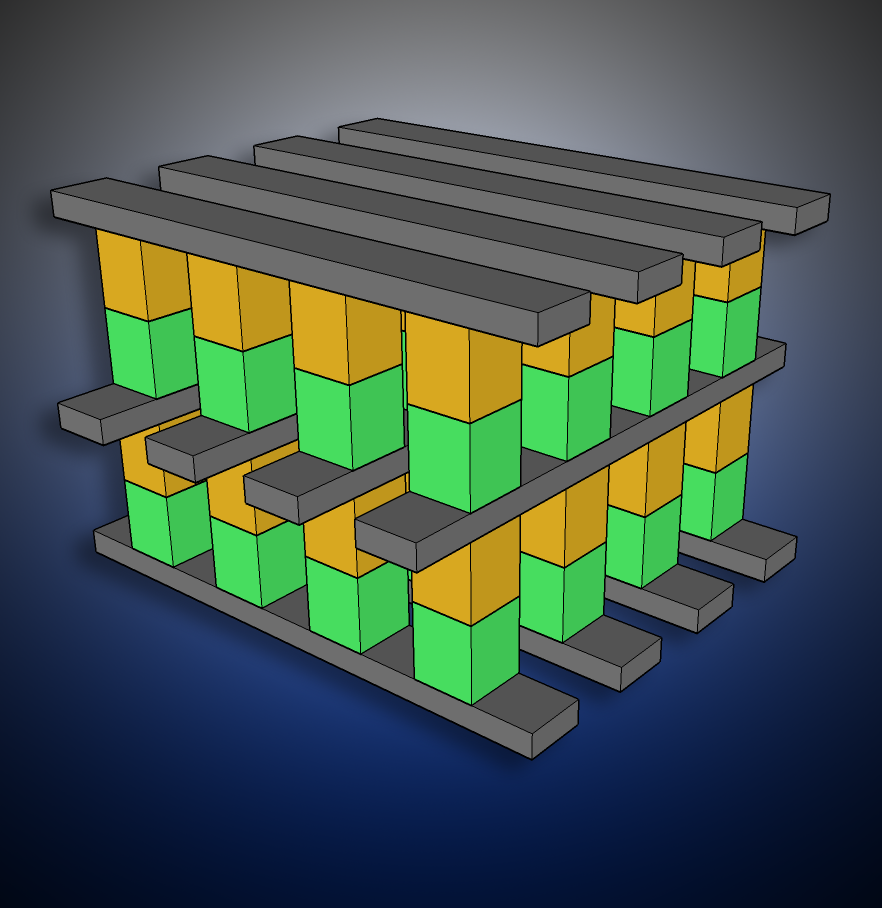
- Bits stored as a change in bulk resistance in a stackable cross-grid array
- First chips were 128 Gbit parts stacking two 64 Gbit planes
- Sold as Intel Optane from April 2017 to July 2022
- Lehi, Utah fab sold to Texas Instruments for US$900 million
What it is
3D XPoint is a non-volatile memory technology built by Intel and Micron Technology. It was revealed in July 2017 and reached the open market under Intel's Optane brand from April 2017 through July 2022. Bits are held as a change in the bulk resistance of the cell material, arranged in a cross-grid array that can be stacked in layers. The access element is an Ovonic Threshold Switch rather than a transistor. Because the memory is fast and byte-addressable, the read-modify-write steps and caching layers that ordinary SSDs rely on are not needed. Early pricing sat below DRAM but above flash memory.
How it came about
Work on 3D XPoint started around 2012, following earlier phase-change memory efforts by both partners. Micron's Mark Durcan said the design differed from earlier PCM and used chalcogenide materials for both the selector and the storage element, chosen for speed and stability over GST. Small volumes of 128 Gbit chips came out of the IM Flash plant in Lehi, Utah during 2015, with mass production expected within 12 to 18 months. Intel showed PCIe development boards at its 2016 developer forum and announced its first product, a PCIe card, on March 19, 2017.
Inside the chip
Each cell stores a bit through a shift in the bulk resistance of its material, and cells sit at the crossings of a grid that stacks vertically. Threshold switches made from a selenium–germanium–silicon compound with arsenic doping act as selectors in place of transistors. Reverse engineering by TechInsights found germanium–antimony–tellurium with low silicon content as the storage material. The memory is bit-addressable and byte-addressable, so it can be read and written in small units rather than whole blocks. Intel Optane Persistent Memory works with Cascade Lake Xeon Scalable processors in Memory Mode, App Direct Mode or Mixed Mode.
How it was made
The first chips were 128 Gbit parts stacking two 64 Gbit planes, produced in small quantity from 2015 at the IM Flash Technologies wafer fab in Lehi, Utah. That plant never ran at full capacity and was later sold to Texas Instruments for US$900 million. Devices shipped in M.2, U.2 and PCI Express add-in card formats, and persistent memory modules fitted standard DIMM slots.
Where it went
Most Optane products appear to the host as NVMe solid-state drives and work with a wide range of chipsets and CPUs, Intel or otherwise. A subset branded Intel Optane Memory can act as a cache for a slower drive on supported Intel platforms, with the Rapid Storage Technology driver picking the hot data. Some Optane SSDs with Intel Memory Drive Technology can also serve as extra main memory with operating system help, up to eight times the real memory capacity. Optane Persistent Memory modules of up to 512 GB plug into DIMM slots and work as memory or as a fast persistent store.
Versions and family
Intel sold Optane SSDs, Optane Memory caching devices and combined Optane Memory with Solid-State Storage units. Micron offered SSDs only, in add-in card form, under the QuantX name such as the QuantX X100. Some early Optane-branded SSDs were in fact NAND drives with an Optane cache. The persistent memory modules of 2019, also called Data Center Persistent Memory Modules, are NVDIMMs with about an order of magnitude more latency than SDRAM.
Why it matters
3D XPoint became the most widely produced standalone memory not based on charge storage, while rival ideas such as ReRAM and magnetoresistive RAM stayed mostly on embedded platforms. Reviewers found Optane SSDs around 2.5 times as fast as Intel's earlier P3700 data-centre drives in read, write and mixed tests, and enterprise parts held a clear lead on large transfers. Micron left the technology in March 2021 to work on Compute Express Link products, and Intel wound down its Optane division in July 2022.
Problems and reception
The first release drew a lukewarm response, but the Optane range later won strong reviews for low-latency work. Storage Review measured sustained 500,000 IOPS on 4K reads and writes with 3 to 15 microsecond latencies in August 2018. Tom's Hardware called the Optane 900p a mythical creature in December 2017 and said it doubled the speed of the best earlier consumer drives. AnandTech found consumer Optane SSDs close to the best NAND drives on large transfers, well behind the enterprise parts.

Questions people ask about 3D XPoint
What kind of memory is 3D XPoint?
It is a non-volatile memory, meaning it keeps its data without power. Bits are stored as a change in the bulk resistance of the cell material inside a stackable cross-grid array, with an Ovonic Threshold Switch acting as the selector instead of a transistor.
Who made it and where?
Intel and Micron Technology developed it together. Chips were produced by IM Flash Technologies LLC, their joint venture, at a wafer fab in Lehi, Utah, which began small-volume output of 128 Gbit parts in 2015.
How was it sold?
Intel sold it as Optane, in SSD, Optane Memory caching and persistent memory forms, while Micron sold QuantX SSDs in add-in card format. Devices used M.2, U.2 or PCI Express cards, and persistent memory modules fitted DIMM slots.
Why did it stop?
Micron said in March 2021 that it would end 3D XPoint work in favour of Compute Express Link products because demand was lacking, and the Lehi fab went to Texas Instruments. Intel wound down its Optane division in July 2022.
Good reading and sources
The facts on this page come from the Wikipedia article "3D XPoint", written by its contributors and used under the CC BY-SA 4.0 licence, and from its Wikidata record (CC0). EveryChip rewrote the text in its own words, with AI assistance, and compares every page with the article to make sure no passage is copied. It may be reused under the same CC BY-SA 4.0 licence with a link back.
It may contain mistakes, and figures change over time. Nothing here is investment or buying advice. If something is wrong, tell us. Last refreshed 2026-11-14.
Like 3D XPoint
All memory chips 🇺🇸 United StatesIntel 1103
First commercially available DRAM integrated circuitMemory · 1970
 WorldDDR4 SDRAM
Fourth-generation synchronous dynamic random-access memory standardMemory · 2012
 WorldDDR5 SDRAM
Fifth-generation synchronous DRAM standard with on-die ECC and dual subchannelsMemory · 2020
 WorldDDR3 SDRAM
Third-generation double data rate memory standard released in 2007Memory · 2007
More from Intel
All of them 🇺🇸 United States and 1 moreSkylake
Intel's 2015 sixth-generation Core microarchitecture, built on 14 nmCPU · x86 · 2015
 🇺🇸 United StatesXeon D
Intel's low-power x86 system-on-chip line for microserversCPU · x86 · 2015
 🇺🇸 United States and 1 moreKaby Lake
Intel's 7th-gen Core CPUs on a refined 14 nm processCPU · x86 · 2016
🇺🇸 United States and 1 moreGoldmont
Low-power Atom microarchitecture for entry-level SoCs, up to four cores.CPU · x86 · 2016