x86 and x86-64
From the 8086 to Core and Ryzen: the instruction set of the PC and most servers. 195 chips on EveryChip so far.
x86 is the instruction set that began with Intel's 8086 of 1978 and still runs most PCs and servers. An instruction set is the list of commands a processor understands, the contract between hardware and software. x86 grew from 16 bits to 32 bits with the 80386 in 1985 and to 64 bits with AMD's x86-64, first shipped in the Opteron in 2003. Intel and AMD are its main makers.
Compatibility above all
x86's great strength is that software written decades ago still runs. Each generation added instructions, such as MMX, SSE and AVX for working on many numbers at once, without dropping the old ones. Inside, modern x86 chips break complex instructions into simpler internal operations, so their cores work much like RISC designs, while the outside stays compatible.
Intel, AMD and others
IBM chose the Intel 8088 for its PC in 1981 and asked for a second source, which led to AMD making x86 chips. Over the years Cyrix, VIA, Transmeta and China's Zhaoxin also made x86 processors. AMD defined the 64-bit extension that Intel later adopted. In 2024 Intel and AMD formed an advisory group to keep the instruction set consistent across their chips.
Famous x86 chips


Further reading
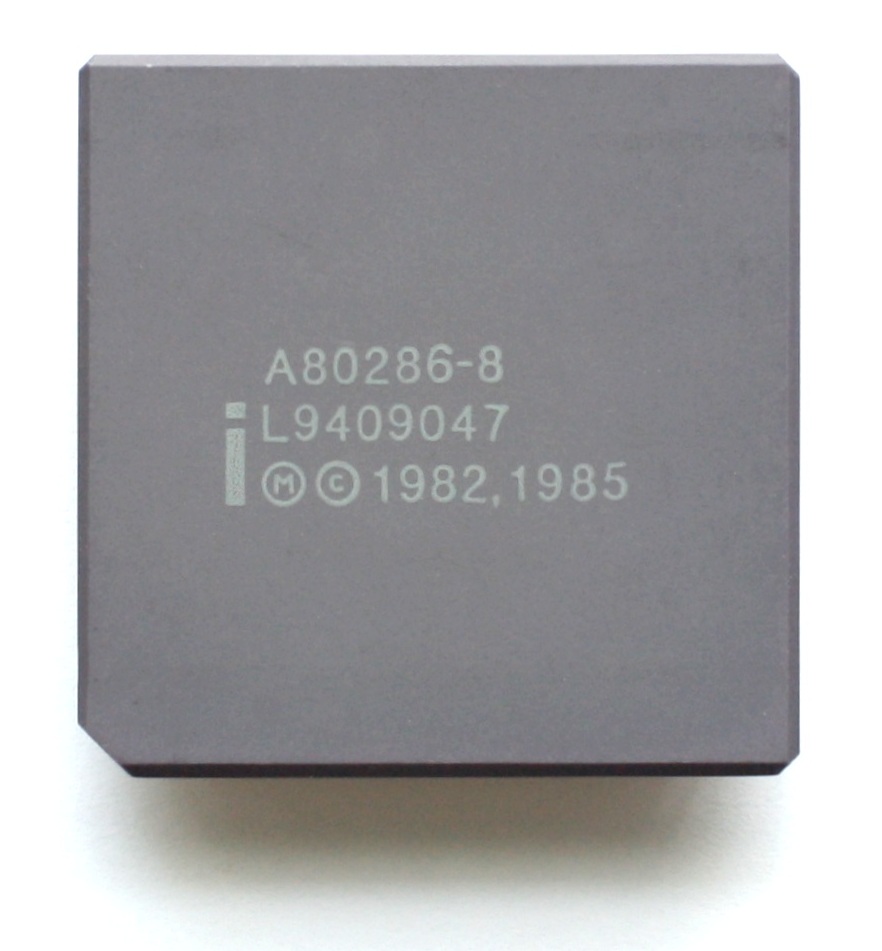 🇺🇸 United StatesIntel 80286
16-bit x86 CPU with protected mode and 24-bit addressing, launched in 1982CPU · x86 · 1982
 🇺🇸 United StatesIntel Atom
Intel's low-power x86 processor line for netbooks, embedded and server useCPU · x86 · 2008
 WorldIntel 80386EX
Embedded variant of the 386 with on-chip peripherals, launched in 1994CPU · x86 · 1994
 🇺🇸 United StatesGeode
Low-power x86 system-on-chip for embedded devicesSoC · x86 · 1999
Photo credits on this page
The small pictures above come from Wikimedia Commons under free licences. Some are cropped to fit.
- Pentium Pro: Thomas Nguyen, CC BY-SA 4.0, source
- Intel 8086: Thomas Nguyen, CC BY-SA 4.0, source
- Intel 80286: Konstantin Lanzet (with permission), CC BY-SA 3.0, source
- Intel Atom: Raimond Spekking, CC BY-SA 4.0, source
- Intel Core 2: Raimond Spekking, CC BY-SA 4.0, source
- Skylake: Eric Gaba ( Sting - fr:Sting ), CC BY-SA 4.0, source
- Intel 80386EX: Konstantin Lanzet, CC BY 3.0, source
- Geode: Appaloosa, CC BY-SA 3.0, source
- I386: Konstantin Lanzet, CC BY-SA 3.0, source
- Athlon 64: Astraera, CC BY-SA 4.0, source