
Yamaha YMF7xx
Yamaha family of ISA and PCI sound controller chips
The Yamaha YMF7xx series comprises audio controller chips for personal computers, spanning ISA and PCI bus architectures. These integrated circuits provided hardware synthesis, legacy DOS compatibility, and AC'97 codec support for budget and mid-range sound cards in the late 1990s.
- Supports 32 or 64-note XG MIDI polyphony
- Emulates OPL3 FM and Sound Blaster Pro for DOS
- Uses 18-bit DACs for low noise and distortion
- YMF754 reduces core power to 2.5 volts
- Default 2 MB sample bank loaded into system RAM
What it is
The YMF7xx designation covers several families of audio controller chips developed by Yamaha. These integrated circuits managed sound processing for personal computers, handling tasks such as MIDI synthesis, digital audio playback, and legacy emulation. The series evolved from Industry Standard Architecture (ISA) bus controllers to Peripheral Component Interconnect (PCI) bus adapters. They are notable for combining hardware-assisted XG synthesis with broad software compatibility, including support for older DOS applications and standard Windows audio drivers.
How it came about
Yamaha structured the YMF7xx line into distinct families based on their interface and feature sets. The OPL3-SA series served the ISA bus market, integrating FM synthesis and codec functions. As the industry shifted to PCI, Yamaha introduced the DS-XG family, starting with model numbers at 720. This transition allowed for higher bandwidth and more complex audio processing. The AC-XG family later focused specifically on integrating AC'97 codec standards, ensuring compatibility with emerging motherboard audio specifications.
Inside the chip
The DS-XG architecture features a hardware XG MIDI synthesizer capable of 32 or 64-note polyphony. It supports full-duplex recording and playback, internally upsampling audio to 48 kHz. A key design element is the legacy block, which emulates OPL3 FM synthesis and Sound Blaster Pro for DOS compatibility. The chips include interfaces for game controllers and MPU-401 MIDI devices. Memory management involves loading a default 2 MB sample bank into system RAM during boot, though users can replace this with custom banks via third-party tools.
How it was made
The chips were designed to operate at varying voltage levels depending on the model. For instance, the YMF744B operates fully at 3.3 volts, while the YMF754 reduces core logic power consumption by using 2.5 volts. These electrical characteristics helped integrate the controllers into power-efficient PCI cards and embedded systems.
Where it went
These controllers powered many inexpensive sound cards, often retailing for under fifty dollars. Despite the low cost, they utilized 18-bit Digital-to-Analogue Converters that offered low noise and distortion comparable to semi-professional equipment. Specific implementations included the Labway XWave 6000, which added hardware for 5.1 surround sound emulation, and the Hoontech SoundTrack i-Phone Digital XG, which featured telephony support. They were widely used in desktop PCs running Windows 9x, Me, 2000, and XP.
Versions and family
The OPL3-SA family includes the YMF701, YMF711, and YMF715, with each iteration adding features like Plug and Play support or 3D audio. The PCI-based DS-XG series began with the YMF724, which supported two-channel output. Later variants like the YMF744 and YMF754 added four-channel output and lower power consumption. The YMF740C offered a reduced feature set with fewer wavetable voices. The AC-XG family includes codecs like the YMF725, YMF743, and YMF753, which handled analog signal conversion.
Why it matters
The YMF7xx series democratized access to quality audio synthesis by providing XG capabilities at a budget price point. Its ability to emulate Roland GS and support custom sample banks gave users flexibility beyond typical consumer hardware. The inclusion of robust legacy support ensured that older software remained functional on newer PCI-based systems, bridging the gap between DOS-era gaming and modern Windows multimedia environments.
Problems and reception
Users noted that while performance was good for the price, driver support varied across operating systems. Windows 9x and Me benefited from VxD drivers that exposed all features, including separate mixer controls. However, WDM drivers for Windows 2000 and XP sometimes lacked these controls, and legacy mode was unsupported on NT-based systems. This limitation affected users who relied on specific hardware-level mixing features.

Questions people ask about Yamaha YMF7xx
What is the difference between YMF7x4 and YMF7x0 chips?
Chips marked YMF7x4 are designed for standalone PCI bus adapter cards. In contrast, models marked YMF7x0 are intended for on-board or embedded systems integrated directly onto motherboards. This distinction helps identify whether the chip is part of a discrete sound card or built-in audio solution.
Can the YMF7xx series play DOS games?
Yes, the DS-XG family includes a legacy block that emulates OPL3 FM synthesis and Sound Blaster Pro. This allows DOS applications to run correctly under Windows 9x and Me. The XG tone generator can also be accessed by DOS apps, ensuring broad compatibility with older software titles.
How does the sample memory work on these chips?
YMF7x4 cards ship with a default 2 MB bank of 8-bit samples. This data must be loaded into the computer's system RAM during the boot process. Users are not limited to this default set and can load custom banks using third-party tools to change instruments or improve sound quality.
Do these chips support surround sound?
Standard models like the YMF744 and YMF754 support four-channel output. Some specific sound cards based on the YMF754, such as the Labway XWave 6000, include additional hardware to emulate 5.1 surround sound and provide a six-channel amplifier for enhanced audio experiences.
Good reading and sources
- Yamaha YMF7xx on WikipediaEncyclopedia
- More photos on Wikimedia CommonsPhotos
- Wikidata recordOpen data
The facts on this page come from the Wikipedia article "Yamaha YMF7xx", written by its contributors and used under the CC BY-SA 4.0 licence, and from its Wikidata record (CC0). EveryChip rewrote the text in its own words, with AI assistance, and compares every page with the article to make sure no passage is copied. It may be reused under the same CC BY-SA 4.0 licence with a link back.
It may contain mistakes, and figures change over time. Nothing here is investment or buying advice. If something is wrong, tell us. Last refreshed 2026-11-14.
Like Yamaha YMF7xx
All analog, power and mixed-signal 🇺🇸 United StatesMOS Technology CIA
I/O controller chip for 6502-based home computersAnalog
🇬🇧 United KingdomVIDC1
Video and sound controller for Acorn Archimedes computersAnalog · Other
 🇺🇸 United States7400 series
Standardised transistor-transistor logic integrated circuits for digital electronics.Analog · 1964
 🇺🇸 United StatesIntel 8255
Programmable parallel input/output interface chip for early microprocessorsAnalog · 1970
More from Yamaha
All of them 🇯🇵 JapanYM2608
Yamaha FM synthesis sound chip for NEC computersAnalog
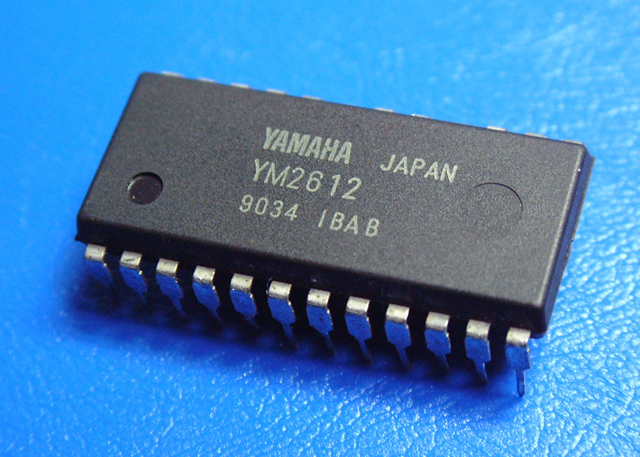 🇯🇵 JapanYM2612
Six-channel FM synthesis sound chip for Sega Mega DriveAnalog
 🇯🇵 JapanYamaha V9958
Video display processor for MSX2+ and turbo R computersGPU
 🇯🇵 JapanYamaha YM2203
Six-channel FM synthesis and SSG sound chip by YamahaAnalog