
AMD K5
AMD's first in-house x86 microprocessor for desktop PCs
The AMD K5 was the company's first x86 processor designed entirely internally, launching in March 1996. It aimed to compete with Intel's Pentium using advanced architecture but faced manufacturing delays and modest clock speeds.
- First AMD x86 CPU designed entirely in-house
- Features out-of-order execution and register renaming
- Used PR ratings to compare performance with Intel Pentium
- Released in March 1996 with 4.3 million transistors
- Compatible with Socket 5 and Socket 7 motherboards
What it is
The K5 is a central processing unit developed by Advanced Micro Devices. It marked the firm's initial effort to create an x86 chip without relying on external designs. Launched in early 1996, it targeted the desktop market where Intel's Pentium dominated. The processor used a complex internal structure to decode standard instructions into simpler operations. Although it offered strong compatibility, its market impact was limited by late arrival and lower clock frequencies than rivals.
How it came about
AMD sought technical independence from Intel with this project. The team aimed for a design closer to the Pentium Pro than the original Pentium. This ambition led to a sophisticated architecture but caused engineering challenges. Manufacturing limits at the time restricted clock speed scaling. The chip arrived later than planned, missing the window for widespread adoption by major PC makers. It served as a learning platform for future in-house developments.
Inside the chip
The chip uses a superscalar RISC core with an x86 decoding front end. It features five integer units capable of out-of-order execution and one floating-point unit. Register renaming helps manage data dependencies, while a large branch target buffer reduces stalls. Speculative execution further improves pipeline efficiency. The level one cache holds 16 kilobytes for instructions and 8 kilobytes for data. Floating-point transcendental functions are handled in hardware for mathematical accuracy.
How it was made
Manufacturing used process nodes of 500 nanometres for early models and 350 nanometres for later ones. Each die contains 4.3 million transistors. The design includes multiple levels of logic which hampered high clock speeds given the technology of the era. AMD produced these chips in-house. The physical package fits into Socket 5 or Socket 7 motherboards, ensuring pin compatibility with existing systems.
Where it went
This processor powered desktop personal computers and some embedded systems. It competed directly with Intel's Pentium line in the mid-1990s. Users installed it in machines requiring standard x86 compatibility. While it did not achieve the same market penetration as the Am486 or the subsequent K6, it provided a viable alternative for budget-conscious builders and specific industrial applications during its short production run.
Versions and family
Two main revisions exist: SSA/5 and 5k86. The initial SSA/5 series ran from 75 to 100 MHz and had disabled branch prediction. The improved 5k86 version fixed these issues, boosting performance by up to thirty percent per clock cycle. Models ranged from 90 to 133 MHz. AMD used a Performance Rating system, labeling a 116 MHz chip as PR166 to reflect its integer speed relative to Intel parts. A rare PR200 model appeared just before the K6 launch.
Why it matters
The K5 demonstrated AMD's ability to design complex x86 cores independently. Its internal test suite became valuable for later projects. Although it did not displace Intel, it paved the way for the successful K6. The chip's floating-point unit offered more reliable results than some competitors, even if it was slower than the Pentium. It remains a notable step in the history of x86 competition.
Problems and reception
Reviewers noted the ambitious architecture but criticized the low clock rates. The chip was seen as technically sound but hampered by manufacturing constraints. It failed to gain significant traction with large computer manufacturers due to its late entry. However, it was respected for its x86 compatibility and the mechanical proof of its floating-point microcode. Enthusiasts often regard it as an underrated component of 1990s computing.


Questions people ask about AMD K5
What does the PR rating mean on AMD K5 chips?
PR stands for Performance Rating. AMD used this label to indicate how the chip's integer performance compared to an Intel Pentium running at that specific clock speed. For example, a K5 PR166 runs at 116 MHz but performs like a 166 MHz Pentium in integer tasks.
How does the K5 architecture differ from the Intel Pentium?
The K5 uses a RISC core with an x86 decoder, similar to the Pentium Pro, whereas the Pentium uses a simpler CISC design. The K5 supports out-of-order execution and register renaming, which the original Pentium lacks, allowing it to handle instructions more efficiently per clock cycle.
Why was the K5 not as successful as the Am486?
The K5 arrived late to the market and suffered from low clock speeds due to manufacturing limitations and complex design logic. These factors prevented it from gaining the widespread acceptance among large computer manufacturers that the earlier Am486 and the later K6 achieved.
Good reading and sources
The facts on this page come from the Wikipedia article "AMD K5", written by its contributors and used under the CC BY-SA 4.0 licence, and from its Wikidata record (CC0). EveryChip rewrote the text in its own words, with AI assistance, and compares every page with the article to make sure no passage is copied. It may be reused under the same CC BY-SA 4.0 licence with a link back.
It may contain mistakes, and figures change over time. Nothing here is investment or buying advice. If something is wrong, tell us. Last refreshed 2026-11-14.
Like AMD K5
All CPUs and microprocessors 🇺🇸 United StatesP6
Intel's sixth x86 design, first with out-of-order executionCPU · x86 · 1995
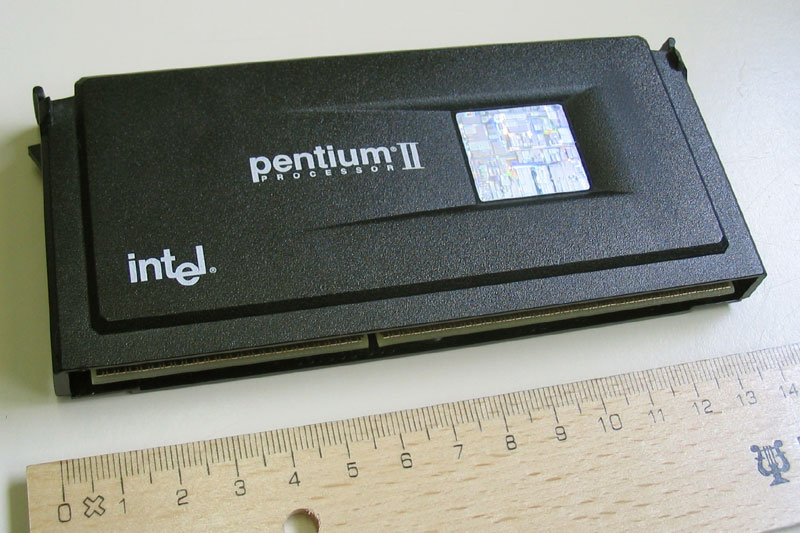 🇺🇸 United StatesPentium II
Intel's 1997 P6 desktop CPU line with MMX, sold in a slot cartridgeCPU · x86 · 1997
 🇺🇸 United StatesAm5x86
High-speed 486-class CPU for legacy system upgradesCPU · x86 · 1995
 🇺🇸 United StatesMediaGX
Integrated x86 system on a chip for low-cost PCsSoC · x86 · 1997
More from AMD
All of them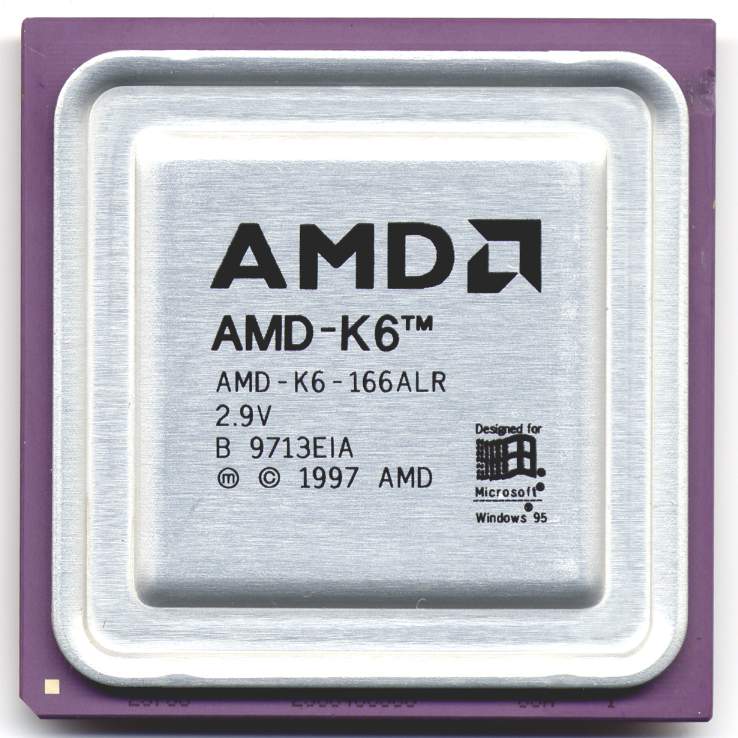 🇺🇸 United StatesAMD K6
x86 microprocessor for Socket 7 desktopsCPU · x86 · 1997
 🇺🇸 United StatesK6-2
x86 microprocessor with 3DNow! instructions for budget PCsCPU · x86 · 1998
 🇺🇸 United StatesAMD K6-III
x86 desktop processor with on-die L2 cacheCPU · x86 · 1999
 WorldAm486
AMD's 486-class processor family from the 1990sCPU · x86 · 1993