
Am5x86
High-speed 486-class CPU for legacy system upgrades
AMD released the Am5x86 in late 1995 as a fast upgrade for older 486 computers. It uses a quadrupled clock speed and large cache to match early Pentium performance in integer tasks.
- Runs at 133 MHz using a 4x multiplier on 33 MHz bus
- Features 16 KiB write-back L1 cache, double the standard 486 size
- Marketed as Am5x86-P75 to indicate Pentium 75 equivalence
- Core used in AMD Élan SC520 microcontrollers and Cisco PIX 501
What it is
The Am5x86 is an x86 central processing unit designed by AMD for 486-class systems. Announced in November 1995 and shipping the following month, it serves as a high-performance drop-in replacement for older chips. Although its name suggests a fifth-generation design, it remains a fourth-generation core. It lacks specific Pentium instructions but achieves comparable integer speed through higher clock rates and improved caching. This processor helped sustain AMD revenue during delays with its next-generation K5 project.
How it came about
Development occurred under the codename X5 before its late 1995 launch. AMD targeted users with existing 486 motherboards who wanted better performance without buying a new system. The chip competed directly with Intel’s Pentium OverDrive. Sales proved vital for AMD while the K5 faced production setbacks. Manufacturing continued until 1999, supporting both desktop PCs and notebook upgrades. Third-party vendors also sold it in kits with voltage regulators for broader compatibility.
Inside the chip
This single-core processor uses an internal multiplier of four. It tricks the motherboard into thinking it runs at double speed, allowing 133 MHz operation on standard Socket 3 boards. The core features 16 KiB of unified L1 cache, which is double the size of typical 486 caches. This cache uses write-back technology for faster data handling. It requires 3.45 volts, often needing a voltage regulator on older sockets. The design omits Pentium-specific commands like cmpxchg8b, sticking strictly to the 486 instruction set.
How it was made
AMD fabricated the chip using a 0.35 micrometre process. It comes in 168-pin pin grid array or 208-pin square flat package forms. Four main versions exist, identified by codes such as ADW, ADY, ADZ, and BGC. Later variants tolerate higher temperatures, making them more suitable for overclocking. The manufacturing run lasted several years, ensuring steady supply for upgrade markets and embedded applications.
Where it went
Users installed this CPU in entry-level desktops and older notebooks to boost speed. It often matches or beats a 75 MHz Pentium in integer benchmarks. Enthusiasts frequently overclocked it to 160 MHz, approaching Pentium 90 MHz performance. Beyond PCs, it powered embedded controllers and served as a second processor for Acorn RiscPC systems. Its 32-bit interface suited the RiscPC OpenBus better than wider Pentium chips. Cisco also used a derivative core in its PIX 501 firewall appliance.
Versions and family
The standard model runs at 133 MHz, though a rare 150 MHz OEM version exists. Users commonly push the chip to 160 MHz. AMD marketed the 133 MHz part as Am5x86-P75, introducing the first PR rating to suggest Pentium equivalence. Third-party sellers like Kingston Technology rebranded it as the Turbochip. The core design later evolved into the AMD Élan SC520 system-on-chip family for microcontroller duties.
Why it matters
This processor extended the life of millions of 486 systems. It provided a cost-effective alternative to expensive motherboard replacements. The introduction of the PR rating influenced how AMD later marketed its processors. By offering near-Pentium speeds on legacy hardware, it maintained AMD’s market presence during a difficult transition period. Its reliability in embedded roles demonstrated the versatility of the underlying 486 architecture.
Problems and reception
Reviewers noted its strong integer performance but pointed out weaknesses in floating-point tasks. Games and operating systems relying on FPU speed favored true Pentium chips. Compatibility with older 486 boards was generally good, unlike some rival offerings. The need for voltage regulators on very old sockets was a minor hurdle. Overall, it was seen as a practical and powerful upgrade path for budget-conscious users.


Questions people ask about Am5x86
Is the Am5x86 a true Pentium processor?
No, it is an enhanced 486 core. It lacks Pentium-specific instructions such as cmpxchg8b. However, its high clock speed and large cache allow it to match Pentium 75 MHz performance in integer arithmetic tasks.
Can I install this chip in any 486 motherboard?
It fits Socket 1, 2, and 3, but older sockets may require a voltage regulator because the chip needs 3.45 volts. The motherboard jumper must be set to 2x multiplier, as the chip internally doubles this to 4x.
What is the PR rating mentioned with this CPU?
PR stands for Performance Rating. AMD used it to market the Am5x86-P75, indicating that its benchmark scores were similar to those of an Intel Pentium running at 75 MHz, despite being a 486-based design.
How fast can the Am5x86 run?
The standard rated speed is 133 MHz. A rare OEM version ran at 150 MHz. Many users successfully overclocked the common models to 160 MHz, achieving performance close to a Pentium 90 MHz system.
Good reading and sources
The facts on this page come from the Wikipedia article "Am5x86", written by its contributors and used under the CC BY-SA 4.0 licence, and from its Wikidata record (CC0). EveryChip rewrote the text in its own words, with AI assistance, and compares every page with the article to make sure no passage is copied. It may be reused under the same CC BY-SA 4.0 licence with a link back.
It may contain mistakes, and figures change over time. Nothing here is investment or buying advice. If something is wrong, tell us. Last refreshed 2026-11-14.
Like Am5x86
All CPUs and microprocessors 🇺🇸 United StatesP6
Intel's sixth x86 design, first with out-of-order executionCPU · x86 · 1995
 🇺🇸 United StatesAMD K5
AMD's first in-house x86 microprocessor for desktop PCsCPU · x86 · 1996
 🇺🇸 United StatesPentium II
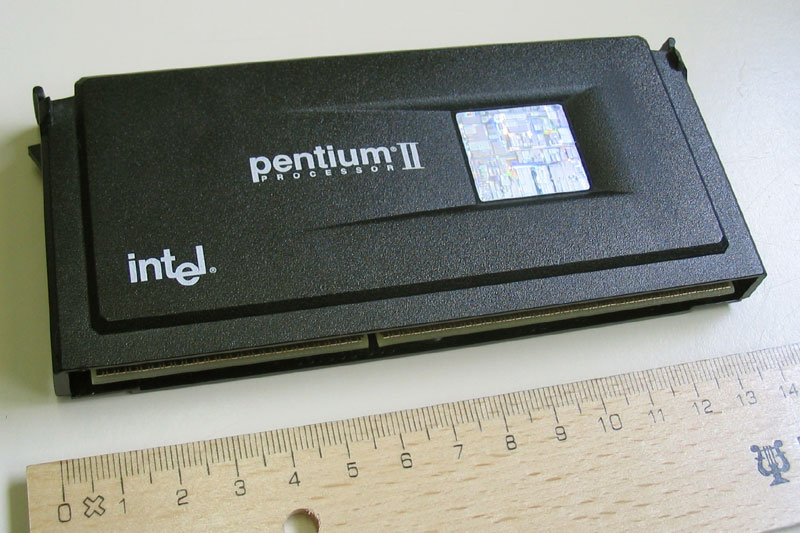
Intel's 1997 P6 desktop CPU line with MMX, sold in a slot cartridgeCPU · x86 · 1997
 🇺🇸 United StatesPentium
Intel's first superscalar x86 chip, with dual integer pipelines and a faster FPUCPU · x86 · 1993
More from AMD
All of them WorldAMD Élan
x86 system on a chip for embedded devicesSoC · x86 · 1993
 🇺🇸 United StatesAMD K6
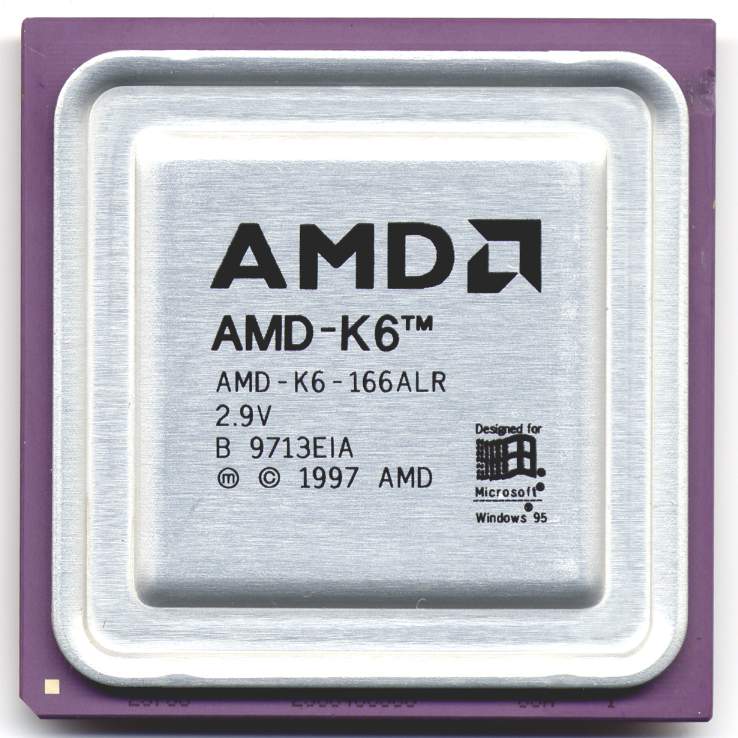
x86 microprocessor for Socket 7 desktopsCPU · x86 · 1997
 WorldAm486
AMD's 486-class processor family from the 1990sCPU · x86 · 1993
 🇺🇸 United StatesK6-2
x86 microprocessor with 3DNow! instructions for budget PCsCPU · x86 · 1998