
Am486
AMD's 486-class processor family from the 1990s
The Am486 is a family of central processing units produced by AMD starting in 1993. It offered performance matching Intel's 486 chips at lower prices, gaining adoption by major PC makers like Compaq and Acer during the mid-1990s.
- Released in 1993 by AMD
- Matched Intel 486 performance clock-for-clock
- Featured 8 KiB or 16 KiB Write-Back L1 cache
- Adopted by Compaq and Acer in 1994
- Core used in AMD Élan SC4xx microcontrollers
What it is
The Am486 is a series of microprocessors designed and manufactured by AMD. Released in 1993, these chips belong to the 80486 class of x86 central processing units. They were built to compete directly with Intel’s 486 line but were often sold at lower price points. The series includes models such as the DX, DX2, and SX2. Later versions introduced enhanced features like extended power-saving modes and larger write-back caches. This family served as the foundation for subsequent AMD processors and embedded microcontroller cores.
How it came about
AMD entered the 486 market nearly four years after Intel. Despite the delay, the company positioned its 40 MHz chip against Intel’s slower 33 MHz parts, offering better value. While competitors like Cyrix struggled to match Intel’s speed, AMD achieved clock-for-clock parity. By 1994, larger computer manufacturers such as Acer and Compaq began using Am486DX and DX2 chips in their systems. This marked a shift from the Am386 era, where AMD primarily supplied smaller builders. The success of this generation helped AMD establish itself as a viable alternative to Intel in the mainstream PC market.
Inside the chip
These processors use an 80486-class architecture. Early models featured an 8 KiB Write-Back L1 cache, which stores frequently used data for faster access. Later variants increased this cache to 16 KiB. The write-back strategy improves efficiency by only writing data to main memory when necessary. The chips also support extended power-saving modes, reducing energy use during idle periods. Integer performance on higher-clocked models was strong, often exceeding early Pentium processors running at 60 or 66 MHz. The design prioritized cost-effective performance without requiring socket changes for many upgrades.
How it was made
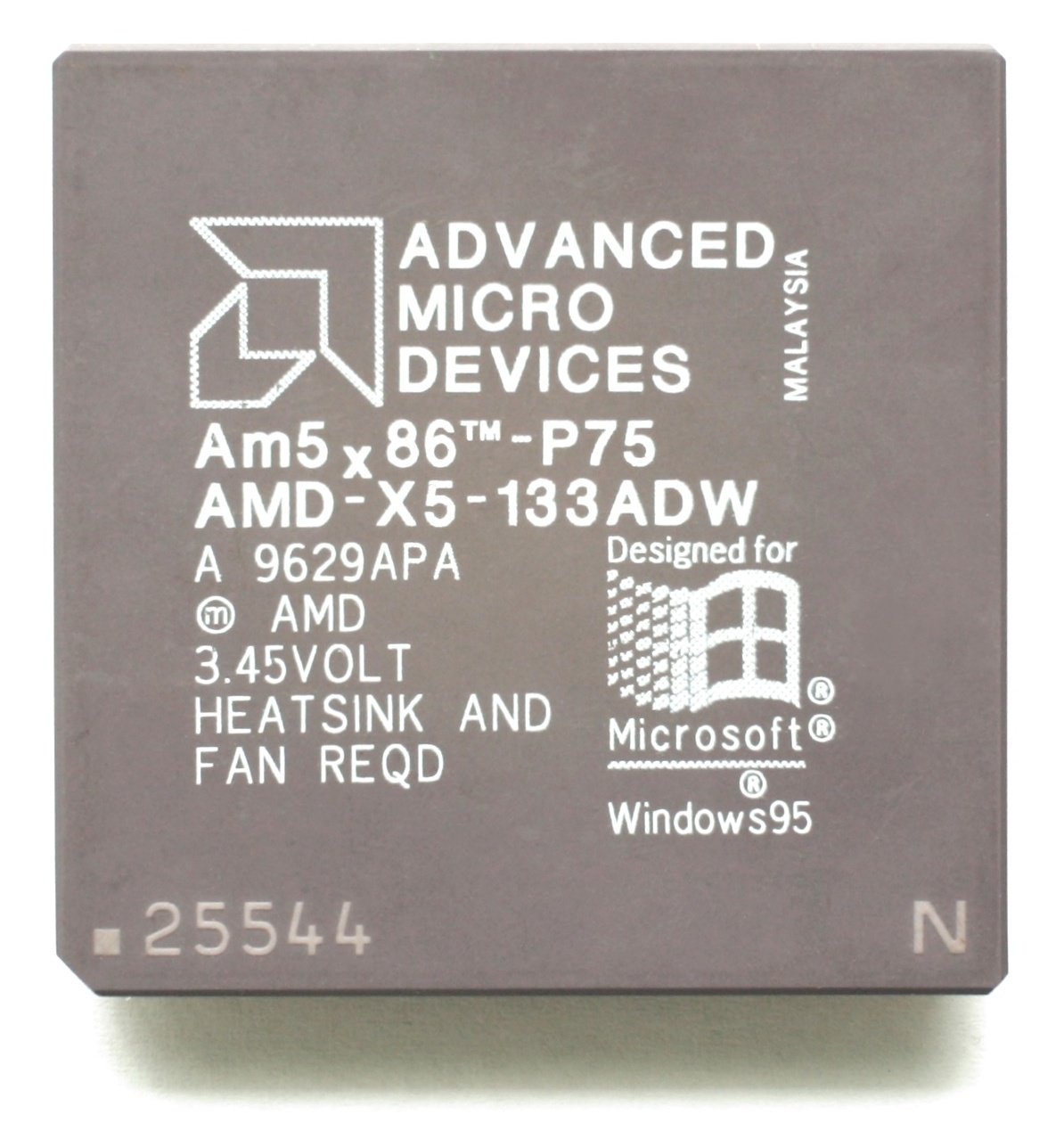
AMD produced the Am486 family throughout the 1990s. The chips were packaged for standard desktop sockets of the era. AMD focused on pricing strategies rather than just raw specifications, often undercutting Intel’s costs for comparable performance levels. The production run included various speed grades, culminating in the 133 MHz Am5x86, which was essentially an enhanced version of the Am486 core.
Where it went
The Am486 found widespread use in personal computers during the mid-1990s. Major brands like Compaq and Acer integrated these chips into their desktop systems. They were suitable for general computing tasks, office applications, and early multimedia work. The higher-clocked versions provided sufficient power for users who did not need the latest Pentium technology. Additionally, derivatives of the Am486 core were used in the AMD Élan SC4xx family of microcontrollers, extending their utility into embedded systems and industrial applications.
Versions and family
The family includes the Am486DX, DX2, and SX2 models. A later derivative, the Am5x86, ran at 133 MHz and offered enhanced performance. The DX4 models from Intel had twice the cache of early AMD parts, but AMD’s DX4-100 remained cheaper than Intel’s DX2-66. The Am486 succeeded the Am386 and was followed by the Am5x86. The core design also spawned the Élan SC4xx microcontroller series, showing the versatility of the underlying architecture beyond standard desktop computing.
Why it matters
The Am486 demonstrated that AMD could produce high-performance x86 chips that matched Intel’s offerings. By pricing aggressive 40 MHz parts below Intel’s 33 MHz chips, AMD captured significant market share. This strategy helped larger PC manufacturers adopt AMD silicon, breaking Intel’s near-monopoly on premium desktop processors. The series proved that clock-for-clock performance could be achieved by a second source, encouraging competition in the CPU market. Its legacy includes paving the way for future AMD architectures and establishing the company as a serious contender in the processor industry.


Questions people ask about Am486
How did the Am486 compare to Intel's 486?
AMD's Am486 matched Intel's performance on a clock-for-clock basis. Unlike some competitors, it did not benchmark lower than the equivalent Intel chip. AMD often priced its faster 40 MHz chips at or below the cost of Intel's slower 33 MHz models.
What cache size did the Am486 have?
The enhanced Am486 series initially featured an 8 KiB Write-Back L1 cache. Later versions upgraded this to a 16 KiB Write-Back L1 cache. This was smaller than Intel's DX4 chips, which had twice the cache, but AMD compensated with lower pricing.
Which companies used the Am486 in their computers?
While the earlier Am386 was used by small manufacturers, the Am486 gained acceptance among larger companies. Acer and Compaq were notable adopters of the Am486DX, DX2, and SX2 chips in their systems around 1994.
Good reading and sources
The facts on this page come from the Wikipedia article "Am486", written by its contributors and used under the CC BY-SA 4.0 licence, and from its Wikidata record (CC0). EveryChip rewrote the text in its own words, with AI assistance, and compares every page with the article to make sure no passage is copied. It may be reused under the same CC BY-SA 4.0 licence with a link back.
It may contain mistakes, and figures change over time. Nothing here is investment or buying advice. If something is wrong, tell us. Last refreshed 2026-11-14.
Like Am486
All CPUs and microprocessors 🇺🇸 United StatesPentium
Intel's first superscalar x86 chip, with dual integer pipelines and a faster FPUCPU · x86 · 1993
 🇺🇸 United StatesPentium
Intel's long-running x86 processor brand, from the 1993 P5 to 2023 budget partsCPU · x86 · 1993
 🇺🇸 United StatesCyrix Cx486
x86 desktop microprocessor competing with Intel 486CPU · x86 · 1993
🇺🇸 United StatesPentium
Intel's first superscalar x86 microprocessor, introducing dual pipelines and the Pentium brand in 1993.CPU · x86 · 1993
More from AMD
All of them WorldAMD Élan
x86 system on a chip for embedded devicesSoC · x86 · 1993
 🇺🇸 United StatesAm386
AMD's first independent x86 microprocessor cloneCPU · x86 · 1991
 🇺🇸 United StatesAm5x86
High-speed 486-class CPU for legacy system upgradesCPU · x86 · 1995
 🇺🇸 United StatesAMD K5
AMD's first in-house x86 microprocessor for desktop PCsCPU · x86 · 1996