🇨🇳 Chips of China
27 chips from China, best known first.
China dominates global chip consumption but relies heavily on imports, driving a state-backed push for self-sufficiency. The industry features major players in memory and logic manufacturing alongside aggressive domestic design efforts. Recent technological breakthroughs in lithography signal a move toward reducing foreign dependency.
- China consumed 53.7% of global chip sales in 2020
- YMTC unveiled 128-layer vertical NAND in April 2020
- SMIC is the fifth largest foundry globally with 5.3% share
- HiSilicon restarted Kirin chipset production in late 2023
- China prohibited US Intel and AMD CPUs in government PCs
Chips in China
China consumes more semiconductors than any other nation, accounting for over half of global sales in 2020. Despite this massive market, the country imported more than eighty percent of its chips that year. To address this imbalance, the government has launched initiatives to boost domestic production. A key target set in 2022 aimed for seventy percent self-sufficiency by national manufacturing. China currently leads the world in new fabrication plant construction, with numerous facilities coming online. This expansion aims to shrink the gap between local output and consumer demand across various sectors.
History
The sector began in 1956 with state lab research and early transistor development. By 1965, the first integrated circuit was created under a Soviet-style industrial model. The Cultural Revolution disrupted progress during the late sixties and seventies. Reforms starting in 1978 shifted focus toward modernization and foreign partnerships. The nineties saw joint ventures with international firms like Philips and NEC. However, delays often resulted in outdated technology. Project 909 in the late nineties sought to produce competitive chips using domestic engineers. These early efforts laid the groundwork for later state-funded growth and independent innovation strategies.
Companies
The ecosystem includes integrated device manufacturers, foundries, and fabless designers. YMTC and CXMT lead in flash memory and DRAM production respectively. SMIC stands as the largest pure-play foundry in mainland China. Hua Hong Semiconductor ranks second domestically. Fabless giants include HiSilicon, which designs mobile processors, and Loongson, which develops general-purpose CPUs. Other notable entities are Zhaoxin, UNISOC, and Hygon. Packaging services are provided by JCET and Huatian Technology. These companies operate across the entire supply chain, from design to final assembly.
Fabs and places
Chinese-owned capacity increased from 2.96 million wafers per month in 2020 to 3.57 million in 2021. Eight out of nineteen new fabs worldwide were under construction in China during 2021. Samsung operates two plants in Xi'an, contributing significantly to global NAND flash supply. YMTC produces around 80,000 wafers monthly at its Wuhan facility. SMIC manufactures chips ranging from 350 nm to 14 nm nodes. Hua Hong’s subsidiary handles 28/22 nm processes. New deep ultraviolet lithography machines announced in 2024 support advanced node development. These facilities form the backbone of domestic production capabilities.
Policy and support
The Made in China 2025 programme targets seventy percent domestic chip production. The China Integrated Circuit Industry Investment Fund pools resources from state investors to support the sector. Export restrictions imposed by the US in 2022 accelerated efforts to reduce foreign reliance. In response, China banned US-made CPUs in government servers by 2027. The government approved domestic alternatives like Loongson and Phytium processors. Trade measures include WTO suits and strategic stockpiling. Support funds frequently invest in emerging semiconductor firms. These policies aim to secure supply chains against geopolitical pressures and sanctions.
Today
Self-sufficiency in AI chips reached forty-one percent in 2025, up from ten percent in 2020. Domestic prototypes for extreme ultraviolet lithography machines were completed in Shenzhen by late 2025. US authorities approved several Chinese tech firms to purchase NVIDIA H200 chips in May 2026. Smuggling cases involving Nvidia hardware via Japan led to arrests in Taiwan. Foundry utilization rates remained high due to competitive pricing and local design mandates. The industry continues to expand capacity while navigating complex international trade regulations.
The facts in this overview come from the Wikipedia article "Semiconductor industry in China", written by its contributors and used under the CC BY-SA 4.0 licence. EveryChip rewrote the text in its own words, with AI assistance, and compares every page with the article to make sure no passage is copied. It may be reused under the same CC BY-SA 4.0 licence with a link back.
Chip hubs in China
 🇨🇳 ChinaESP8266
Low-cost Wi-Fi microcontroller chip by Espressif SystemsMicrocontroller · RISC · 2014
 🇨🇳 ChinaESP32
A low-cost microcontroller system on a chip with Wi-Fi and Bluetooth support.Microcontroller · Arm · 2016
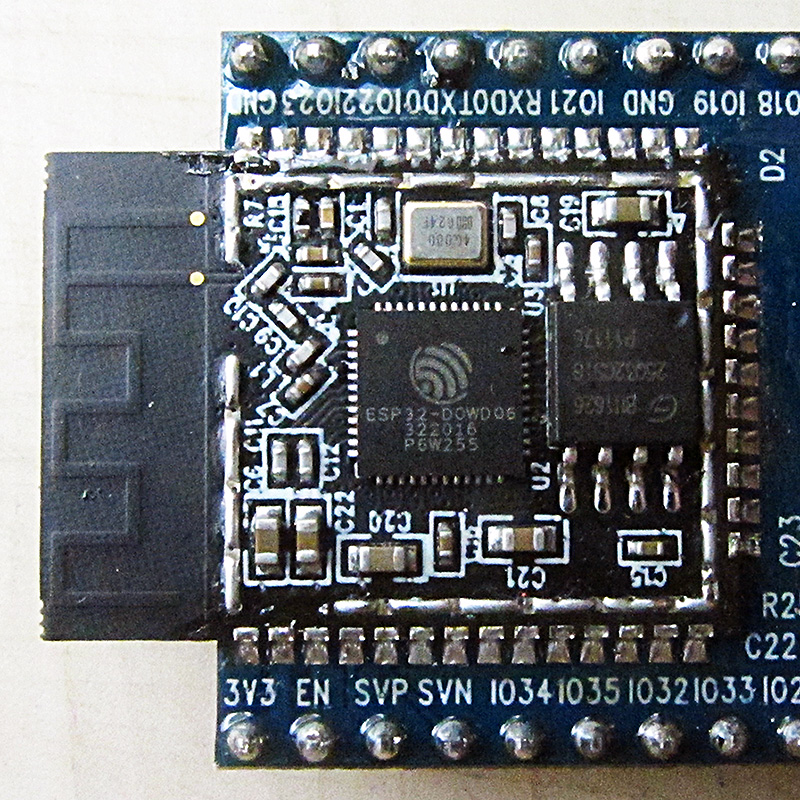 🇨🇳 ChinaESP32
Low-cost Wi-Fi and Bluetooth microcontroller family by EspressifMicrocontroller · RISC · 2021
🇨🇳 ChinaESP32
Low-cost Wi-Fi and Bluetooth microcontroller familyMicrocontroller · RISC · 2016
🇨🇳 ChinaESP32
Low-cost Wi-Fi and Bluetooth microcontroller family by EspressifMicrocontroller · RISC · 2016
Photo credits on this page
The small pictures above come from Wikimedia Commons under free licences. Some are cropped to fit.
- ESP32: Brian Krent, CC BY-SA 4.0, source
- ESP32: Ubahnverleih, CC0, source
- ESP8266: Laserlicht, CC BY-SA 4.0, source