Console and arcade chips
The chips of the Atari, NES, PlayStation, Xbox, Switch and the arcade boards. 16 chips on EveryChip so far.
Games consoles have often used custom chips designed for one machine, made in tens of millions. The Atari 2600 drew its picture with a chip called TIA; the NES used a Ricoh chip with a 6502 core; Sony's PlayStation 2 and 3 had the Emotion Engine and the Cell. Since 2013 PlayStation and Xbox consoles have used custom AMD chips, while Nintendo's Switch uses Nvidia's Tegra.
Custom silicon for a fixed machine
A console sells for years with the same hardware, so its makers can afford a chip tuned to games and can count on game developers to learn it in depth. Early chips were small and simple, with the processor racing the TV's electron beam to draw each line. Later consoles had exotic designs: the Cell had one PowerPC core and eight vector cores, which were powerful but hard to program.
From exotic to standard parts
From the PlayStation 4 and Xbox One onwards, Sony and Microsoft chose AMD SoCs that combine x86 CPU cores and Radeon graphics on one die, which made games easier to bring to PCs. The PlayStation 5 and Xbox Series consoles of 2020 use AMD Zen 2 cores and RDNA 2 graphics. Console chips are shrunk to new nodes over their lives to cut cost and power.
Famous console chip chips
 Television Interface AdaptorThe Atari 2600's video and sound chip, 1977
 MOS 6507The Atari 2600's processor
 Ricoh 2A03The NES processor with a 6502 core
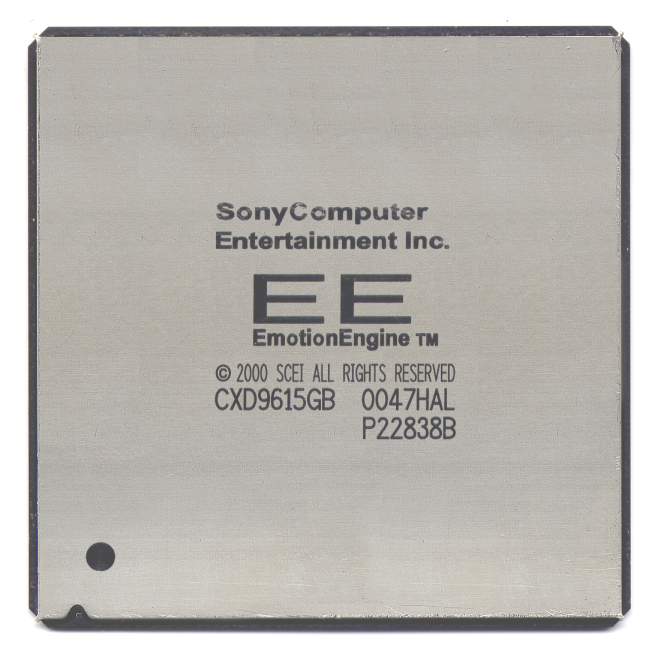 Emotion EngineThe PlayStation 2 processor, Sony and Toshiba
 Cell Broadband EngineThe PlayStation 3 chip, Sony, Toshiba and IBM
 Microsoft XCPU (Xenon)The Xbox 360's three-core IBM processor
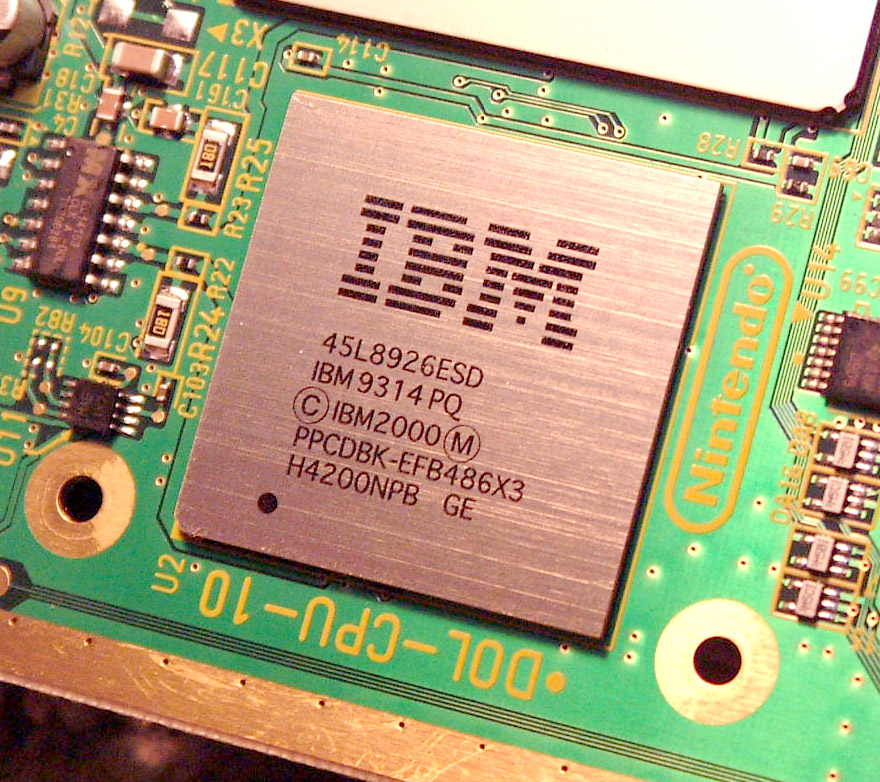 GekkoThe GameCube's IBM PowerPC processor
 TegraNvidia SoC family used in the Nintendo Switch
Further reading
🇺🇸 United States and 1 moreMicrosoft XCPU (Xenon)
Three-core PowerPC CPU at the heart of the Xbox 360 consoleCPU · Power · 2003
🇺🇸 United StatesGekko
Custom PowerPC CPU for the Nintendo GameCubeCPU · Power · 2000
 🇺🇸 United StatesBroadway
32-bit PowerPC CPU for the Nintendo Wii consoleCPU · Power · 2006
 🇺🇸 United States and 1 moreEspresso
32-bit PowerPC CPU for the Nintendo Wii U consoleCPU · Power · 2012
Photo credits on this page
The small pictures above come from Wikimedia Commons under free licences. Some are cropped to fit.
- Cell Broadband Engine: Greenpro, CC BY-SA 3.0, source
- Microsoft XCPU (Xenon): Konstantin Lanzet, CC BY 3.0, source
- Emotion Engine: Unknown author, CC BY-SA 3.0, source
- MOS 6507: Konstantin Lanzet, CC BY 3.0, source
- Television Interface Adaptor: Evan-Amos, Public domain, source
- Gekko: Baz1521, CC BY-SA 3.0, source
- Broadway: ZyMOS, CC BY-SA 4.0, source
- Ricoh 2A03: PantheraLeo1359531, CC BY 4.0, source
- Tegra: Raimond Spekking, CC BY-SA 4.0, source
- Espresso: Henriok, CC0, source