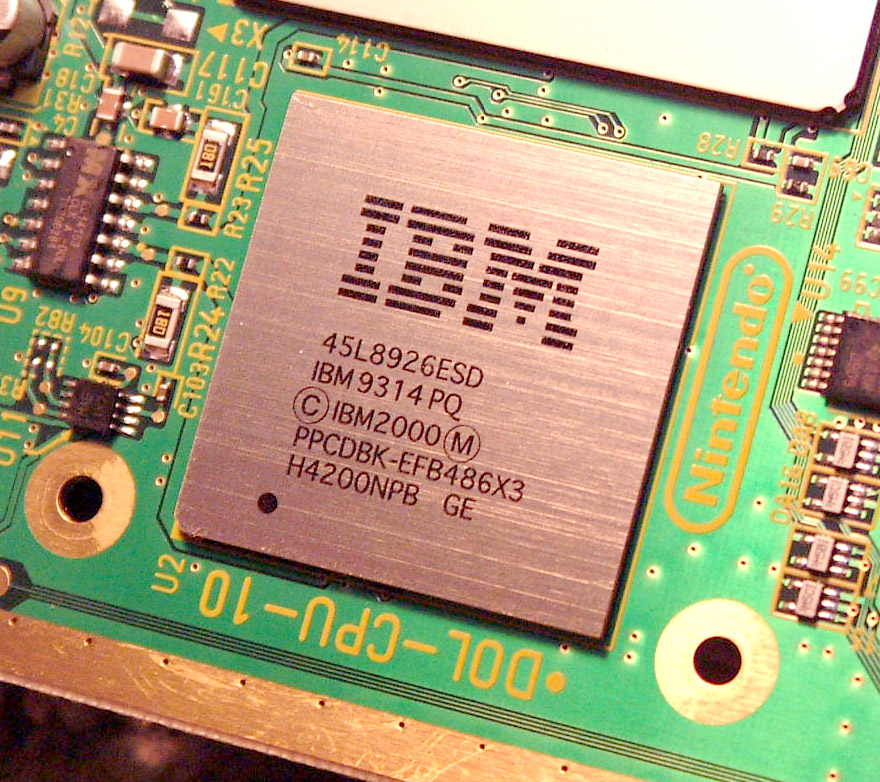
Gekko
Custom PowerPC CPU for the Nintendo GameCube
IBM designed the Gekko microprocessor in 2000 for Nintendo. It served as the central processor for the GameCube console and Triforce arcade board. The chip used a modified PowerPC core to handle game logic and graphics data efficiently.
- Runs at 486 MHz with out-of-order execution
- Contains 18.6 million transistors on a 43 mm2 die
- Supports paired-single SIMD for 3D graphics
- Dissipates only 4.9 watts of power
- Successor to the NEC VR4300 in Nintendo consoles
What it is
The Gekko is a 32-bit microprocessor built for video game systems. IBM created it in 2000 under a contract with Nintendo. It powered the GameCube home console and the Triforce arcade hardware. The chip handles tasks like physics calculations, artificial intelligence, and moving graphics data. It uses a superscalar design that can execute multiple instructions at once. This allows it to manage complex game scripts and lighting effects while keeping pace with the graphics unit.
How it came about
Nintendo and IBM announced their partnership in 1999. The deal was worth one billion dollars, marking IBM’s largest single order at the time. Engineers needed a processor that could run near 400 MHz and work closely with the Flipper graphics chip. IBM adapted its existing PowerPC 750CXe design rather than starting from scratch. They customized the bus architecture and floating-point units to meet specific gaming needs. Production began in 2000 and continued until 2007.
Inside the chip
The core is based on the PowerPC G3 architecture. It runs at 486 MHz and features out-of-order execution. Two integer arithmetic units handle general calculations. A separate 64-bit floating-point unit supports double-precision math. This unit can also act as two 32-bit channels for single-precision operations. These paired singles provide about 1.9 GFLOPS of performance for 3D graphics. The chip includes roughly 50 new SIMD instructions. A 64-bit front-side bus connects to the chipset at 162 MHz.
How it was made
IBM Microelectronics manufactured the chip using a 180 nm process. The fabrication used six layers of copper wiring. The silicon die measures 43 square millimetres. It contains 6.35 million logic transistors and 18.6 million transistors in total. The package is a plastic ball grid array measuring 27 by 27 millimetres. It has 256 contact points. The processor operates at 1.8 volts for both logic and input-output signals. Heat dissipation is rated at 4.9 watts.
Where it went
The primary application was the Nintendo GameCube console. It managed game scripting, collision detection, and geometry transformations. The processor could send compressed data directly to the graphics processor. This reduced bottlenecks during intense visual scenes. Later, the same hardware powered the Triforce arcade system board. This allowed arcade developers to use similar tools and assets as home console games. The chip facilitated smooth lighting and moving graphics data through the system.
Versions and family
The Gekko is a customized version of the PowerPC 750CXe. It shares its lineage with standard desktop processors but includes specific changes for gaming. Its direct successor is the Broadway processor. IBM also designed Broadway for Nintendo, and it powers the Wii console. The predecessor in Nintendo hardware was the NEC VR4300 used in the Nintendo 64. The Espresso processor later followed Broadway in the Wii U.
Why it matters
This processor demonstrated how custom silicon could enhance console performance. By modifying an existing core, IBM delivered high efficiency for 3D tasks. The partnership set a precedent for future collaborations between chip makers and game firms. The architecture influenced the design of the Wii processor. It proved that balanced operation between CPU and GPU was critical for sixth-generation gaming. The chip remained in production for seven years.

Questions people ask about Gekko
What is the Gekko processor?
It is a custom 32-bit PowerPC microprocessor made by IBM for Nintendo. It served as the main CPU for the GameCube console and the Triforce arcade board.
How fast does the Gekko run?
The processor operates at a clock speed of 486 MHz. It uses a superscalar out-of-order design to handle multiple instructions efficiently.
Who manufactured the Gekko chip?
IBM Microelectronics produced the chip. They used a 180 nm process with copper wiring to create the silicon die.
What makes the Gekko good for graphics?
It includes about 50 new SIMD instructions called paired singles. These allow the floating-point unit to perform two 32-bit operations at once for 3D math.
Good reading and sources
- Gekko (processor) on WikipediaEncyclopedia
- More photos on Wikimedia CommonsPhotos
- Wikidata recordOpen data
The facts on this page come from the Wikipedia article "Gekko (processor)", written by its contributors and used under the CC BY-SA 4.0 licence, and from its Wikidata record (CC0). EveryChip rewrote the text in its own words, with AI assistance, and compares every page with the article to make sure no passage is copied. It may be reused under the same CC BY-SA 4.0 licence with a link back.
It may contain mistakes, and figures change over time. Nothing here is investment or buying advice. If something is wrong, tell us. Last refreshed 2026-11-14.
Like Gekko
All CPUs and microprocessors 🇺🇸 United States and 1 moreMicrosoft XCPU (Xenon)
Three-core PowerPC CPU at the heart of the Xbox 360 consoleCPU · Power · 2003
 🇺🇸 United StatesBroadway
32-bit PowerPC CPU for the Nintendo Wii consoleCPU · Power · 2006
 🇺🇸 United States and 1 moreEspresso
32-bit PowerPC CPU for the Nintendo Wii U consoleCPU · Power · 2012
 🇺🇸 United StatesPowerPC 7xx
Third-generation 32-bit PowerPC microprocessor family for PCs and embedded systems.CPU · Power · 1997
More from IBM
All of them 🇺🇸 United StatesRAD750
Radiation-hardened PowerPC processor for spacecraft and satellitesCPU · Power · 2001
 🇺🇸 United StatesPOWER4
First dual-core non-embedded microprocessor from IBMCPU · Power · 2001