
Radeon R300
First consumer GPU with full Direct3D 9 support
Developed by ATI Technologies and launched in August 2002, the R300 graphics processor introduced full Direct3D 9 capability to consumer hardware. It featured an eight-pipeline architecture and a 256-bit memory bus, setting new performance standards for three years.
- First consumer chip with full Direct3D 9 support
- Used 110 million transistors on a 150 nm process
- Featured a 256-bit memory bus with crossbar controller
- Introduced flip-chip packaging for better cooling
- Outperformed GeForce4 Ti 4600 by up to 278%
What it is
The R300 is a graphics processing unit developed by ATI Technologies. Introduced in August 2002, it served as the core for the Radeon 9700 series. This chip marked a significant leap in consumer graphics by supporting Direct3D 9.0 and OpenGL 2.0 fully. It was the first product ATI marketed as a Visual Processing Unit. The design included acceleration for two-dimensional interfaces, video playback, and multiple display outputs. Its architecture provided a major boost in features and speed compared to the previous R200 generation.
How it came about
ATI faced strong competition from Nvidia’s GeForce 4 Ti line. Instead of releasing a refreshed R250 chip, the company focused resources on the next-generation R300. The West Coast team, formerly ArtX Inc., designed the core under the codename Khan. This strategy allowed ATI to regain the performance lead. The Radeon 9700 PRO launched in August 2002 with a 325 MHz clock speed. This move proved successful, enabling ATI to lead development rather than trail competitors. The chip remained the basis for their product lines for over three years.
Inside the chip
The architecture uses eight pixel pipelines with one texture mapping unit each. These units support loopback operations for up to sixteen textures per pass. Four vertex shader units provide double the geometry processing power of earlier models. The chip supports Shader Model 2.0 with 96-bit floating point precision. A 256-bit memory bus with four load-balanced controllers improves bandwidth efficiency. HyperZ III technology saves fillrate and bandwidth. Anti-aliasing uses multi-sample gamma correction for better image quality and performance than supersampling methods.
How it was made
The initial R300 core used a 150 nanometre fabrication process. It contained 110 million transistors, making it the most complex GPU of its time. ATI employed flip-chip packaging for the first time on a video card. This technique exposes the die directly to the cooling solution, allowing higher clock speeds. Later variants like the RV350 used a 130 nm process, while the RV370 moved to 110 nm. The RV360 introduced Low-K fabrication. All models in this generation utilized single-slot cooling solutions.
Where it went
The R300 powered the Radeon 9700, 9800, and 9600 series cards. It also drove the integrated Xpress 200 graphics. Gamers and professionals used these chips for high-end desktop computing. The Mobility Radeon 9600 brought DirectX 9 shaders to laptops. OEMs like Dell adopted the PCIe-based X300 and X600 variants. The architecture enabled playable performance in new titles for at least three years after launch. John Carmack used the Radeon 9700 for Doom 3 demonstrations, highlighting its capability.
Versions and family
Derivatives include the R350 (Radeon 9800) and R360 (Radeon 9800 XT). Mid-range chips like the RV350 powered the Radeon 9600 and Mobility 9600. The RV360 added Low-K fabrication for the 9600 XT. Entry-level models included the Radeon 9500 and 9550. The RV370 and RV380 cores supported native PCI Express in the X300 and X600 series. The X550 also used the RV370 chip. These variants allowed ATI to cover enthusiast, mid-range, and budget segments effectively.
Why it matters
Reviewers considered the performance gain one of the greatest in 3D graphics history. It outperformed the GeForce4 Ti 4600 significantly, especially with anti-aliasing enabled. This success made advanced image quality features usable in demanding games. Nvidia’s response, the GeForce FX 5800, arrived late and struggled with pixel shading. The R300’s long useful lifetime set a high bar for competitor products. It shifted industry expectations for shader capabilities and memory bandwidth in consumer hardware.
Problems and reception
The Radeon 9700 PRO received widespread acclaim for its efficiency and speed. Critics noted the strategic shift to third-party manufacturing for most cards. This freed engineering resources for driver improvements. The chip handled heavy blending with minimal visible quality loss despite FP24 precision limits. Overclockers found significant headroom in the 9600 series. The single-slot design was praised compared to the dual-slot requirements of competing Nvidia cards.


Questions people ask about Radeon R300
What makes the R300 historically significant?
It was the first consumer graphics chip to fully support Direct3D 9.0 and Shader Model 2.0. This allowed for more flexible pixel and vertex shaders, setting a new standard for consumer 3D graphics performance and features.
How did ATI improve cooling for this chip?
ATI used flip-chip packaging for the first time on a video card. This method flips the die to expose it directly to the cooling solution, allowing for better heat dissipation and higher clock speeds.
What was the memory architecture of the R300?
The chip utilized a 256-bit memory bus divided into four load-balanced 64-bit controllers. This crossbar design improved bandwidth efficiency and helped overcome memory latency limitations common in earlier designs.
Good reading and sources
- Radeon R300 series on WikipediaEncyclopedia
- More photos on Wikimedia CommonsPhotos
- Wikidata recordOpen data
The facts on this page come from the Wikipedia article "Radeon R300 series", written by its contributors and used under the CC BY-SA 4.0 licence, and from its Wikidata record (CC0). EveryChip rewrote the text in its own words, with AI assistance, and compares every page with the article to make sure no passage is copied. It may be reused under the same CC BY-SA 4.0 licence with a link back.
It may contain mistakes, and figures change over time. Nothing here is investment or buying advice. If something is wrong, tell us. Last refreshed 2026-11-14.
Like Radeon R300
All graphics processors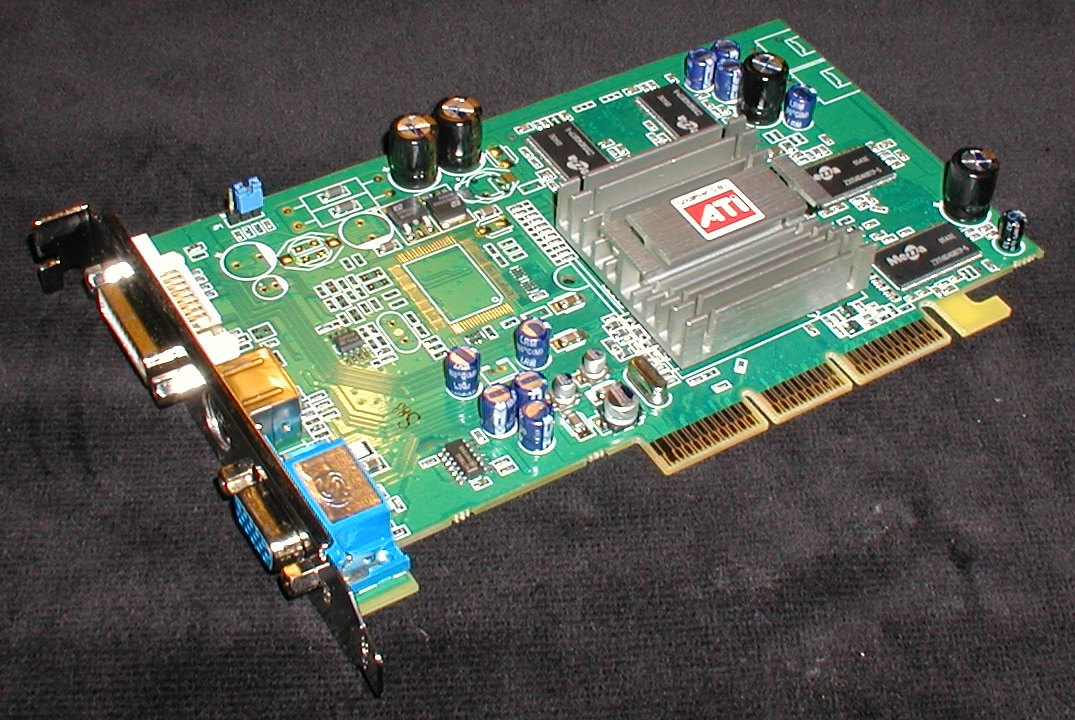 🇨🇦 CanadaRadeon R200
Second-generation ATI GPU with DirectX 8.1 supportGPU · GPU architecture · 2001
 🇺🇸 United StatesRankine
Nvidia GPU microarchitecture from 2003 for DirectX 9GPU · GPU architecture · 2003
 🇺🇸 United StatesKelvin
Nvidia GPU microarchitecture for GeForce 3 and 4 seriesGPU · GPU architecture · 2001
 🇨🇦 CanadaR420
ATI GPU core for Radeon X800 graphics cardsGPU · GPU architecture · 2004
More from ATI Technologies
All of them 🇨🇦 CanadaRadeon R100
First generation Radeon graphics chip with hardware T&LGPU · GPU architecture · 2000
🇺🇸 United StatesRadeon
Brand of graphics processors and computer products by AMDGPU · GPU architecture · 2000
 WorldGDDR3 SDRAM
Memory standard for graphics cards and game consolesMemory · 2004
 🇨🇦 CanadaRadeon Xpress 200
ATI chipset for AMD and Intel desktops with integrated graphicsGPU · 2004