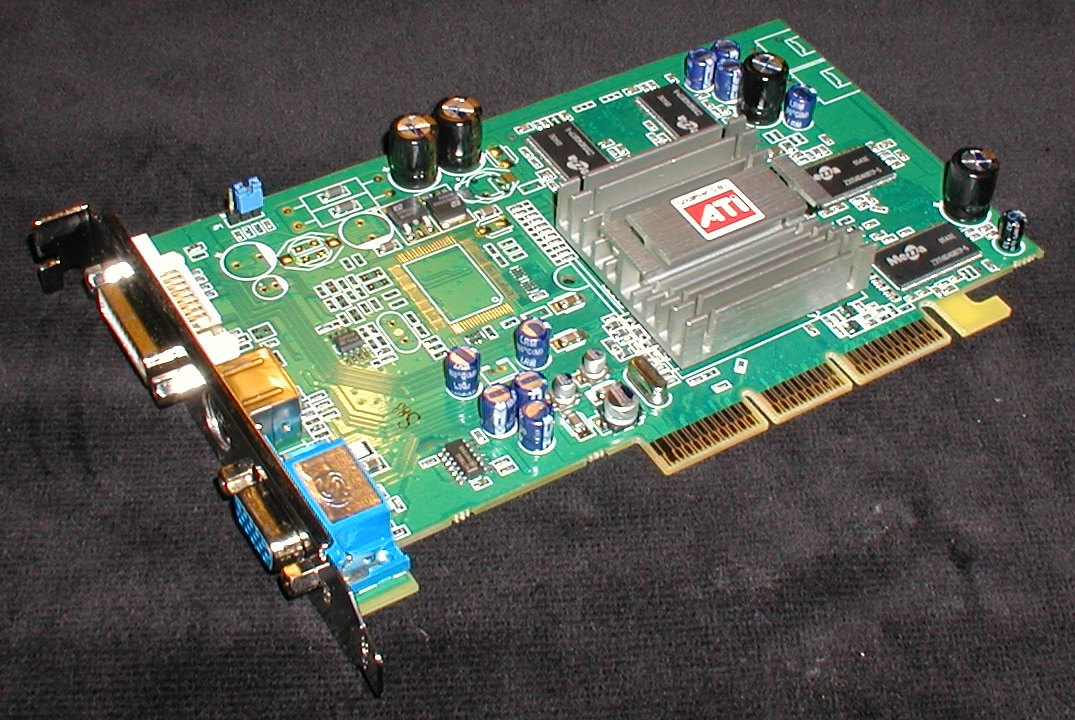
Radeon R200
Second-generation ATI GPU with DirectX 8.1 support
The R200 is a graphics processing unit developed by ATI Technologies and released in 2001. It introduced programmable pixel shaders and advanced memory management to the Radeon line, competing directly with Nvidia GeForce3 cards in the mid-range market.
- First ATI GPU with programmable pixel shaders
- Supports DirectX 8.1 and Pixel Shader 1.4
- Manufactured using a 150 nm process node
- Features HyperZ II for memory bandwidth savings
- Includes TruForm hardware tessellation engine
What it is
The R200 is the second generation of graphics processors from ATI Technologies. Launched in late 2001 as the Radeon 8500, it brought significant improvements in 3D acceleration over the previous R100 series. The chip supports Microsoft Direct3D 8.1 and OpenGL 1.3, enabling more complex visual effects through programmable shaders. It also includes hardware for video decoding and dual monitor outputs, making it a versatile choice for both gaming and multimedia tasks on personal computers.
How it came about
ATI developed the R200 to compete with Nvidia’s GeForce3. The company rebranded its product lines in 2001 to reflect DirectX capabilities, assigning the 8000 series to DirectX 8.1 features. The initial launch faced criticism due to immature drivers that hindered performance in games. Despite these early software issues, the hardware proved capable. ATI later cancelled a planned refresh called the R250 to focus resources on the next-generation R300 architecture, which would fully support DirectX 9.0.
Inside the chip
The architecture features four pixel pipelines, each with two texture units. This 4x2 design allows the chip to address six texture layers per pass using a loop-back method, reducing the need for multi-pass rendering. It was ATI’s first GPU with programmable pixel and vertex processors, supporting Pixel Shader 1.4. Key features include HyperZ II for memory bandwidth savings and TruForm, a hardware tessellation engine that increases geometric detail. The chip also contains a video decoding engine called Video Immersion II.
How it was made
Manufacturers produced the R200 chips using a 150 nanometre fabrication process. The main R200 die contains approximately 60 million transistors. Derivatives like the RV250 and RV280 use the same process but have lower transistor counts of around 36 million. The chips were packaged for desktop cards and integrated graphics solutions. Production continued for several years, with later variants rebranded to extend the product lifecycle without changing the underlying silicon manufacturing technology.
Where it went
These GPUs powered a wide range of desktop graphics cards, including the Radeon 8500, 9000, and 9200 series. They were popular in mid-range gaming PCs and OEM systems. The architecture also extended to mobile computing through the Mobility Radeon 9000 and 9200, which offered power-saving features for laptops. Apple used the Mobility Radeon 9200 in iBook G4 models. Integrated graphics versions appeared in chipsets for Pentium 4 and Pentium M processors, providing basic 3D acceleration for mainstream desktops.
Versions and family
The family includes the high-end Radeon 8500 and the cost-reduced 8500 LE. The LE was later rebranded as the Radeon 9100. Lower-cost derivatives include the RV250 (Radeon 9000) and RV280 (Radeon 9200), which removed some features like TruForm to save space and power. A cancelled variant, the R250 or Radeon 8500 XT, was intended to run at higher clock speeds. Integrated graphics versions were marketed as the 9000 Pro IGP and 9100 Pro IGP for motherboard chipsets.
Why it matters
The R200 established ATI as a strong competitor in the DirectX 8.1 era. Its support for Pixel Shader 1.4 allowed for more efficient rendering in games that utilized the feature, such as Half-Life 2. Although Nvidia held the performance crown with the GeForce4 Ti series, the R200 offered better value and multimedia features. The decision to skip the R250 refresh and move to R300 helped ATI regain the performance lead in the subsequent generation. Open source drivers for Linux and BSD systems continue to support this hardware.
Problems and reception
Initial reviews highlighted poor driver quality and slow anti-aliasing performance. Critics discovered that the drivers automatically lowered texture filtering quality in specific games like Quake III Arena to boost frame rates. This controversy damaged early trust in the product. However, subsequent driver updates improved stability and performance. The card eventually gained respect for its price-to-performance ratio and superior feature set compared to competing mid-range options from Nvidia.

Questions people ask about Radeon R200
What is the R200 architecture?
The R200 is the second generation of Radeon GPUs developed by ATI. It features four pixel pipelines and supports DirectX 8.1, introducing programmable shaders to the Radeon line for improved 3D graphics performance.
Which cards use the R200 chip?
The primary cards are the Radeon 8500 and 8500 LE. Later rebrands include the Radeon 9100. Derivatives like the RV250 and RV280 power the Radeon 9000 and 9200 series, offering similar features at lower costs.
Did the R200 support DirectX 9?
No, the R200 supports DirectX 8.1. ATI marketed some later R200-based cards as DirectX 9 compatible, but they lacked full hardware compliance. The first truly DirectX 9 compliant ATI card was the Radeon 9700 based on the R300 architecture.
What was TruForm in the R200?
TruForm was a hardware tessellation engine included in the R200. It automatically increased the geometric complexity of 3D models to make them smoother. Due to limited developer adoption and visual artifacts, ATI removed it from future chips.
Good reading and sources
- Checking your browserAnandTech, Article
- GeForce RTX 20 Series Graphics Cards and LaptopsNvidia, Article
The facts on this page come from the Wikipedia article "Radeon R200 series", written by its contributors and used under the CC BY-SA 4.0 licence, and from its Wikidata record (CC0). EveryChip rewrote the text in its own words, with AI assistance, and compares every page with the article to make sure no passage is copied. It may be reused under the same CC BY-SA 4.0 licence with a link back.
It may contain mistakes, and figures change over time. Nothing here is investment or buying advice. If something is wrong, tell us. Last refreshed 2026-11-14.
Like Radeon R200
All graphics processors 🇺🇸 United StatesKelvin
Nvidia GPU microarchitecture for GeForce 3 and 4 seriesGPU · GPU architecture · 2001
 🇨🇦 CanadaRadeon R300
First consumer GPU with full Direct3D 9 supportGPU · GPU architecture · 2002
🇺🇸 United StatesRadeon
Brand of graphics processors and computer products by AMDGPU · GPU architecture · 2000
 🇺🇸 United StatesVoodoo 5
Final graphics card series from 3dfx InteractiveGPU · GPU architecture · 2000
More from ATI Technologies
All of them 🇨🇦 CanadaRadeon R100
First generation Radeon graphics chip with hardware T&LGPU · GPU architecture · 2000
 🇨🇦 CanadaR420
ATI GPU core for Radeon X800 graphics cardsGPU · GPU architecture · 2004
 WorldGDDR3 SDRAM
Memory standard for graphics cards and game consolesMemory · 2004
 🇨🇦 CanadaRadeon Xpress 200
ATI chipset for AMD and Intel desktops with integrated graphicsGPU · 2004