
IBM Power
RISC microprocessors for servers and supercomputers by IBM
IBM designs and sells Power microprocessors for high-performance servers and supercomputers. Originating in the late 1980s from RISC research, the family evolved through POWER, PowerPC, and Power ISA architectures to support modern data centres.
- First released in February 1990 for RS/6000 systems
- POWER4 was the first commercial multi-core processor
- Power ISA was open-sourced by IBM in August 2019
- Power10 uses 7 nm manufacturing technology
- RAD6000 variant is used in space missions
What it is
Power microprocessors are central processing units designed by IBM for enterprise servers and supercomputing tasks. First released in February 1990 as part of the RS/6000 series, these chips implement a Reduced Instruction Set Computing architecture. The name originally stood for Performance Optimization With Enhanced RISC. Over decades, the design has evolved from discrete multi-chip modules to advanced single-die processors using nanometre-scale manufacturing. They power IBM Power Systems and have been adopted by other manufacturers for high-end workstations and storage devices.
How it came about
Development began in 1974 with the 801 project at IBM Thomas J. Watson Research Center, aiming for a simple telephone switching computer. This research established RISC principles where instructions complete in constant time. By 1985, the America project created the architecture for the first POWER processors. The RS/6000 series launched in 1990, introducing the POWER1 CPU. Subsequent generations like POWER2 and POWER4 unified server lines and introduced multi-core designs. In 2019, IBM open-sourced the Power ISA, transferring foundation administration to the Linux Foundation.
Inside the chip
The architecture uses a RISC approach, executing simple instructions rapidly. Early models like POWER1 employed register renaming and out-of-order execution across multiple discrete chips. Later designs integrated these functions onto single dies. POWER4 became the first commercial multi-core processor. POWER5 added simultaneous multithreading, allowing multiple threads per core. POWER6 prioritised high clock speeds over out-of-order execution, while POWER7 returned to efficiency with eight cores and embedded DRAM caches. Modern versions support hardware virtualisation and vector media extensions for parallel data processing.
How it was made
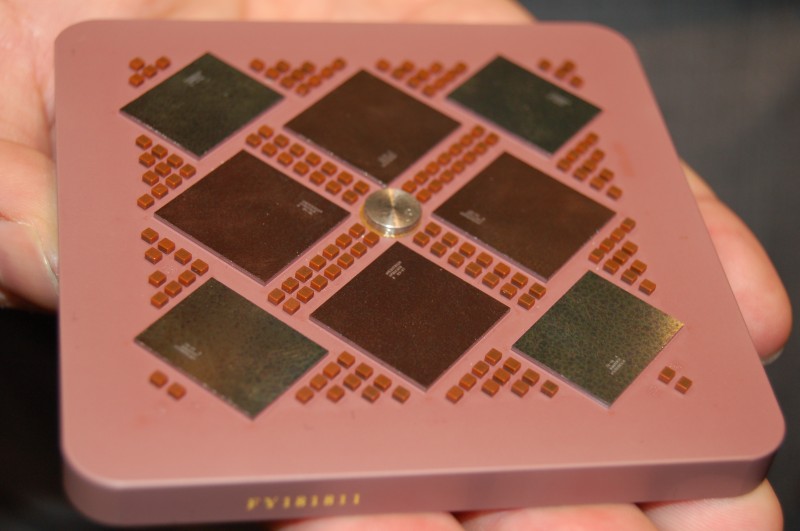
IBM manufactures these processors, often using advanced nodes like the 7 nm technology for Power10 and 14 nm FinFET for POWER9. Early chips such as POWER1 used ten discrete components on a module. The POWER2 Super Chip later consolidated this into a single large processor with high transistor counts. Copper interconnects were introduced with POWER3-II to improve speed. Packaging has ranged from ceramic multi-chip modules to single-die implementations, with recent generations focusing on dense integration and energy efficiency.
Where it went
These chips drive IBM RS/6000, AS/400, and Power Systems servers. They are prevalent in supercomputers, including the Summit and Sierra systems built with Nvidia GPUs. Workstations and data storage devices also utilise the architecture. Other manufacturers like Bull and Hitachi have incorporated Power processors into their server offerings. The RAD6000 variant, hardened against radiation, has been used extensively in space missions. The architecture supports operating systems such as AIX, Linux, and IBM i.
Versions and family
The family includes POWER1 through POWER8, followed by POWER9, Power10, and Power11. PowerPC variants emerged from an alliance with Apple and Motorola, merging into the Power ISA. Notable models include the single-chip RSC, the radiation-hardened RAD6000, and the cost-reduced PowerPC 970. POWER6+ and POWER7+ offered incremental speed improvements. Power10 launched in September 2021, while Power11 arrived in July 2025. Each generation typically introduces higher core counts, improved threading, or new instruction set extensions.
Why it matters
Power processors pioneered commercial multi-core computing with POWER4. They unified IBM disparate server lines under the Power Systems brand. The open-sourcing of the Power ISA in 2019 aimed to broaden adoption beyond IBM hardware. The architecture supports high-performance scientific computing, evident in its use by national laboratories. By maintaining active development since the late 1980s, it remains a key player in enterprise computing, influencing standards for server reliability and throughput.


Questions people ask about IBM Power
What does the name POWER stand for?
The name was originally an acronym for Performance Optimization With Enhanced RISC. It refers to the Reduced Instruction Set Computing architecture that simplifies instructions to improve processing speed and efficiency in server environments.
Which supercomputers use Power processors?
The Summit and Sierra supercomputers use POWER9 processors coupled with Nvidia Volta GPUs. These systems were built for the United States Department of Energy and went online in 2017 and 2018 respectively.
Is the Power architecture still developed by IBM?
Yes, the Power line remains under active development. IBM introduced Power10 in September 2021 and Power11 in July 2025. In 2019, IBM also open-sourced the Power ISA to allow broader industry participation.
What was the first multi-core Power processor?
POWER4 was the first commercially available multi-core processor. It merged different instruction sets to unify IBM server families and featured large on-die L2 caches to reach high frequencies.
Good reading and sources
- Big Blue Open Sources Power Chip Instruction SetThe Next Platform, Article
- IBM’s New Telum Chip Reboots the MainframeIEEE Spectrum, Article
The facts on this page come from the Wikipedia article "IBM Power microprocessors", written by its contributors and used under the CC BY-SA 4.0 licence, and from its Wikidata record (CC0). EveryChip rewrote the text in its own words, with AI assistance, and compares every page with the article to make sure no passage is copied. It may be reused under the same CC BY-SA 4.0 licence with a link back.
It may contain mistakes, and figures change over time. Nothing here is investment or buying advice. If something is wrong, tell us. Last refreshed 2026-11-14.
Like IBM Power
All CPUs and microprocessors 🇺🇸 United StatesPOWER2
IBM RISC processor for RS/6000 workstationsCPU · Power · 1993
 🇺🇸 United StatesPOWER3
64-bit PowerPC microprocessor for IBM workstations and serversCPU · Power · 1998
 🇺🇸 United StatesPOWER5
Dual-core server microprocessor with simultaneous multithreadingCPU · Power · 2004
 WorldPOWER6
Dual-core IBM server microprocessor with hardware decimal mathCPU · Power · 2007
More from IBM
All of them 🇺🇸 United StatesPOWER1
IBM's first high-end RISC processor, launched in 1990.CPU · Power · 1990
 🇺🇸 United StatesIntel 80486
32-bit x86 CPU with pipelined execution and on-chip cache, launched 1989CPU · x86 · 1989
 🇺🇸 United StatesI486
32-bit microprocessor with on-chip cache and FPUCPU · x86 · 1989
 WorldIBM 386SLC
IBM’s low-power 386SX-compatible processor for portable systems.CPU · x86 · 1991