
GeForce 8 series
Nvidia's first unified shader GPU generation
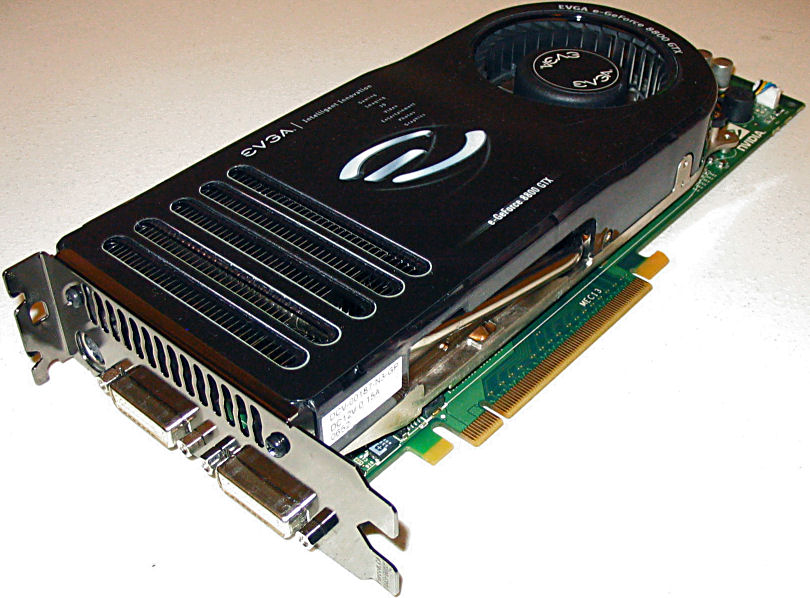
The GeForce 8 series is Nvidia's eighth generation of graphics processors, launched in November 2006. Built on the Tesla microarchitecture, it introduced unified shaders and Direct3D 10 support, marking a major shift in GPU design for PCs.
- First Nvidia GPU with unified shader architecture
- G80 core used 90 nm process with 681 million transistors
- Supported Direct3D 10 and Shader Model 4.0
- 8800 GT introduced 65 nm manufacturing in 2007
- PureVideo HD accelerated H.264 and VC-1 decoding
What it is
The GeForce 8 series represents the eighth generation of Nvidia graphics processing units. Released starting in late 2006, this family was built on the Tesla microarchitecture. It was notable for being the company's first implementation of a unified shader model, allowing the same processing units to handle both vertex and pixel tasks. The series supported Microsoft Direct3D 10 and Shader Model 4.0, enabling new visual effects in compatible software. Models ranged from entry-level chips for basic display output to high-end cards designed for demanding gaming and high-resolution rendering.
How it came about
Nvidia developed the Tesla architecture as its third major GPU design. The launch began on November 8, 2006, with the high-end 8800 GTX and GTS models. These initial cards used the G80 core, which was the largest commercial GPU constructed at that time. A minor manufacturing defect involving a resistor caused a brief recall just before launch, but did not delay the release. Throughout 2007, Nvidia expanded the line with mid-range and entry-level options. The series eventually transitioned to smaller manufacturing processes, with the G92 core introducing 65 nm production in late 2007.
Inside the chip
The Tesla architecture introduced unified shaders, replacing separate vertex and pixel pipelines. This allowed for more efficient use of processing resources. The high-end G80 core contained 128 stream processors and a 384-bit memory interface. Entry-level models like the 8400 GS used simpler cores such as the G86 or G98. The series supported 10-bit color output for improved image fidelity. Video playback was enhanced by PureVideo HD technology, which offloaded decoding of H.264 and VC-1 formats to the GPU. Later revisions added support for PCI Express 2.0 and OpenGL 3.3.
How it was made
The initial flagship chips were manufactured using a 90 nm process. The G80 die measured 480 square millimeters and contained approximately 681 million transistors. Due to size constraints, the design was split into a main shader core and an I/O core. In October 2007, the 8800 GT introduced a 65 nm process, reducing power consumption and heat. This smaller node allowed for single-slot cooling solutions on some models. The fabrication was handled by external foundries, as Nvidia does not operate its own manufacturing plants for these components.
Where it went
These graphics cards were primarily used in desktop personal computers for gaming and multimedia. The high-end 8800 Ultra and GTX models targeted enthusiasts playing games at resolutions up to 2560 by 1600 pixels. Mid-range cards like the 8600 GT offered balanced performance for mainstream gamers. Entry-level models such as the 8400 GS were popular in home theater PCs due to their video decoding capabilities and low power draw. Some integrated motherboard variants served basic display needs in office systems. Apple also used a modified 8800 GS in certain iMac models.
Versions and family
The series included several tiers: GS, GT, GTS, GTX, and Ultra. The 8800 GTX was the initial flagship, followed by the faster 8800 Ultra. The 8800 GT provided near-flagship performance at a lower price point. Entry-level options included the 8300 and 8400 series, with the latter seeing three distinct revisions based on different cores. The 8800 GS was later rebranded as the 9600 GSO. The series was succeeded by the GeForce 9 family, which continued the Tesla architecture with refinements.
Why it matters
The GeForce 8 series established the unified shader model as an industry standard. Its support for Direct3D 10 enabled developers to create more complex visual scenes. The 8800 GT became a long-lasting reference point for minimum system requirements in PC gaming, remaining relevant for many years after its release. The introduction of hardware-accelerated video decoding helped popularize high-definition media playback on personal computers. The series demonstrated that higher model numbers did not always guarantee better performance than previous generations.
Problems and reception
Reviewers praised the 8800 GTX for its significant performance lead over competitors. However, the 8800 Ultra was criticized for offering poor value due to its high price and marginal speed gains. Some early 8800 GT and GTS 512 MB cards faced compatibility issues with older PCI Express 1.0a motherboards, resulting in no display output. Users could resolve this by flashing an older BIOS, though this disabled PCI Express 2.0 features. The entry-level 8300 and 8400 cards were noted for having inferior gaming performance compared to the previous generation they replaced.



Questions people ask about GeForce 8 series
What was the main architectural change in the GeForce 8 series?
It introduced a unified shader model. Previous GPUs had separate units for vertex and pixel processing. The Tesla architecture combined these into stream processors that could handle any type of shading task, improving efficiency and flexibility for developers creating Direct3D 10 applications.
Why did some 8800 GT cards fail on older motherboards?
Cards based on the G92 core supported PCI Express 2.0. Some older motherboards with PCI Express 1.0a chipsets were incompatible, causing the card to spin its fan but produce no image. Users could fix this by flashing the card BIOS to an older version, though this disabled PCI Express 2.0 features.
How did the 8800 Ultra compare to the 8800 GTX?
The Ultra was architecturally identical to the GTX but featured higher clock speeds for the core, shaders, and memory. This provided about ten percent more performance. However, it cost significantly more, leading many reviewers to consider it a poor value proposition compared to the already fast GTX model.
Were all GeForce 8 cards powerful enough for gaming?
No. While the 8800 series was high-performance, the entry-level 8300 and 8400 models had reduced graphics power. They were suitable for basic tasks and media playback but struggled with intense 3D applications. In some cases, they performed worse than the previous generation GeForce 7200 and 7300 cards they were meant to replace.
Good reading and sources
- GeForce 8 series on WikipediaEncyclopedia
- More photos on Wikimedia CommonsPhotos
- Wikidata recordOpen data
The facts on this page come from the Wikipedia article "GeForce 8 series", written by its contributors and used under the CC BY-SA 4.0 licence, and from its Wikidata record (CC0). EveryChip rewrote the text in its own words, with AI assistance, and compares every page with the article to make sure no passage is copied. It may be reused under the same CC BY-SA 4.0 licence with a link back.
It may contain mistakes, and figures change over time. Nothing here is investment or buying advice. If something is wrong, tell us. Last refreshed 2026-11-14.
Like GeForce 8 series
All graphics processors 🇺🇸 United StatesRadeon HD 4000 series
AMD graphics processor series with GDDR5 supportGPU · GPU architecture · 2008
 🇨🇦 CanadaR420
ATI GPU core for Radeon X800 graphics cardsGPU · GPU architecture · 2004
 🇺🇸 United StatesGeForce 9 series
Nvidia's ninth generation of desktop and mobile graphics processors.GPU · GPU architecture · 2008
 🇺🇸 United StatesRankine
Nvidia GPU microarchitecture from 2003 for DirectX 9GPU · GPU architecture · 2003
More from Nvidia
All of them 🇺🇸 United StatesRSX Reality Synthesizer
Graphics processor for the PlayStation 3 consoleGPU · GPU architecture · 2006
 🇺🇸 United StatesTesla
Nvidia GPU microarchitecture with unified shadersGPU · GPU architecture · 2006
🇺🇸 United StatesNForce 500
Motherboard chipset series for AMD and Intel PCsAnalog · 2006
WorldNForce 600
Nvidia chipset series for Intel and AMD PCsAnalog · 2006